
Who is…
Abraham and what is his significance?
Hebrew: אַבְרָהָ֔ם —meaning: Father of a multitude
also known as: Abram —meaning: Exalted father
also known as: Abram ben Terah, and Abram son of Terah, Avraham, and Ibrahim
What is the pivotal significance of Abraham?
Abraham (originally Abram) is the hinge figure of the Hebrew Bible. In Genesis he marks the turn from the universal story of humanity (creation, fall, flood, Tower of Babel) to the particular story of one family that becomes Israel. Everything that follows in biblical history—the Exodus, the Law, the monarchy, the prophets, and Jesus the Messiah—traces back to the promises made to him.
Yahweh God called Abram out of Ur of the Chaldeans (or Haran) with a 3-part promise (Genesis 12:1, 2, 3):
- Promised Land (Canaan)
- Descendants who will become a great nation
- Blessing that will reach “all the families of the earth”
Abraham is a real man who lived roughly in the early 2nd millennium BC. He is a son of Terah, mentioned in Scripture (Genesis 11:27) prior to his older brothers Nahor II and Haran, because he was the heir of the promises of God. He was born in what is now Iraq and was originally named Abram, until God later changed his name.
Lineage, from Creation to Abraham
God → ADAM → Seth → Enos → Cainan → Mahalaleel → Jared → Enoch → Methuselah → Lamech → NOAH → Shem → Arpachshad → Shelah → EBER (founder of the Hebrews) → Peleg → Reu → Serug → Nahor I → Terah → ABRAHAM
Move from Ur to Nomadic Life

For many years, Abram lived among his relatives in his native country of Chaldea (Genesis 11:31). Then, with his father, family and household, he left the city of Ur, where he lived. He traveled 300 miles north to Haran and lived there for 15 years. The cause of his migration was a call from God (Acts 7:2-4). There is no mention of this first call in the Old Testament; it is implied, however, in Genesis 12.
While they lived at Haran, Terah died at the age of 205 years. Abram now received a 2nd and more definite call, accompanied by a promise from God (Genesis 12:1-2). As a result, he left at the age of 75 (Genesis 12:4), taking his nephew Lot with him, not knowing where he was going (Hebrews 11:8). He trusted God implicitly.
Abram now, with a large household of probably a thousand souls, began a migratory life, and lived in tents.
Move to Shechem
Passing along the valley of the Jabbok, in the land of Canaan, he formed his first encampment at Shechem (Sichem) (Genesis 12:6), in the valley or oak-grove of Moreh, between Ebal on the north and Gerizim on the south.
Here he received the great promise, “I will make of thee a great nation,” etc. (Genesis 12:2-3; 12:7).
Covenant
God’s covenant was formalized in 2 key scenes: God alone passes between the pieces of sacrificed animals while Abram sleeps (Genesis 15), signaling that the promise is God’s unilateral commitment; and circumcision is given as the sign of the “everlasting covenant” (Genesis 17). Abram’s name is changed to Abraham—“father of a multitude.” The climactic test was the binding of Isaac (the Akedah, Genesis 22), in which Abraham’s willingness to sacrifice the promised son becomes the supreme demonstration of trust.
A single verse became theologically explosive: “Abram believed the Lord, and he credited it to him as righteousness” (Genesis 15:6). This is the model of a relationship with God based on trust rather than pedigree or law-keeping.
God’s promise brought not only temporal but also spiritual blessings. It implied that he was the chosen ancestor of the great Deliverer whose coming had been long ago predicted (Genesis 3:15).
Move to location between Luz and Ai
Soon after this, for some reason not mentioned, he removed his tent to the mountain district between Bethel (then called Luz), and Ai, towns about two miles apart, where he built an altar to “Jehovah.”

Move to Negev
He again moved into the southern tract of Israel, called by the Hebrews the Negeb (Negev).
Refuge in Egypt
Due to a later famine he was compelled to go down into Egypt. This took place in the time of the Hyksos, a Semitic race which now held the Egyptians in bondage. Here took place Abram’s deception which exposed him to the rebuke of Pharaoh (Genesis 12:18). Sarai was restored to him; and Pharaoh loaded him with presents, recommending that he leave the country.
Return to Canaan

Abram returned to Canaan richer than when he left it, “in cattle, in silver, and in gold” (Genesis 12:8; 13:2. Compare Psalm 105:13-14). The whole group then moved northward, and returned to their previous location near Bethel. Here disputes arose between Lot’s shepherds and those of Abram about water and pasturage.
Abram generously gave Lot his choice of the pasture-ground. (Compare 1 Corinthians 6:7.) He chose the well-watered plain where Sodom was located. Thus the uncle and nephew were separated.
Immediately after this, Abram was cheered by a repetition of the promises already made to him.
Move to Hebron
He then moved to the plain or “oak grove” of Mamre, which is in Hebron. He finally settled here, pitching his tent under a famous oak or terebinth tree, called “the oak of Mamre” (Genesis 13:18). This was his third resting-place in the land.

Who and what is Mamre? and what is its biblical significance?
Also, see 25 minute streaming video “MAMRE — Where God Appeared to Abraham” by archaeologist Joel P. Kramer (Expedition Bible) / “It is often said that there is no archaeological proof for Abraham. If that is the case, then what explanation is there for what was basically nothing but an ancient campsite still being revered over 4000 years later? Join Joel as he explains the archaeological and spiritual significance of Mamre… where God appeared to Abraham and made a promise that still blesses us today!”
Abram fights to save his nephew
14 years before this, while Abram was still in Chaldea, this area had been invaded by Chedorlaomer, King of Elam, who brought under tribute to him the 5 cities in the plain to which Lot had moved. This was a heavy burden on the inhabitants of these cities. After 12 years they revolted. This brought Chedorlaomer’s vengeance, in league with 4 other kings. He ravaged the whole country, plundering the towns, and carrying the inhabitants away as slaves. Among these was Abraham’s nephew Lot.
Hearing of the disaster that had befallen his nephew, Abram immediately gathered from his own household a band of 318 armed men. He was joined by the Amorite chiefs Mamre, Aner, and Eshcol. He pursued Chedorlaomer and overtook him near the springs of the Jordan River. They attacked and routed his army, pursuing it over the Anti-Lebanon Mountains (aka Anti-Libanus or Antilibanus, a range dominated by Mount Hermon) as far as Hobah, near Damascus.
They returned with all the spoils that had been carried away.
Meeting with King Melchizedek of Salem (later Jerusalem)
Returning by way of Salem (later called Jerusalem), the king of that place, Melchizedek, came out to meet them with refreshments. Abram presented him with a tenth of the spoils, in recognition of his character as a priest of the most high God (Yahweh) (Genesis 14:18-20).
Archaeologists discovered a tablet, dated to the reign of the grandfather of Amraphel (Genesis 14:1), one of the witnesses is called “the Amorite, the son of Abiramu,” or Abram.
Back to Hebron
After returning to his home at Mamre, God repeated and enlarged the promises made to Abram (Genesis 13:14). “The word of the Lord” (an expression occurring here for the first time) “came to him” (15:1). He now understood better the future that lay before the nation that was to spring from him.
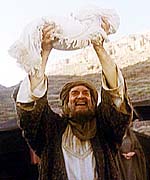
His 1st son Ishmael is born
Sarai, now 75 years old, impatiently persuaded Abram to take Hagar, her Egyptian maid, as a concubine, intending any resulting children would be counted as her own.
Ishmael was born and regarded as the heir of these promises (Genesis 16). When Ishmael was 13 years old, God again revealed yet more explicitly and fully his gracious purpose; and in token of the sure fulfillment of that purpose, the patriarch’s name was now changed from Abram to Abraham (Genesis 17:4-5), and the rite of circumcision was instituted as a sign of the covenant.
It was then affirmed that the heir to these covenant promises would be the son of Sarai, though she was now ninety years old. God directed that his name should be Isaac. At the same time, in commemoration of the promises, Sarai’s name was changed to Sarah.
On that memorable day, Abraham and his son Ishmael and all the males of his house were circumcised (Genesis 17) [See: ISHMAEL].
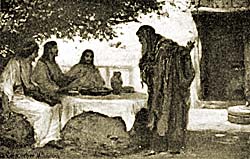
3 highly unusual visitors arrive
Three months after this, as Abraham sat in his tent door, he saw three men approaching. They accepted his hospitality. Seated under an oak tree, they shared food that Abraham and Sarah provided.
1 of the 3 visitors was none other than the Lord (2nd Person of the Trinity), and the other 2 were angels disguised as men. On this occasion, the Lord renewed his promise of a son by Sarah and rebuked her unbelief.
Abraham accompanied the 3 as they proceeded on their journey. The 2 angels went on toward Sodom; while the Lord tarried behind and talked with Abraham, revealing to him the destruction that was about to fall on that guilty city.
The patriarch interceded earnestly on behalf of the doomed city. But as not even 10 righteous persons were found in it, for whose sake the city would have been spared, the Lord acted. The city was destroyed. Early next morning Abraham saw the smoke of the fire that consumed it as the “smoke of a furnace” (Genesis 19:1-28).
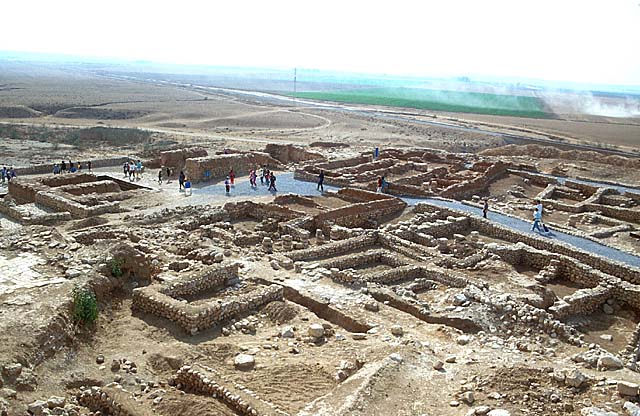

Move from Mamre to Gerar
After living at Mamre for 15 years, Abraham moved south and pitched his tent among the Philistines, near Gerar. Sadly, this is where Abraham lied to Abimelech the King (Genesis 20). (See ABIMELECH.)
Move to Beer-sheba / His 2nd son Isaac is born
Soon after this event, the patriarch left the area of Gerar, and moved down the fertile valley about 25 miles to Beer-sheba. It was probably here that Isaac was born. Abraham was now 100 years old.
Jealousy now arose between Sarah and Hagar, whose son, Ishmael, was no longer regarded as Abraham’s heir. Sarah insisted that both Hagar and her son should be sent away. This was done, although it was a hard trial for Abraham (Genesis 21:12).
Ishmael survived and became the father of the Arab tribes and nations. (See HAGAR and ISHMAEL)
At this point, there is an approximately 25 year blank in the patriarch’s history. These years of peace and happiness were spent at Beer-sheba.
Divine test of faith—the sacrifice of Isaac at Jehovah-jireh
The next time we see him, his faith is put to a severe test from God. He was commanded to go and offer up Isaac, the heir of all the promises, as a sacrifice on one of the mountains of Moriah (believed to be the later site of Solomon’s Temple).
His faith stood the test (Hebrews 11:17-19). He proceeded in a spirit of unhesitating obedience to carry out the command; and when about to kill his son, whom he had laid on the altar, his uplifted hand was stopped by the angel of Jehovah. A ram (male goat) was revealed, entangled in nearby bushes. This was offered instead of Isaac.
This place was therefore named Jehovah-jireh, meaning “The Lord will provide.”
The promises made to Abraham were again confirmed (and this was the last recorded word of God to the patriarch). He descended the mountain with his son, and returned to his home at Beer-sheba (Genesis 22:19), where he lived for some years.
Move from Beer-Sheba to Hebron
He then moved north to Hebron. Some years after this, Sarah died at Hebron, being 127 years old. Abraham purchased a burial place, the cave of Machpelah, from Ephron the Hittite (Genesis 23). There he buried Sarah.
Isaac’s Marriage
His next concern was to provide a wife for Isaac. He sent his steward, Eliezer, to Haran (or Charran, Acts 7:2), where his brother Nahor II and his family resided (Genesis 11:31).
The result was that Rebekah, the daughter of Nahor II’s son Bethuel, became the wife of Isaac (Genesis 24).
Abraham then married Keturah, who became the mother of 6 sons, whose descendants were afterwards known as the “children of the east” (Judges 6:3), and later as “Saracens”—an ancient nomadic desert people of Syria and Arabia living on the fringes of the Roman Empire.
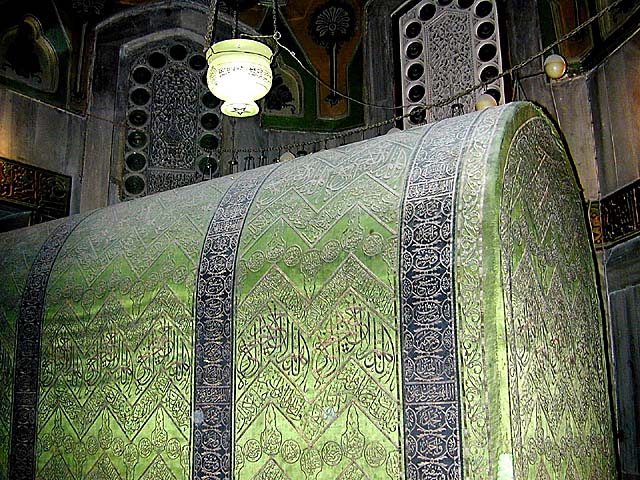
Abrahamic religions— Why do 3 religions call Abraham father
Judaism sees him as Avraham Avinu (“our father Abraham”), the first Jew and the origin of the covenant people. Descent through Isaac and Jacob, plus circumcision, defines membership. He is also the model of hospitality and of arguing with God for justice (Sodom).
Christianity sees Abraham as the prototype of justification by faith before the Mosaic Law. Believers, Jew or Gentile, become his spiritual children (Romans 4; Galatians 3). Matthew’s genealogy of Jesus begins with Abraham.
Islam regards Ibrahim as a prophet, a hanif (pure monotheist), and “friend of God.” Muslims trace their line through Ishmael, mistakenly credit Abraham and Ishmael with purifying the Kaaba, and see the entire religion as the restoration of Abraham’s original submission (islam) to the one God.
That shared ancestry is why Judaism, Christianity, and Islam are called the Abrahamic religions.
Abraham’s Death
At the age of 175 years, 100 years after he had first entered the land of Canaan, Abraham died and was buried in the old family burial cave at Machpelah (Genesis 25:7-10).
The history of Abraham made a wide and deep impression on the ancient world, and references to it are interwoven in the religious traditions of almost all Eastern nations. He is called “the friend of God” (James 2:23), “faithful Abraham” (Galatians 3:9), “the father of us all” (Romans 4:16). Muslims call him “Ibrahim.” [See: What does the Qur'an say about Abraham and Jesus?]
Relatives
- Grandfather: Nahor I
- Father: Terah
- Brothers: Haran, Nahor II
- Sons: Isaac, Ishmael, Ishbak, Jokshan, Medan, Midian, Shuah, Zimran
- Wives: Sarah, Keturah
- Concubine: Hagar, mother of Ishmael
- Nephews: Lot, Thahash, Uz
- Sister-in-law: Milcah
- Grandsons: Jacob, Esau, Dedan, Epher, Hanoch
- Great-grandsons: Asher, Benjamin, Dan, Ephraim, Gad, Issachar, Joseph, Judah, Levi, Manasseh, Naphtali, Reuben, Simeon, Zebulun
- Notable Descendants include: King David, the prophets of Old Testament Scripture, Jesus Christ, and the Apostles
Archaeology
- Ur, Northern
- Tel Haran
- Sin, the moon god
- Tel Dan (Leshem)
- Valley of Siddim
- Who and what is Canaan?
- Isaac and Ishmael / sons of a wife versus concubine
- Mount Moriah
- Have the BURIAL SITES of any people in the Bible been found? Answer
- Sepulchres and Tombs of the Bible
 Archaeology and the Bible provides abundant evidence in support of the Bible. Find answers to your questions about archaeology and biblical history.
More Information
- Who is Abram?
- Story of Abraham (from The HOPE)
- Story of Abraham (from God’s Story)
 What and who is Ur in the Bible?
- What is the Euphrates River of Mesopotamia?
- What is Chaldea?
 Who and what is Mamre?
- What is Machpelah?
- Who is Sarai?
- Who is Sarah in the Bible?
- What is a covenant in the Bible?
- Who is Isaac? What do we know about him?
- Who is Ishmael, and what is his significance?
- What is circumcision? What is it’s significance?
- Who is Jacob? and what is his significance?
- Biblical burial sites—Have the burial sites of any people in the Bible been found?
- About burials in the Bible
- What is “Abraham’s Bosom”?
- What is a concubine?
- Answers about famines in the Bible
- What is consecration?
- What is the significance of Iraq in the Bible?
 What is the significance of Iraq in the Bible?
 Answers about the pharaohs of the Bible
 Answers about sheep in the Bible
- What does the Bible say about goats?
 Answers about camels in the Bible
- Abraham and Isaac (coloring page)