What is the…
Tribe of Ephraim
Origin
The Tribe of Ephraim conists of the descendants of Ephraim, a son of Joseph and a great-great-grandson of Abraham. This tribe took precedence over that of Manasseh because of Jacob’s blessing (Genesis 41:52; 48:1).
The descendants of Joseph ultimately formed 2 of the tribes of Israel, whereas each of the other sons of Jacob (Israel) was the founder of only one tribe. Thus, there were in reality 13 tribes; but the number 12 was preserved by excluding that of Levi when Ephraim and Manasseh are mentioned separately (Numbers 1:32-34; Joshua 17:14, 17; 1 Chronicles 7:20).
Territory of the Tribe of Ephraim
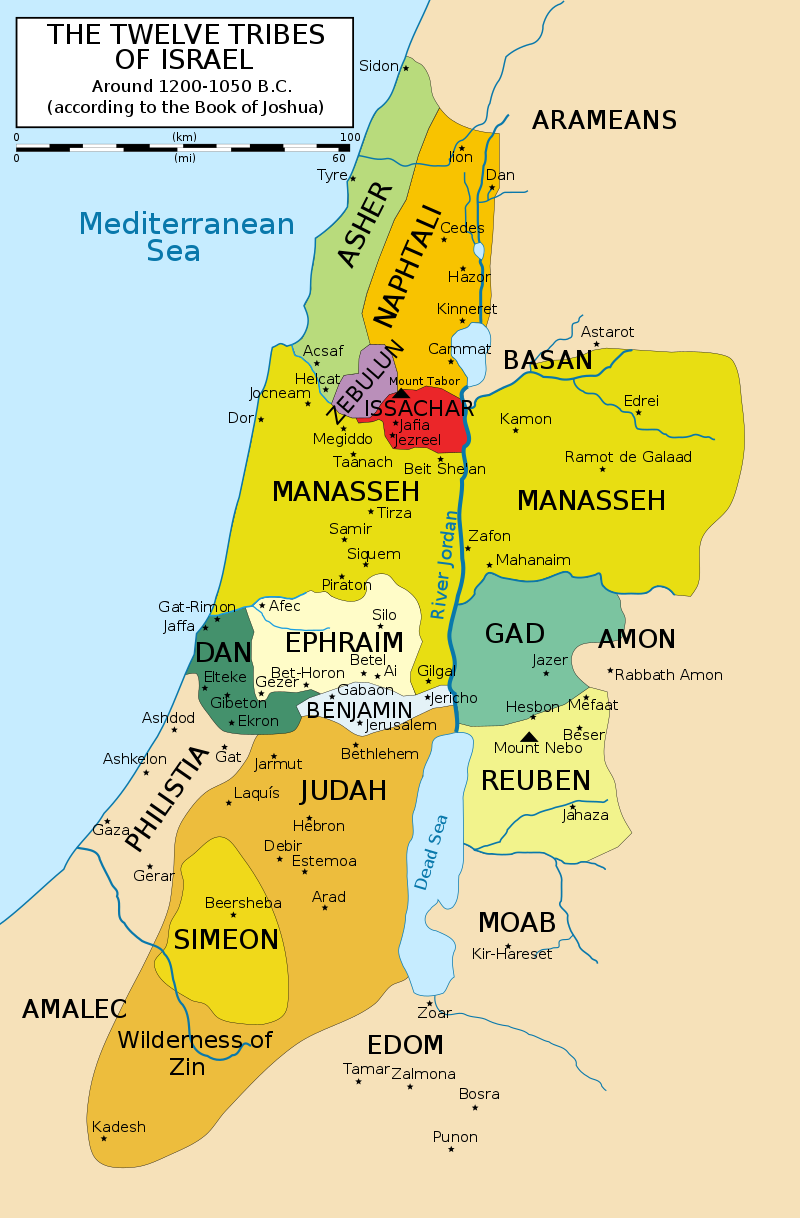
This map shows the approximate location and boundaries of the 12 Israelite tribes, based on records in the Book of Joshua. This, and more, was The Promised Land given by God to the descendants of Israel, the grandson of Abraham. The full extent of the Canaanite land promised was never acquired, due to the repeated disobedience of the Israelites during the their commanded conquest of this very idolatrous, heathen land, after the Exodus from slavery in Egypt and the following 40 years of Divine punishment wandering in the wilderness, before Joshua and the living descendants were allowed to enter the land, following the death of Moses.
At the time of the first census in the wilderness this tribe numbered 40,500 (Numbers 1:32,33); forty years later, when about to take possession of the Promised Land, it numbered only 32,500.
During the march (see camp) Ephraim’s place was on the west side of the tabernacle (Numbers 2:18-24).
When the spies were sent out to spy the land, “Oshea the son of Nun” of this tribe signalized himself.
The boundaries of the portion of the land assigned to Ephraim are given in Joshua 16:1-10. It included most of what was afterwards called Samaria as distinguished from Judea and Galilee. It thus lay in the center of all traffic, from north to south, and from Jordan to the sea, and was about 55 miles long and 30 broad.
The tabernacle and the ark were deposited within its limits at Shiloh, where it remained for four hundred years.
During the time of the judges and the first stage of the monarchy this tribe manifested a domineering and haughty and discontented spirit.
“For more than five hundred years, a period equal to that which elapsed between the Norman Conquest and the War of the Roses, Ephraim, with its two dependent tribes of Manasseh and Benjamin, exercised undisputed pre-eminence.
Joshua the first conqueror, Gideon the greatest of the judges, and Saul the first king, belonged to one or other of the three tribes. It was not till the close of the first period of Jewish history that God ‘refused the tabernacle of Joseph, and chose not the tribe of Ephraim, but chose the tribe of Judah, the Mount Zion which he loved’ (Psalm 78:67-68). When the ark was removed from Shiloh to Zion the power of Ephraim was humbled.”
Among the causes which operated to bring about the disruption of Israel was Ephraim’s jealousy of the growing power of Judah. From the settlement of Canaan till the time of David and Solomon, Ephraim had held the place of honor among the tribes.
Area
The Tribe of Ephraim occupied the central and fairest portions of the land, and had Shiloh (Israel’s spiritual capital at that time) and Shechem within its borders. But now when Jerusalem became the capital of the kingdom, and the center of power and worship for the whole nation of Israel, Ephraim declined in influence.
The discontent came to a crisis by Rehoboam’s refusal to grant certain redresses that were demanded (1 Kings 12).
Prophecies about Ephraim
More information
Israel (Jacob) made a prophetic blessing on Ephriam in Genesis 49:13-20 (excerpt):
Joseph took them both [his two sons], Ephraim with his right hand toward Israel’s left, and Manasseh with his left hand toward Israel’s right, and brought them close to him. But Israel stretched out his right hand and laid it on the head of Ephraim, who was the younger, and his left hand on Manasseh’s head, crossing his hands, although Manasseh was the firstborn. …When Joseph saw that his father laid his right hand on Ephraim’s head, it displeased him; and he grasped his father’s hand to remove it from Ephraim’s head to Manasseh’s head.
Joseph said to his father, “Not so, my father, for this one is the firstborn. Place your right hand on his head.”
But his father refused and said, “I know, my son, I know; he also will become a people and he also will be great. However, his younger brother [Ephraim] shall be greater than he, and his descendants shall become a multitude of nations.”
He blessed them that day, saying,
“By you Israel will pronounce blessing, saying,
‘May God make you like Ephraim and Manasseh!’ ”Thus he put Ephraim before Manasseh. —NASB
The great fall of the northern kingdom (symbolically called Ephraim
Prophecy
Woe to the proud crown of the drunkards of Ephraim,
And to the fading flower of its glorious beauty,
Which is at the head of the fertile valley
Of those who are overcome with wine! —Isaiah 28:1 NASBThe proud crown of the drunkards of Ephraim is trodden under foot. —Isa. 28:3 NASB
And these also reel with wine and stagger from strong drink:
The priest and the prophet reel with strong drink,
They are confused by wine, they stagger from strong drink;
They reel while having visions,
They totter when rendering judgment. —Isa. 28:7Fulfillment
These tribes were brutally conquered by the Assyrians following the northern tribes’ marked period of licentious living.
Return to The Promised Land, at peace with the other tribes
Due to jealousies and sin in ancient times (see King Jeroboam), the 12 tribes of Israel split into 2 separate kingdoms: The Kingdom of Israel (the northern kindgom of 10 tribes) and The Kingdom of Judah (the southern kingdom of 2 tribes, with the Tribe of Judah being dominant). Because of Ephraim’s dominant size in the northern kingdom, it represents (or symbolizes) the 10 northern tribes of Israel who came to be dispersed throughout the world since ancient times. This prophecy says these tribes will return to the land of Israel in the days before and during The Great Tribulation. And when the Messiah returns, these two groups of tribes will come to peace with each other.
And He [Yahweh] will lift up a standard for the nations
And assemble the banished ones of Israel,
And will gather the dispersed of Judah
From the four corners of the earth.
Then the jealousy of Ephraim will depart,
And those who harass Judah will be cut off;
Ephraim will not be jealous of Judah,
And Judah will not harass Ephraim. —Isaiah 11:12-13 NASBEphraim [the northern kingdom] will be like a mighty man,
And their heart will be glad as if from wine;
Indeed, their children will see it and be glad,
Their heart will rejoice in the Lord. —Zechariah 10:7 NASBOther prophecies include: Jeremiah 31:1; Hosea 5:14; Zechariah 9:10
BOOK OF REVELATION — Revelation 7:4–8 mentions that people from the 12 tribes of Israel will be sealed by an angel of God. However, this selection of the 12 tribes does not include the names of Ephraim or Dan, although their names are among the 12 tribes that settled in the Promised Land. It has been suggested that this might be because of Dan’s exceptionally strong waywardness from God. For whatever reason, Ephraim’s descendants will be included under the name of his father Joseph, and will thus be a part of the 144-thousand Israelite evangelists for Christ during The Great Tribulation.
And I heard the number of those who were sealed. One hundred and forty-four thousand of all the tribes of the children of Israel were sealed:
of the tribe of Judah twelve thousand were sealed;
of the tribe of Reuben twelve thousand were sealed;
of the tribe of Gad twelve thousand were sealed;
of the tribe of Asher twelve thousand were sealed;
of the tribe of Naphtali twelve thousand were sealed;
of the tribe of Manasseh twelve thousand were sealed;
of tribe of Simeon twelve thousand were sealed;
of the tribe of Levi twelve thousand were sealed;
of the tribe of Issachar twelve thousand were sealed;
of the tribe of Zebulun twelve thousand were sealed;
of the tribe of Joseph twelve thousand were sealed; [presumably these will be Ephraimites]
of the tribe of Benjamin twelve thousand were sealed.
Brother Tribes
- Asher
- Benjamin
- Dan
- Gad
- Issachar
- Judah
- Levi
- Manasseh — a son of Joseph, son of Jacob, as is Ephraim
- Naphtali
- Reuben
- Simeon
- Zebulun
More Information
- Who is EPHRAIM? Answer
- What is MOUNT EPHRAIM? Answer
- What is the city of Ephraim in the wilderness? Answer
- What is the GATE OF EPHRAIM? Answer
- What is SHILOH? Answer
- What is SHECHEM? Answer
- PROPHECY and the Bible
- PROPHECY—Is there valid prophetic evidence that the Bible is God’s Word? Answer