Dogville
 for violence and sexual content.
Reviewed by: Jim O’Neill
CONTRIBUTOR
| Moral Rating: | Very Offensive |
| Moviemaking Quality: |
|
| Primary Audience: | Adults |
| Genre: | Drama |
| Length: | 2 hr. 57 min. |
| Year of Release: | 2003 |
| USA Release: |
August 29, 2003 (festival) March 26, 2004 (limited) DVD: August 24, 2004 |




Why is the world the way it is (filled with oppression, suffering, death, and cruelty)? If God is all-knowing, all-powerful, and loving, would he really create a world like this? Answer
lust in the Bible


How can we know there’s a God? Answer
What if the cosmos is all that there is? Answer

Discover the good news that Jesus Christ offers
Are you good enough to get to Heaven? Answer

| Featuring |
|---|
|
Nicole Kidman (Grace Margaret Mulligan) Paul Bettany (Tom Edison) Harriet Andersson (Gloria) “Light Keeps Me Company” Lauren Bacall (Ma Ginger) Jean-Marc Barr (The Man with the Big Hat) James Caan (The Big Man) Ben Gazzara John Hurt (Narrator—voice) Patricia Clarkson (Vera) Stellan Skarsgård (Chuck) Udo Kier (The Man in the Coat) Zeljko Ivanek (Ben) Chloë Sevigny (Liz Henson) See all » |
| Director |
| Lars von Trier — “Dancer in the Dark,” “Breaking the Waves” |
| Producer |
| Zentropa Entertainments, Isabella Films B.V. (as Isabella Films International), See all » |
| Distributor |

“A quiet little town not far from here.”
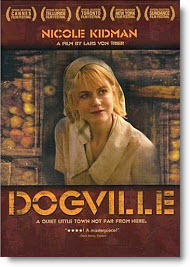
“Dogville,” a film by Danish director, Lars Von Trier(“Breaking the Waves,” “Dancer in the Dark”) has an all-star, mostly American cast, and some rather impressive cinematography, lighting, costuming and special effects. In fact, it looks a little too impressive for a film that purports to be a Dogma 95 adherent. Last year, I wrote about “Italian for Beginners,” another Danish film which really does exemplify the scaled-down, special-effects averse, story and theme prominent technique of the Dogma 95 school of filmmaking. I liked that film, and I admired “Dogville” (which I saw in Rome), even though I detected some cracks in its declaration of adherence to the Dogma 95 doctrine.
Nicole Kidman, Lauren Bacall, Ben Gazzara, Zeljko Ivanek and James Caan don’t work for peanuts, even when they agree to reduce their fees. Period automobiles cost a small fortune to rent and to insure.
When a ten year old boy is shot in the chest, flies backwards into the air and lands slumped in a heap (more on this later) a lot of money has to be spent on stunts and effects. “Dogville” may not have sounded the death knoll for a commendable cinematic movement, but it may have wounded it.
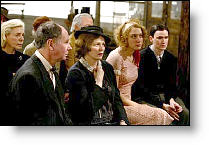
“Dogville” is the story of a civilization which self-destructs when it loses its moral vision. The film’s title refers to a small town set in Depression-era America. The film contains no background scenery. The entire set is a soundstage whose houses, shops and streets are diagrammed in two dimensions with paint on the stage. Wandering amidst those white lines and some half-constructed stage sets are the characters and the machines they employ (automobiles, trucks, carts and a wheelchair). Beyond the mostly bare proscenium is complete darkness.
At first, the setting, or the lack of one, is disconcerting. It’s also a bit pretentious, in a European art-house sort of way. After awhile, though, I didn’t miss the trees or the sky or the houses or any of the atmospherics that have become cinematic staples, and by now clichés, of depression-era films. The focus quickly shifts from background to story, and to character. With his unorthodox and unsettling technique, Von Trier has accomplished something original. And something remarkable.
A stranger (Nicole Kidman) enters the town of Dogville under mysterious circumstances. She is wanted by the police and by a group of gangsters with whom she is connected. The townspeople must decide whether to hide her from both groups and to keep her as one of their own or to turn her into the authorities. They not only keep her, they come to depend on her, to use her, and even to possess her, to the point of putting her in chains. The stranger becomes the reason, the motivation, and ultimately the justification, for the way the townspeople think and behave.
This story is an old one. It’s been the subject of great art (“Don Giovanni,” “Tartuffe,” many Flannery O’Connor stories), spirited comedy (Orton’s “Entertaining Mr. Sloan,” Wilson’s “The Music Man”), and even some good movies (remember how the people in an isolated California town both condemned and bound to Melanie Daniels in “The Birds”?).
In “Dogville,” the presence of the stranger allows the people in the town to chip away at their own moral foundation while simultaneously trying to build a stronger one for the new arrival. Ben Gazzara plays a blind resident of the town who refuses to acknowledge that he can’t see. The rest of the residents lose sight of who they are as they break more and more rules. The more laws they violate, the more they insist that the evil that results has a source other than themselves.
The bad behavior starts small, but escalates to bigger and bigger crimes, until it erupts in an immolation scene which is devastating in its brutality, hopelessness, and cynicism.
Even children become victims of the destruction, although von Trier’s children are no innocents. Their sins of pride rival, even surpass, their more experienced but more fatigued elders. The youngsters’venom, like that of a baby scorpion, produces maximum dread and destruction. Nonetheless, the childrens’ death scene is harsh, almost craven, and the ensuing cynicism (a remark about a dog’s whaling bark being nothing more than a protest over a lost bone) has the effect of salt being thrown into an open wound.
The town leader, who at first behaves as though he were a mayor or a minister or simply the most concerned and considerate citizen of the group actually turns out to be a writer, and perhaps the most insidious of the townspeople. He tries to keep the community intact and to protect the stranger, but he too uses her in cynical and evil ways. He tries to recreate her in a way that a writer recreates what he sees and what he knows, but his creation also has a way of recreating him, and ultimately destroying him. He does not live by, or encourage his town to live by, God’s will “on Earth as it is in Heaven.” He exerts his own will. And of course, there is no trace of heaven on the Earth he tries to build. Only its opposite.
If there is only blackness on the other side of Dogville, then Dogville as a town and as a population of souls, makes no sense. If there is nothing to hope for, or to pray for, then all that remains is decay and death by fire. It’s no wonder that so many people who attended the show I did said how depressing it was. They were right. It made me think about why so many things in today’s world can depress.
If we really did live in a world such as Dogville, and Von Trier seems to believe that his film gives an accurate picture of smalltown American life (that European art house thinking again), a world in which we can make up our own rules as we go along-and what’s to stop us if there’s nothing on the other side except darkness-we will have no moral purpose, or that purpose will change so much as to ultimately become meaningless.
When we read the letters of St. Paul or the gospel of St. John, we see darkness and doubt, but we also see something that breaks through the darkness. There is a light on that dusty road to Damascus, and there is an empty tomb on the other side of blood-soaked Golgotha. If we can’t see those things, then we, like Ben Gazzara’s character, can’t see, and won’t see, anything else.
“Dogville” is pessimistic, violent and cruel. It’s the evil twin of Thorton Wilder’s “Our Town.” I think it betrays some basic concepts of Dogma 95; however, I recommend it [for adults only] as a cautionary tale, and a bold, exhilarating cinematic exercise. You won’t see anything else quite like it. Even in those stuffy art-houses.
Violence: Extreme | Profanity: Moderate | Sex/Nudity: Heavy
Q & A

Why is the world the way it is? If God is all-knowing, all-powerful, and loving, would He really create a world like this? (filled with oppression, suffering, death and cruelty) Answer
Why does God allow innocent people to suffer?
What about the issue of suffering? Doesn’t this prove that there is no God and that we are on our own? Answer
ORIGIN OF BAD THINGS—Why are they in our world if a good God created us? Answer
See list of Relevant Issues—questions-and-answers.

[Better than Average/5]
[Excellent/5]
[Very Offensive/5]
[Very Offensive/5]
[Very Offensive/3]
[Extremely Offensive/4]
In fact, I dare to say that if the reality of the world was really such, we ought not deserve to live, and that’s just the idea that liberal movies these days are pushing: All people are evil, we deserve not to live. The only true power in the world is evil, for God never acts, while evil triumphs. (Increasingly some other films like “Avatar” do portray good, but it’s never in christianity, but rather in some pagan cult). The reality isn’t this one, however. In real life there are, of course, sociopaths, but a large amount of people are also good and ready to help and defend the weak, act selflessly and help make the world a better place.
Those people in the film are living devils which deserve nothing better then execution for they cannot live in society and by no means they should be portrayed as the majority of the society. What really happens is that the media only shows negative news such as terrorist explosions, rapers and such things and rarely people working in charity, or even normal hard work (which is positive by itself too), or church activities. This creates an extremely negative image of the world, while the Bible exhorts us to be positive:
Mattias 5:6 “Blessed are they that hunger and thirst after righteousness: for they shall be filled.” Filipenses 4:4 “Rejoice in the Lord always: again I will say, Rejoice.” Having a negative view of the world that God created doesn’t construct anything positive and maybe that’s one of the greatest challenges for christians these days: How to stay positive even in the face of demonic propaganda like this movie.
Moral rating: Extremely Offensive / Moviemaking quality: 4
Later on in the film, we see a change in Grace. This forgiving attitude seems to be fading away, and human nature is taking over. This is something that stuck with me. Can one person, besides Jesus Christ, be THIS forgiving? Sometime or another, you’re gonna explode or act in a way that you never thought you would, abandoning all of your previous beliefs and attitudes. Eventually, we find out that Grace’s daddy is a mob boss, and she is given the chance to join him or to go on with her life, possibly to stay in Dogville and start anew. Then she realizes that she CAN have revenge. It is her right, and the people of Dogville deserve every bit of it. Grace is a whole different person here, and its very disturbing to watch. She orders her father to send out his team of mobsters and massacre the entire village, including the children. In my humble opinion, the children should have been spared, but this goes to show the lengths Grace was willing to go to in order to get back at the town. No harm comes to the dog, however.
To me, this film was an amazing character study about human nature. What forces us to turn on each other? Why is it so hard to accept others who are different from us? Can we find it in ourselves to forgive others, even when they have caused us extreme pain in the worst way possible? Or will our natural desire to get revenge and take matters into our own hands get the best of us? These are the questions and thoughts that this film poses.
Whether or not you liked the film or not, you can’t deny that these questions are pretty powerful and extremely relevent to today.
I was totally captivated by this film, although it is something that I won’t be able to watch again for awhile. It’s that powerful. However, I only recommend it to ages 18 and up. Some scenes are quite disturbing. It will be an experience you won’t soon forget.
My Ratings: [Very Offensive/5]