
If God made everything, who made God? Does God really exist? How can we know?

In our everyday experience, just about everything seems to have a beginning. In fact, the laws of science show that even things which look the same through our lifetime, like the sun and other stars, are running down. The Sun is using up its fuel at millions of tons each second. Since, therefore, it cannot last forever, it had to have a beginning. The same can be shown to be true for the entire universe.
So when Christians claim that the God of the Bible created the entire universe, some will ask what seems a logical question, namely “Where did God come from?”
The Bible makes it clear in many places that God is outside of time. He is eternal, with no beginning or end—He is infinite! He also knows all things, being infinitely intelligent.1
Is this logical? Can modern science allow for such a notion? And how could you recognize the evidence for an intelligent Creator?
How to recognize intelligence

There is nowhere any argument to prove it. He who disbelieves this truth is spoken of as one devoid of understanding (Psalm 14:1).
The arguments generally adduced by theologians in proof of God’s existence are:
The a priori argument, which is the testimony afforded by reason.
The a posteriori argument, by which we proceed logically from the facts of experience to causes. These arguments are:
The cosmological, by which it is proved that there must be a First Cause of all things, for every effect must have a cause.
The teleological, or the argument from design. We see everywhere the operations of an intelligent Cause in nature.
The moral argument, called also the anthropological argument, based on the moral consciousness and the history of mankind, which exhibits a moral order and purpose which can only be explained on the supposition of the existence of God. Conscience and human history testify that “verily there is a God that judgeth in the earth.”
Scientists get excited about finding stone tools in a cave because these speak of intelligence—a tool maker. They could not have designed themselves. Neither would anyone believe that the carved Presidents’ heads on Mt. Rushmore were the product of millions of years of chance erosion. We can recognize design—the evidence of the outworkings of intelligence—in the man-made objects all around us.

Similarly, in William Paley’s famous argument, a watch implies a watchmaker.2 Today, however, a large proportion of people, including many leading scientists, believe that all plants and animals, including the incredibly complex brains of the people who make watches, motor cars, etc., were not designed by an intelligent God but rather came from an unintelligent evolutionary process. But is this a defensible position?
Design in living things
Molecular biologist Dr. Michael Denton, writing as an agnostic, concluded:
“Alongside the level of ingenuity and complexity exhibited by the molecular machinery of life, even our most advanced [twentieth century technology appears] clumsy. …It would be an illusion to think that what we are aware of at present is any more than a fraction of the full extent of biological design. In practically every field of fundamental biological research ever-increasing levels of design and complexity are being revealed at an ever-accelerating rate.”3
The world-renowned crusader for Darwinism and atheism, Prof. Richard Dawkins, states:
“We have seen that living things are too improbable and too beautifully “designed” to have come into existence by chance.”4
Thus, even the most ardent atheist concedes that design is all around us. To a Christian, the design we see all around us is totally consistent with the Bible’s explanation that God created all.
However, Evolutionists like Dawkins reject the idea of a Designer. He comments (emphasis added):

“All appearance to the contrary, the only watchmaker in nature is the blind forces of physics, albeit deployed in a very special way. A true watchmaker has foresight: he designs his cogs and springs, and plans their interconnections, with future purpose in his mind’s eye. Natural selection, the blind, unconscious, automatic process which Darwin discovered, and which we now know is the explanation for the existence and apparently purposeful form of all life, has no purpose in mind… It has no mind… It does not plan for the future… it is the blind watchmaker.”5
Selection and design
Life is built on information, contained in that molecule of heredity, DNA. Dawkins believes that natural selection6and mutations (blind, purposeless copying mistakes in this DNA) together provide the mechanism for producing the vast amounts of information responsible for the design in living things.7
Natural selection is a logical process that can be observed. However, selection can only operate on the information already contained in genes—it does not produce new information.8 Actually, this is consistent with the Bible’s account of origins; God created distinct kinds of animals and plants, each to reproduce after its own kind.

One can observe great variation in a kind,and see the results of natural selection. For instance, dingoes, wolves and coyotes have developed over time as a result of natural selection operating on the information in the genes of the wolf/dog kind.
But no new information was produced—these varieties have resulted from rearrangement, and sorting out, of the information in the original dog kind. One kind has never been observed to change into a totally different kind with new information that previously did not exist!
Without a way to increase information, natural selection will not work as a mechanism for evolution. Evolutionists agree with this, but they believe that mutations somehow provide the new information for natural selection to act upon.
Can mutations produce new information?
Actually, it is now clear that the answer is no! Dr. Lee Spetner, a highly qualified scientist who taught information and communication theory at Johns Hopkins University, makes this abundantly clear in his recent book:
“In this chapter I’ll bring several examples of evolution, [i.e., instances alleged to be examples of evolution] particularly mutations, and show that information is not increased… But in all the reading I’ve done in the life-sciences literature, I’ve never found a mutation that added information.”9
“All point mutations that have been studied on the molecular level turn out to reduce the genetic information and not to increase it.”10
“The NDT [neo-Darwinian theory] is supposed to explain how the information of life has been built up by evolution. The essential biological difference between a human and a bacterium is in the information they contain. All other biological differences follow from that. The human genome has much more information than does the bacterial genome. Information cannot be built up by mutations that lose it. A business can’t make money by losing it a little at a time.”11
Evolutionary scientists have no way around the conclusions that many scientists, including Dr. Spetner, have come to. Mutations do not work as a mechanism to fuel the evolutionary process.
For further information, see: Can genetic mutations produce positive changes in living creatures? Answer
More problems!

Scientists have found that within the cell, there are thousands of what can be called “biochemical machines.” All of their parts have to be in place simultaneously or the cell can’t function. Things which were thought to be simple mechanisms, such as being able to sense light and turn it into electrical impulses, are in fact highly complicated.
Since life is built on these “machines,” the idea that natural processes could have made a living system is untenable. Biochemist Dr. Michael Behe uses the term “irreducible complexity” in describing such biochemical “machines.”
“…systems of horrendous, irreducible complexity inhabit the cell. The resulting realization that life was designed by an intelligence is a shock to us in the twentieth century who have gotten used to thinking of life as the result of simple natural laws. But other centuries have had their shocks, and there is no reason to suppose that we should escape them.”12
Richard Dawkins recognizes this problem of needing “machinery” to start with when he states:

“The theory of the blind watchmaker is extremely powerful given that we are allowed to assume replication and hence cumulative selection. But if replication needs complex machinery, since the only way we know for complex machinery ultimately to come into existence is cumulative selection, we have a problem.”13
A problem indeed! The more we look into the workings of life, the more complicated it gets, and the more we see that life could not arise by itself. Not only is a source of information needed, but the complex “machines” of the chemistry of life need to be in existence right from the start!
A greater problem still!

Some still try to insist that the machinery of the first cell could have arisen by pure chance. For instance, they say, by randomly drawing alphabet letters in sequence from a hat, sometimes you will get a simple word like “BAT.”14 So given long time periods, why couldn’t even more complex information arise by chance?
However, what would the word “BAT” mean to a German or Chinese speaker? The point is that an order of letters is meaningless unless there is a language convention and a translation system in place which makes it meaningful!
In a cell, there is such a system (other molecules) that makes the order on the DNA meaningful. DNA without the language/translation system is meaningless, and these systems without the DNA wouldn’t work either.
The other complication is that the translation machinery which reads the order of the “letters” in the DNA is itself specified by the DNA! This is another one of those “machines” that needs to be fully-formed or life won’t work.
Can information arise from non-information?
Dr. Werner Gitt, Director and Professor at the German Federal Institute of Physics and Technology, makes it clear that one of the things we know absolutely for sure from science, is that information cannot arise from disorder by chance. It always takes (greater) information to produce information, and ultimately information is the result of intelligence:
“A code system is always the result of a mental process (it requires an intelligent origin or inventor)… It should be emphasized that matter as such is unable to generate any code. All experiences indicate that a thinking being voluntarily exercising his own free will, cognition, and creativity, is required.”15
“There is no known natural law through which matter can give rise to information, neither is any physical process or material phenomenon known that can do this.”16
What is the source of the information?

We can therefore deduce that the huge amount of information in living things must originally have come from an intelligence, which had to have been far superior to ours, as scientists are revealing every day. But then, some will say that such a source would have to be caused by something with even greater information/intelligence.
However, if they reason like this, one could ask where this greater information/intelligence came from? And then where did that one come from . one could extrapolate to infinity, for ever, unless .
Unless there was a source of infinite intelligence, beyond our finite understanding. But isn’t this what the Bible indicates when we read, “In the beginning God”? The God of the Bible is an infinite being not bound by limitations of time, space, knowledge, or anything else.

So which is the logically defensible position?—that matter eternally existed (or came into existence by itself for no reason), and then by itself arranged itself into information systems against everything observed in real science? Or that a being with infinite intelligence,17 created information systems for life to exist, agreeing with real science?
The answer seems obvious, so why don’t all intelligent scientists accept this? Michael Behe answers:
“Many people, including many important and well-respected scientists, just don't want there to be anything beyond nature. They don't want a supernatural being to affect nature, no matter how brief or constructive the interaction may have been. In other words . they bring an a priori philosophical commitment to their science that restricts what kinds of explanations they will accept about the physical world. Sometimes this leads to rather odd behavior.”18
The crux of the matter is this: If one accepts there is a God who created us, then that God also owns us. He thus has a right to set the rules by which we must live. In the Bible, He has revealed to us that we are in rebellion against our Creator. Because of this rebellion called sin, our physical bodies are sentenced to death—but we will live on, either with God, or without Him in a place of judgment.
But the good news is that our Creator provided, through the cross of Jesus Christ, a means of deliverance for our sin of rebellion, so that those who come to Him in faith, in repentance for their sin, can receive the forgiveness of a Holy God and spend forever with their Lord.
[Watch The HOPE online (streaming video)]
So who created God?

By definition, an infinite, eternal being has always existed—no one created God. He is the self-existing one—the great “I am” of the Bible.19 He is outside of time; in fact, He created time.
You might say, “But that means I have to accept this by faith, as I can’t understand it.”
We read in the book of Hebrews, “But without faith it is impossible to please him: for he that cometh to God must believe that he is, and that he is a rewarder of them that diligently seek him” (Hebrews 11:6).
But this is not blind faith, as some think. In fact, the Evolutionists who deny God have a blind faith—they have to believe something that is against real science—namely, that information can arise from disorder by chance.
Have you ever seen your own brain? We all believe in many things that we have never seen. Have you ever seen the wind? Have you seen history? We see the effects of the wind, but the wind is invisible. We have records of history, but it is by faith we believe that certain historical events happened. Television waves are invisible, but an antenna and a receiver can detect their presence.
Do you know that you have a receiver? Prior to becoming a child of God, your “receiver” (your spirit) is dead because of sin (see Ephesians 2:1). You need to be plugged into the life of God, and then you will come alive and be aware of the invisible spiritual realm.
Learn more about God and his plan for your life
—Adapted from author Ray Comfort




• Answers in Genesis • Institute for Creation Research • Creation Research Society • Creation.com
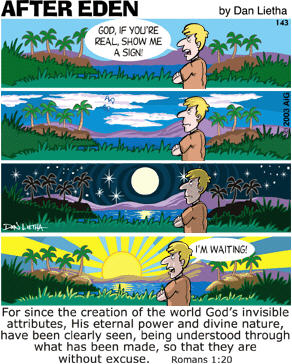
The Christian faith is not a blind faith; it is a logically defensible faith. This is why the Bible makes it clear that anyone who does not believe in God is without excuse:
“For the invisible things of him from the creation of the world are clearly seen, being understood by the things that are made, even his eternal power and Godhead; so that they are without excuse” (Romans 1:20).
Author: Ken Ham, Answers in Genesis. First published in: Creation Ex Nihilo, 20(3):32-34, June-August 1998.
For a more in-depth article, read: Who created God?
References and Notes
Psalms 90:2; 106:48; 147:5. Notice that it is only things which have a beginning which have to have a cause. See J. Sarfati, “If God created the universe, then who created God?” 12(1), CEN Technical Journal (1998), pp. 20-22. Return to text.
W. Paley, Natural Theology, 1802. Reprinted in 1972 by St Thomas Press, Houston, Texas. Return to text.
M. Denton, Evolution: A Theory in Crisis (Adler and Adler, Maryland: 1986), p. 342. Return to text.
R. Dawkins, The Blind Watchmaker (N.Y.: W.W. Norton & Co, 1987), p. 43. Return to text.
Ref. 4, p. 5. Return to text.
Natural selection—the concept that some variants in a population will be less “fit” to survive and/or produce offspring than others in a given environment. Return to text.
See C. Wieland, Stones and Bones (Australia: Creation Science Foundation Ltd, 1995), and G. Parker, Creation: Facts of Life (Green Forest, Arkansas: Master Books, 1996). Return to text.
L. Lester and R. Bohlin, The Natural Limits to Biological Change (Dallas Texas: Probe Books, 1989), pp. 175-6. Return to text.
L. Spetner, Not by Chance (Brooklyn, New York: The Judaica Press Inc.), pp. 131-2. Return to text.
Ref. 9, p. 138. Return to text.
Ref. 9, p. 143. Return to text.
M. Behe, Darwin’s Black Box (New York: The Free Press, 1996), pp. 252-253. Return to text.
Ref. 4, pp. 139-140. Return to text.
Actually, generating words is far simpler than sentences or paragraphs. Simple calculations show that even a billion years would not be enough time to generate even one protein “sentence.” Return to text.
W. Gitt, In the Beginning was Information, (Bielenfeld, Germany: CLV), pp. 64-7. Return to text.
Ref. 15, p. 79. Return to text.
Thus, capable of generating infinite information, and certainly the enormous, though finite, information of life. Return to text.
Ref. 12, p. 243. Return to text.
Exodus 3:14; Job 38:4; John 8:58, 11:25, et al. Return to text.
Copyright © 1998, 2003, Creation Ministries International, All Rights Reserved—except as noted on attached “Usage and Copyright” page that grants ChristianAnswers.Net users generous rights for putting this page to work in their homes, personal witnessing, churches and schools. Illustrations and layout copyright, 2003, Films for Christ
Recommended Reading
Where did life come from? Is Evolutionism really the best scientific answer? Answer
How do you explain the high degree of design and order in the universe? Learn more about the universe / origin of life / origin of species / origin of mankind
- Is Jesus Christ the answer?