Is there evidence that the Israelites once lived in Egypt as the Bible says? Has Joseph's original tomb been found?
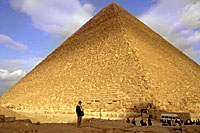
The Bible tells us that when Jacob and his family migrated from Asia to Egypt, they were settled in “the land of Rameses” and that they became property owners there (Genesis 47:11, 27). Eventually, the Israelites were used as slave laborers to build the city of Rameses (Exodus 1:11), and when they left after 430 years (Exodus 12:40), they departed from Rameses (Exodus 12:37). From these references, we can conclude that the Israelites spent the years of the Egyptian Sojourn in and around Rameses.
The name Rameses actually comes from a later period than the Israelite Sojourn. It was the name given to a city built by Rameses the Great (Rameses II) in the eastern Nile Delta in the 13th century BC. This more familiar name was then used retrospectively by later scribes when copying the Biblical texts. Although the location of Rameses was in dispute for some years, that dispute has now been settled. We not only know where Rameses was located, but we know much about the history of the ancient site.
Since 1966, extensive excavations have been undertaken there under the direction of Manfred Bietak of the Austrian Archaeological Institute, Cairo (for previous reports, see Shea 1990: 100-103; Wood 1991: 104-106; Aling 1996: 20-21). It is possible that Prof. Bietak may have, for the first time, found physical evidence for the presence of the Israelites in Egypt.
Archaeology uncovers the history of the land of Rameses
Ancient Rameses is located at Tell el-Daba in the eastern Delta, approximately 100 km northeast of Cairo. In antiquity, the Pelusiac branch of the Nile flowed past the site, giving access to the Mediterranean. In addition, the town lay on the land route to Canaan, the famous Horus Road. Thus, it was an important commercial and military center.
Now there arose a new king over Egypt, who did not know Joseph. —Exodus 1:8
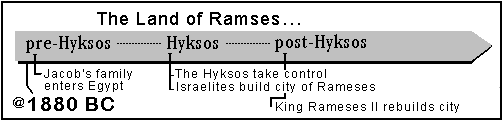
We can divide the history of the site into three periods: pre-Hyksos, Hyksos and post-Hyksos. The Hyksos were a Semitic people from Syria-Palestine, who took up residence in the eastern Nile Delta and eventually ruled northern Egypt for some 108 years, ca. 1663-1555 BC (15th Dynasty).[1] Jacob and his family arrived in Egypt around 1880 BC, based on an Exodus date of ca. 1450 BC. That was in the pre-Hyksos period when the name of the town was Rowaty, “the door of the two roads” (Bietak 1996: 9,19). [2]
Could this be the Israelites?
The earliest evidence for Asiatics at Rowaty (the city that later named Rameses) occurs in the late 12th Dynasty (mid 19th century BC). [3] At that time a rural settlement was founded. It was unfortified, although there were many enclosure walls, most likely for keeping animals. The living quarters consisted of rectangular huts built of sand bricks (Bietak 1986: 237; 1991b: 32). It is highly possible that this is the first material evidence of Israelites in Egypt. It is the right culture in the right place at the right time.
Not all residents of the first Asiatic settlement at Tell el-Daba lived in huts. One of them, evidently an important official, lived in a small villa. The Bible tells us that Joseph became a high official after he correctly interpreted pharaoh's dreams (Genesis 41:39-45). We are not told where Joseph lived while serving in the Egyptian bureaucracy. It seems logical to assume, however, that after discharging his duties associated with the famine, he would have moved to Rameses to be near his father and brothers.
Could this villa have been Joseph's house? [4]
The villa was 10 x 12 meters in size, situated on one side of an enclosure measuring 12 x 19 meters. It consisted of six rooms laid out in horseshoe fashion around an open courtyard. The most striking aspect of the house is that the floor plan is identical to the Israelite “four-room house” of the later Iron Age in Palestine (Holladay 1992a). In this type of house two side rooms and a back room were arranged around a central space, or courtyard. [5]
Nearby, arranged in a semi-circle around the villa, were poorer two-roomed homes, approximately 6 x 8 meters in size. If the villa was the home of Joseph, then the surrounding huts might have been those of Joseph's father and brothers. Approximately 20% of the pottery found in the settlement debris was of Palestinian Middle Bronze Age type (Bietak 1996: 10). In the open spaces southwest of the villa was the cemetery of the settlement. Here, some of the most startling evidence was found.
Hebrew Tombs?
The tombs were constructed of mud bricks in Egyptian fashion, but the contents were strictly Asiatic. Although they had been thoroughly plundered, 50% of the male burials still had weapons of Palestinian type in them. Typically, the deceased males were equipped with two javelins, battle-axes and daggers. Tomb 8 contained a fine example of a duckbill-ax and an embossed belt of bronze (Bietak 1996: 14). One of the tombs, however, was totally unique and unlike anything ever found in Egypt…
Joseph's tomb?
At the southwest end of the burial area, some 83 meters from the villa compound, was a monumental tomb, Tomb 1. It was composed of a nearly square superstructure containing the main burial chamber, and a chapel annex. In a robbers' pit sunk into the chapel, excavators found fragments of a colossal statue depicting an Asiatic dignitary. The likeness was of a seated official 1 times life size. It was made of limestone and exhibited excellent workmanship. The skin was yellow, the traditional color of Asiatics in Egyptian art. It had a mushroom-shaped hairstyle, painted red, typical of that shown in Egyptian artwork for Asiatics. A throwstick, the Egyptian hieroglyph for a foreigner, was held against the right shoulder. The statue had been intentionally smashed and defaced (Bietak 1996: 20-21).
In his book Pharaohs and Kings: A Biblical Quest, David Rohl suggests that this is the tomb of Joseph himself (1995: 360-67).[6] The evidence seems to support this hypothesis. We must assume that Tomb 1 was that of the occupant of the villa, and thus possibly of Joseph himself. The Bible is very specific as to what became of Joseph's body.
“So Joseph died, being one hundred and ten years old; and they embalmed him, and he was put in a coffin in Egypt.” —Genesis 50:26
Moses took the bones of Joseph with him during the Exodus because Joseph had made the sons of Israel swear an oath.
Joseph had said, “God will surely come to your aid, and then you must carry my bones up with your from this place.” —Exodus 13:19; cf. Genesis 50:25
Inside the burial chamber excavators found fragments of an inscribed limestone sarcophagus and a few bone fragments, but no intact skeleton as in the other tombs in the cemetery (Bietak 1991a: 61). Sometime after the burial, a pit was dug at the end of the chapel and a tunnel dug into the burial chamber. The “coffin” (sarcophagus) was then broken and the remains of the deceased removed by these “tomb robbers” (Rohl 1995: 363). It was common for tombs to be broken into in antiquity and the valuables removed, but to have the body taken is highly unusual.
Was the statue broken at the time the bones were removed, or was that done at another time? Archaeology cannot tell us the answer; we can only speculate.
It is likely that the statue was broken during a time of political turmoil (Bietak 1996: 21), possibly when the Hyksos took over rule of the region. It appears most likely that the “new king, who did not know about Joseph” (Exodus 1:8) was the first Hyksos king who came to power ca. 1663 BC.[7] At that time, the Israelites came under intense oppression (Exodus 1:9-11). Perhaps the Hyksos destroyed the statue when they overthrew local Egyptian authority. Since the remains in the tomb would also have been in danger, faithful Israelites may have removed them for safekeeping at this time.
Evidence that the Hyksos took control
In the next phase of occupation, [8] the humble dwellings of were covered over and a huge palace complex constructed. It is obvious that the newcomers, although Asiatic, were different from those in the previous period. [9]
The palace complex comprised several large buildings, purely Egyptian in style. It included upper stories, porticos, courtyards, pools, gardens and cemeteries (Bietak 1996: 21-30). The rich finds of this phase suggest that the occupants were high officials engaged in foreign trade. It appears that this was the initial phase of Hyksos settlement at the site. [10] With the coming of these peoples, the fortunes of the families of Jacob's sons declined (Exodus 1:8-12a).
Without identifying inscriptions, we will never know for sure if the earlier people were Israelites. [11] Contemporary references to Jacob's 12 sons have not been found. Since the sons of Jacob were humble shepherds, we should not expect to find such records, except possibly for Joseph.[12] However, there are ancient references to several of the tribes of Israel which, of course, were named after the sons of Jacob. So, in an indirect way, we do have inscriptional references to the sons of Jacob, albeit from a later time.
This much we can say about the discoveries in Rameses. The finds represent exactly what we would expect to find from Israelite occupation in Egypt.
Notes
-
The Egyptian word Hyksos means “foreign rulers.” In common usage, however, the term is used to refer in general to the Asiatics who settled in the eastern Delta of Egypt in the Second Intermediate Period. The dates for Hyksos rule are not known precisely. Those used here are based on the following:
Expulsion of the Hyksos in approximately the 15th year of Ahmose (Bietak 1991b: 48)
A total of 108 years for the rule of the Hyksos according to the Turin papyrus (Bietak 1991b: 48)
The chronology of Wente and Van Siclen for the 18th Dynasty (Wente and Van Siclen 1977: 218). This chronology gives a death date for Tuthmosis III of 1450 BC, which correlates with the Biblical date for the Exodus. According to Scripture, the Pharaoh of the Exodus perished in the Yam Suph (Exodus 14:5-9,18,28; 15:4,7; Psalm 106:9-11; 136:15), therefore, we correlate the date of the Exodus with the death date of the Pharaoh of the Exodus. The chronology of Wente and Van Siclen also incorporates the low date of 1279 BC for the accession of Rameses II accepted by most scholars today.
-
In the 14th Dynasty, toward the end of the 18th century BC, the name of the town was changed to Avaris, “the (royal) foundation of the district” (Bietak 1996:40). When the Hyksos later established their capital there, they retained the name Avaris. It was probably the Hyksos rulers who forced the Israelites to build the store cities of Pithom (= Tell el-Maskhuta) and Rameses (= Tell el-Daba = Avaris) (Exodus 1:11). When Rameses II rebuilt the city in the 13th century in the post-Hyksos period, and long after the Israelites had left Egypt, the name was changed to Rameses.
The location of Pithom has also been a matter of some debate. Now, however, it seems quite certain that it should be located at Tell el-Maskhuta at the eastern end of the Wadi Tumilat, 15 km west of Ismailiya. Asiatic remains similar to those found at Tell el-Daba have been found there and attributed to the Hyksos (Holladay 1992b: 588-89; 1997:332-34). According to Holladay, the Hyksos occupation at Tell el-Maskhuta took place ca. 1750-1625 BC. It would have been sometime during this time period, then, that the Israelites built the store city of Pithom.
Area F/I, Str. d/2, and Area A/II, Str H
- Str. d/2 at Tell el-Daba
In Palestine, the side rooms were usually delineated by stone columns. With the scarcity of stone in Egypt, this feature would not be expected. Holladay suggests that the ground floor of such a house was primarily utilized for the economic aspects of family life such as the storage of food, tools and supplies, and the housing of animals. The family living space, on the other hand, was most likely on the second floor.
As a result of his nontraditional chronology of ancient Egypt, however, British historian David Rohl dates Tomb 1 to the late 17th century BC (1995: 339), rather than the mid-nineteenth century as determined by the excavators. Since Rohl believes the Sojourn to be only 215 years based on the Septuagint (1995: 329-32), Joseph and Tomb 1 end up being approximately contemporary by his chronology. The present author, however, disagrees with both of these views and holds to conventional Egyptian chronology and a Sojourn of 430 years (Ex 12:40) as recorded in the Masoretic text of the Hebrew Bible. Moreover, Rohl places Joseph and Tomb 1 in Str. d/1, while the present author accepts the excavators' dating of Tomb 1 to Str. d/2, and believes Str. d/2 to be a more compatible context for Joseph and the Israelites.
We are not certain of the name of the first Hyksos king. Redford suggests Salitis/Saites based on literary references (1992: 342), while Ward suggests Khyan based on inscriptional evidence (1984:162-72).
Str. d/1 dating to the early 13th Dynasty (early 18th century BC)
Str. d/2
Str. d/1
Str. d/2
There is a canal connecting the Nile with the Faiyum in the western desert named Bahr Yusuf, the “canal of Joseph.” Development of the Faiyum is associated with Dynasty 12, the time when Joseph was in Egypt carrying out land reforms (Genesis 41:46-49; Gardiner 1961: 35-36). Whether the name of the canal is ancient or from a relatively modern tradition is not known. Otherwise, the name of Joseph has not turned up in Egypt (see Aling 1996).
Bibliography
- Y. Aharoni, The Land of the Bible, revised edition, translated and edited by A.F. Rainey (Philadelphia: The Westminster Press, 1979).
- C.F. Aling, “The Historicity of the Joseph Story,” Bible and Spade 9 (1996), pp. 17-28.
- M. Bietak, Avaris and Piramesse: Archaeological Exploration in the Eastern Nile Delta, (London: The British Academy, 1986); “Der Friedhof in einem Palastgarten aus der Zeit des spten Mittleren Riches und andere Forschungsergebnisse aus dem stlichen Nildelta (Tell el-Daba 1984-1987),” Agypten und Levante 2 (1991a), pp. 47-109; “Egypt and Canaan During the Middle Bronze Age,” Bulletin of the American Schools of Oriental Research, 281 (1991b), pp. 27-72; Avaris: The Capital of the Hyksos, (London: British Museum Press, 1996).
- A. Biran, “City of the Golden Calf,” Bible and Spade, 5 (1976), pp. 22-27; “To the God Who is in Dan,” in Temples and High Places in Biblical Times, A. Biran, editor, (Jerusalem: Hebrew Union College, 1981), pp. 142-51.
- A. Chambon, “Tell el-Far'ah I: L'ge du Fer,” Mmoire 31 (Paris: Editions Recherche sur les Civilisations, 1984).
- I. Finkelstein, “Izbet Sartah: An Early Iron Age Site Near Rosh Haayin, Israel,” BAR International Series 299 (Oxford: B.A.R., 1986).
- V. Fritz and A. Kempinski, Ergebnisse der Ausgrabunden auf der Hiebet el-Msas (Tel Masos) 1972-1975 (Wiesbaden: Otto Harrassowitz, 1983).
- A. Gardiner, Egypt of the Pharaohs (London: Oxford University Press, 1961).
- H. Gauthier, Dictionnaire des noms goraphiques contenus dans les textes hiroglyphiques, Volume 1 (Cairo: L'Institute Franais d'Archologie Orientale, 1925).
- H.L. Ginsberg, “Aramaic Letters,” in J.B. Pritchard, editor, Ancient Near Eastern Texts Relating to the Old Testament (Princeton: Princeton University Press, 1969), pp. 491-492.
- D.V. Hadley, “Asher,” in D.N. Freedman, editor, The Anchor Bible Dictionary, Vol. 1 (New York: Doubleday, 1992), pp. 482-483.
- J.S. Holladay, Jr. “House, Israelite,” in D.N. Freedman, editor, The Anchor Bible Dictionary, Volume 3 (New York: Doubleday, 1992a), pp. 308-18; “Maskhuta, Tell el-,” in D.N. Freedman, editor, The Anchor Bible Dictionary, Volume 4 (New York: Doubleday, 1992b), pp. 588-92; “Maskhuta, Tell el-,” in E.M. Meyers, editor, The Oxford Encyclopedia of Archaeology in the Near East, Volume 3 (New York: Oxford University Press, 1997), pp. 432-437.
- K.A. Kitchen, Ancient Orient and Old Testament, (Downers Grove IL: InterVarsity, 1966); Ramesside Inscriptions Translated and Annotated: Notes and Comments, Volume 1 (Oxford: Blackwell, 1993).
- A. Lemaire, “House of David Restored in Moabite Inscription,” Biblical Archaeology Review, 20/3 (1994), pp. 30-37.
- C.C. McCown, Tell en-Nasbeh I (Berkeley: The Palestine Institute of Pacific School of Religion, 1947).
- A.L. Oppenheim, “Babylonian and Assyrian Historical Texts,” in J.B. Pritchard, editor, Ancient Near Eastern Texts Relating to the Old Testament (Princeton: Princeton University Press, 1969), pp. 265-317, 556-567.
- D.B. Redford, “Hyksos: History,” in D.N. Freedman, editor, The Anchor Bible Dictionary, Volume 3 (New York: Doubleday, 1992), pp. 341-344.
- D.M. Rohl, Pharaohs and Kings: A Biblical Quest (New York: Crown, 1995).
- H. Shanks, “Strata,” Biblical Archaeology Review, 23/2 (1997), p. 8.
- W.H. Shea, “Leaving Egypt,” Archaeology and Biblical Research, 3 (1990), pp. 99-111.
- E. Stern, Material Culture of the Land of the Bible in the Persian Period 538-332 B.C. (Warminster: Aris & Phillips, 1982).
- W.A. Ward, “Royal-Name Scarabs,” in Olga Tufnell, Studies on Scarab Seals, Volume 2 (Warminster: Aris & Phillips, 1984), pp. 151-192.
- E. Wente and C. Van Siclen III, “A Chronology of the New Kingdom,” in Studies in Honor of George R. Hughes January 12, 1977, J.H. Johnson and E.F. Wente, editors, Studies in Ancient Oriental Civilization, 39 (Chicago: The Oriental Institute, 1977), pp. 217-261.
- B.G. Wood, “Recent Discoveries and Research on the Conquest,” Archaeology and Biblical Research, 4 (1991), pp. 104-110; “Mesha, King of Moab,” Bible and Spade, 9 (1996), pp. 55-64.
- G.E. Wright, Shechem: The Biography of a Biblical City (London: Gerald Duckworth, 1965).
Author: Dr. Bryant G. Wood of Associates for Biblical Research. Adapted from the ABR article: “The Sons of Jacob: New Evidence for the Presence of the Israelites in Egypt”
Copyright © 1998, Associates for Biblical Research, All Rights Reserved—except as noted on attached “Usage and Copyright” page that grants ChristianAnswers.Net users generous rights for putting this page to work in their homes, personal witnessing, churches and schools.