
What is…
Cyprus
also known as: Chittim, Kittim, Kypros
Its people: Cypriots (Greek transliteration: Kypriṓtēs)or Cyprians
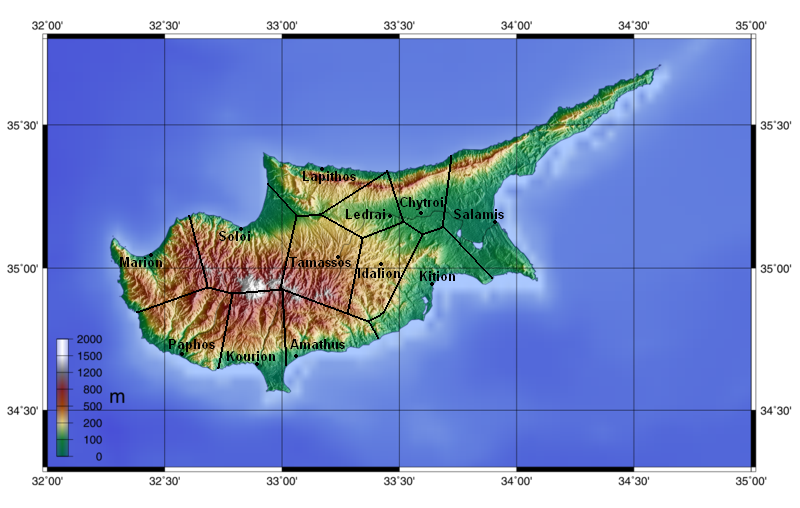
This is one of the largest islands of the Mediterranean, about 148 miles long and 40 wide (3rd largest), and surrounded by turquoise sea. It is located about 60 miles from the Syrian coast.
Many Cypriot archeological discoveries have been made here (e.g., Bronze Age tombs at Hala Sultan Tekke with rich artifacts, Roman mosaics)—all highlight the island's ancient wealth and trade (including copper from the Troodos Mountains).
In ancient times it was a center of great commercial activity. High quality corn, wine and oil were produced here. It was also rich in timber and in mineral wealth.
Cyprus was earlier called “Chittim” in the Old Testament (Numbers 24:24). Greek colonists gave it the name of Kypros, from the cyprus, i.e., the henna (see CAMPHIRE), which grew on this island.
It was originally inhabited by Phoenicians. In 477 BC, it fell under the dominion of the Greeks; and became a Roman province 58 BC.
Cyprus is first mentioned in the New Testament as the native place of Barnabas.
Now Joseph, a Levite of Cyprian birth, who was also called Barnabas by the apostles (which translated means Son of Encouragement), and who owned a field, sold it and brought the money and laid it at the apostles’ feet. —Acts 4:36, 37
It was the scene of Paul’s first missionary labors (13:4-13), when he and Barnabas and John Mark were sent forth by the church of Antioch.
It was afterwards visited by Barnabas and Mark alone (15:39). Mnason, an “old disciple,” probably one of the converts of the day of Pentecost belonging to this island, is mentioned (21:16). It is also mentioned in connection with the voyages of Paul (Acts 21:3; 27:4).
Archeology
Archaeological evidence on Cyprus corroborates historical details from Acts 13, where Paul and Barnabas preached in Salamis (Barnabas's hometown), traveled across the island, and reached Paphos, encountering the Roman proconsul Sergius Paulus and the sorcerer Elymas (Bar-Jesus).
The most prominent discovery supporting biblical accuracy is a series of inscriptions mentioning Sergius Paulus (or members of the Sergius Paulus family) as a proconsul on Cyprus:
A key Greek inscription found at Soloi (Soli) in northern Cyprus, dating to around AD 54 (during Claudius's reign), refers to a “proconsul Paulus.” This aligns with the timing and title in Acts 13:7, where Luke calls Sergius Paulus a “proconsul” (anthypatos in Greek). Earlier critics had questioned this title, as Cyprus was briefly an imperial province, but evidence shows it became a senatorial province governed by proconsuls by the mid-1st century AD.
Additional inscriptions from the region confirm the presence and prominence of the Sergius Paulus family on the island, supporting the historicity of this figure and the Roman administrative context Paul encountered. These findings help affirm the reliability of Luke's account, including accurate Roman titles and governance details.
Major biblical-era sites on Cyprus with relevant remains include:
Paphos (the Roman capital where the encounter with Sergius Paulus occurred): Excavations reveal Roman-era structures, mosaics, an agora, an odeon (amphitheater), and sites traditionally associated with Paul, such as “Apostle Paul's Pillar” near the Chrysopolitissa basilica (linked to his flogging in tradition, though not directly attested archaeologically).
Salamis (eastern port where they landed): Extensive Roman ruins, including well-preserved baths with mosaics, frescoes, statues, inscriptions, a theater, and other public buildings, illustrate the Roman urban life Paul and Barnabas would have navigated.
Other sites like Kourion (Curium), with notable Roman mosaics and structures, and Kition (modern Larnaca), tied to Old Testament “Kittim” references, show broader Iron Age to Roman continuity, including trade connections.
Early Christian archaeology on Cyprus also emerges from the 1st century onward, reflecting the island's role in Christianity's spread (influenced by Barnabas and early converts). Excavations have uncovered early churches, mosaics, and structures damaged by earthquakes (e.g., 4th-century finds with coins, imported glass, painted plaster, and skeletal remains from collapse events). Later traditions link sites to Barnabas (e.g., his monastery near Salamis).
Overall, archaeology on Cyprus strongly supports the New Testament's portrayal of Roman provincial life, accurate titles, and key locations in Acts 13, reinforcing the historical credibility of Paul's early ministry there. No major finds contradict the biblical narrative; instead, they illuminate its setting.
More information
- Who is Barnabas—a Cypriot Messianic Jew?
- Who is Mnason—a Cypriot?
 What is Paphos?
- What is Phoenicia? Phoenicians?
- Chittim
- Salamis (on east coast)
- Camphire
- Apostle Paul and Archaeology—What does archaeology tell us about Paul’s travels through Cyprus (Acts 13:4-12)?
- Who is Paul? and what is his significance?
- John Mark
- Who is Mark?
- Answers about islands of the Bible
- Answers about Ancient Rome in the Bible
- Answers about idolatry and false gods in the Bible
- Places in the Bible
 Archaeology and the Bible, abundant evidence for the Bible’s reliability . Discover answers to your questions.
- Similar word: cypress