A Scanner Darkly
 for drug and sexual content, language and a brief violent image.
Reviewed by: Michael Karounos
CONTRIBUTOR
| Moral Rating: | Very Offensive |
| Moviemaking Quality: |
|
| Primary Audience: | Adults |
| Genre: | Sci-Fi Animation Mystery Action Adventure Adaptation |
| Length: | 1 hr. 40 min. |
| Year of Release: | 2006 |
| USA Release: |
July 7, 2006 (limited), July 28, 2006 (wide) |




What if the cosmos is all that there is? Answer
How do we know the Bible is true? Answer
Are there biblical examples of depression and how to deal with it? Answer
What should a Christian do if overwhelmed with depression? Answer
How can we know there’s a God? Answer
If God made everything, who made God? Answer

Is there an actual place called “Hell”? Answer
Why was Hell made? Answer
Will there literally be a burning fire in Hell? Answer
What if I don’t believe in Hell? Answer



| Featuring |
|---|
| Keanu Reeves, Mitch Baker, Robert Downey Jr., Winona Ryder, Woody Harrelson |
| Director |
|
Richard Linklater |
| Producer |
| George Clooney, Steven Soderbergh, Jonah Smith |
| Distributor |

“Everything Is Not Going To Be OK”

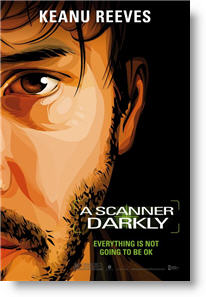
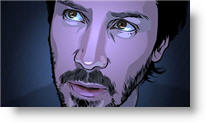
A “Scanner Darkly” is about drug users, undercover cops, and a secret organization, New Path, which produces the drug “Substance D” (“Death”). The plot of the movie revolves around three friends: Bob, Jim, Ernie, and their drug dealer, Donna. Bob Arctor (Keanu Reeves) provides the hangout for Jim Barris (Robert Downey Jr.) and Ernie Luckman (Woody Harrelson) in a home that he used to share with his wife and two daughters.
The reason Bob now lives alone is that one day he banged his head on a kitchen cabinet and had an epiphany that he’s been wasting his life living a suburban lifestyle. The wife and children disappear to be replaced by Jim, Ernie and, occasionally, a hyper-paranoid Substance D user named Charles Freck (Rory Cochrane). The dealer is Donna Hawthorne (Winonah Rider) who keeps Bob at arm’s length for reasons not entirely clear at first. What Jim, Ernie, Freck, and Donna don’t seem know is that Bob is actually an undercover narcotics officer.
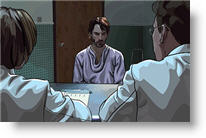
Bob’s job is to find out the source of Substance D. In the process of hanging out with his new buddies, he becomes addicted to the drug and begins to suffer from the side effects which include nasty hallucinations. Freck is the object lesson for the “death” effects of the drug, as he imagines himself, his dog, and his house crawling with various-sized aphids. Later, as he contemplates suicide, he hallucinates that a bug-like alien is standing in his bedroom. The alien tells him that his punishment for eternity is for the alien to read him a list of his sins, including the “one millions lies” he has told. Meanwhile, in a reversal of Kafka’s “Metamorphosis”, Bob hallucinates that Jim and Ernie, though not himself, are big bugs who carry on a conversation with one another.
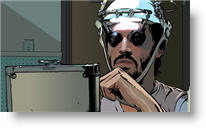
Bugs are a recurring theme. Bob Arctor plants “bugs” in his house to monitor the druggies. His function as an undercover narcotics officer is that of a “scanner”—someone who scans the video transmitted by the bugs. In the reviews of the movie, this central metaphor has been overshadowed by the white noise that the drug scene generates. There are dozens of “F” words, the Lord’s name is repeatedly taken in vain, the characters talk about doing drugs, scoring drugs, storing drugs, and even when they’re not talking about drugs, their conversation is so drug-induced that it seems to be about drugs even when it isn’t.
Nonetheless, for all the emphasis on drugs, the movie is not about drugs. Like other Philip K. Dick stories such as Do Androids Dream of Electric Sheep? (“Blade Runner”), “We Can Remember It For You Wholesale” (“Total Recall”), and (“Minority Report”), “Scanner” is about government and corporate abuses. Dick admired Ayn Rand and his work is suffused with a strong vein of libertarianism: people should be free to do drugs and otherwise live as they please as long as they’re not hurting anyone.
There are two villains in the movie: 1) the corporation New Path which produces Substance D and makes money off the suffering of its victims; and 2) the government whose intrusive spying is a violation of civil liberties. The central metaphor of the movie is the act of scanning: what the officers do in their offices. They stare at the multiple screens which secretly spy on the targets of their investigation.
The movie gets complicated when Bob’s addiction causes schizophrenia. He doesn’t realize that the person he’s spying on is himself because the drug has caused the two hemispheres of his brain, the “perceptive” and “cognitive” halves, to “compete” with one another. This is a metaphor for Bob’s inability to balance his dual identity and represents an existential crisis. Bob is unable to understand the world he is living in because Substance D alters reality.
Without giving away too much, Bob discovers rows of blue flowers that transfix him. A corporate type tells him that “This isn’t your God anymore, although it once was.” It is an intriguing reference and combined with Freck’s “hell” and Donna’s reference to “God’s M.O.” constitutes at least three clear references to religion. Various writers claim that “A Scanner Darkly” is a phrase taken from the apostle Paul’s phrase “a glass darkly”: “For now we see through a glass, darkly; but then face to face: now I know in part; but then shall I know even as also I am known” (1 Corinthians 13:12 KJV). In a voice-over at the end of the movie, Bob thinks to himself: “What does a scanner see? Into the head? Into the heart? Clearly or darkly?” Bob’s schizophrenia is ultimately a loss of faith in his role as a “scanner,” as someone who purports to know the “truth” about people. Taken together with the other religious references, the idea of the “scanner” as an existential seeker who wants to know in full, points the viewer to the ultimate question: what is Substance D?
The answer to that question lies in its origin as a blue flower, a symbol of Romanticism made famous by a German writer named Georg Friedrich Philipp von Hardenburg (1772-1801) who wrote an unfinished novel called Heinrich von Ofterdingen (1802) in which the protagonist dreams of a blue flower filling his soul with longing. The scholar Corbin Scott Carnell, writing in Bright Shadow of Reality: C.S. Lewis and the Feeling Intellect, observes:
“Not infrequently the locus of melancholy is fixed upon someone who is loved but does not return love, or on some ideal person who has died, or upon some golden time which is no more—the glory of Greece, the grandeur of Renaissance Italy, the mystic charm of the Middle Ages… the pursuit of the unattainable… The dreamer keeps on creating better worlds—in other places, among different people, etc. This motif is found in German literature as the search for the Blaue Blume [the blue flower]… A sense of separation from what is desired, a ceaseless longing which always points beyond.” (21) (Accessed at: http://ic.net//RAZ40.HTM.)
In a similar fashion, Substance D, which is distilled from the blue poppies, is an addictive drug that ultimately causes the user to hallucinate, to dream of other worlds that in Dick’s vision are not “better” as in the quotation above, but worse because they are inspired by religion.
In response to Bob’s confusion of reality with dreams, Donna says: “We’re all dreaming.” The convergence of the image of the blue flowers with a dream-like search for the “unattainable” is, I believe, Dick’s commentary on the hopeless pursuit of knowledge through religious belief. Nietzsche famously called Christianity the religion of “death,” while Marx even more famously called it the “opiate of the people.” All of these complex references intersect in the “drug” of “death”—Substance D, which is referred to as a “God,” and as the experience of one’s “sins.”
Those are the complex themes underlying the movie. Unfortunately, if the viewer doesn’t understand the ideas the movie is struggling with, then it is bound to be a talky, boring experience at the end of which one says “Huh?”
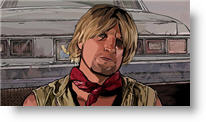
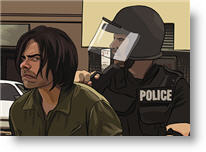
The rotoscoping is a revolutionary technique that requires actors of exceptional expression. That is why Robert Downey Jr., Woody Harrelson, and Rory Cochrane come across as amusing three dimensional characters, while nKeanu Reeves and, to some extent, Winona Ryder do not. Nature abhors a vacuum, and the proof of that maxim is the unnatural acting of the vacuous Reeves whose two-dimensional talent simply cannot animate a two-dimensional form.
The movie contains nudity, brief scenes of sexual activity, scores of F-words, perhaps a score of profanities, and is a hodgepodge of images and ideas whose parts never quite constitute a coherent sum or narrative. Although Dick can’t be blamed for Linklater’s attempt to bring his novel to the screen, it is relevant that Dick himself was a tortured person who struggled with drug addiction and perhaps resented the easy moral posturing of Christians who condemned drug use. Like the scanners in his novel, Dick could only see darkly and had he read past the twelfth verse in 1 Corinthians he might have understood that the answer to his unhappy life lay in the thirteenth verse: “And now these three remain: faith, hope and love. But the greatest of these is love.”
Violence: Moderate / Profanity: Extreme / Sex/Nudity: Moderate
See list of Relevant Issues—questions-and-answers.

Very Offensive / 5
Anyone who has read Dick widely will know that reflections on the 1 Corinthians 13 verse occurs a number of times in various books. In addition to this, Dick himself once gave a speech where he commented on the verse by asserting that he felt it would one day need to be updated with reference to scanners that looked into us, rather than it only being about us staring through obscured glass. There is no doubt that the title, and the film in general, is based on 1 Corinthians 13:12; it is, however, actually 1 Corinthians chapter 15 that Dick explores most deeply in “A Scanner Darkly.”
Paul’s profound reflections on the nature of death as understood by a community built around and motivated by belief in resurrection are never far from any moment of the narrative of this film. The drug that shapes and controls the characters and narrative is called “Substance Death,” and the film unfolds as an exploration of the notion of death from within a society where power abuse, corruption, anxiety, loneliness and despair are far more central concepts for most people than is resurrection.
The most profound moments of analysis in the film are infused with the incites of 1 Corinthians 15: “Then shall it come to pass the saying that is written,” a voice said. “Death is swallowed up. In victory.” Perhaps only Fred heard it. “Because,” the voice said, as soon as the writing appears backward, then you know which is illusion and which is not. The confusion ends, and death, the last enemy, Substance Death, is swallowed not into the body but up—in victory. Behold, I tell you the sacred secret now: we shall not all sleep in death.”
“A Scanner Darkly” is not a simple, straight-forward film; it is not a film that gives all its ideas away easily, up front; but it is definitely a film worth watching and ruminating upon. Not only will Christians familiar with St Paul’s writings have an advantage when it comes to perceiving how they illuminate the narrative of the film, but they should also be motivated to explore to what extent Dick’s reflections on 1 Corinthians illuminate and transpose the text in a contemporary context.
Better than Average / 4
My Ratings: Offensive / 2