The Passion of the Christ
 for sequences of graphic violence.
Reviewed by: Brett Willis
STAFF WRITER
| Moral Rating: | GOOD—but contains graphic violence |
| Moviemaking Quality: |
|
| Primary Audience: | Adults Mature-Teens |
| Genre: | Historical Drama |
| Length: | 2 hr. 6 min. |
| Year of Release: | 2004 |
| USA Release: |
February 25, 2004 |
If Jesus is God, how could he die? If Jesus died on the cross, then how can he be alive today? Answer
Discover Jesus Christ in context…
…discover the overwhelming message of HOPE that God brings to man—presented chronologically from the foundation of the world to our own time. Watch it online, full-length motion picture. Very popular and enlightening…
Watch the film now…






| Featuring |
|---|
|
James Caviezel … Jesus Maia Morgenstern … Mary, mother of Jesus Christo Jivkov … John Francesco De Vito … Peter Monica Bellucci … Magdalen Mattia Sbragia … Caiphas (Caiaphas) Toni Bertorelli … Annas Luca Lionello … Judas Hristo Shopov (Hristo Naumov Shopov) … Pontius Pilate Claudia Gerini … Claudia Procles Fabio Sartor … Abenader Giacinto Ferro … Joseph of Arimathea Aleksander Mincer (Olek Mincer) … Nicodemus See all » |
| Director |
| Mel Gibson — “Braveheart,” “The Man Without a Face” |
| Producer |
|
Icon Productions Bruce Davey Mel Gibson Stephen McEveety |
| Distributor |
| Newmarket Film Group |
“This film tells the story of the last 12 hours in the life of Jesus, on the day of his crucifixion in Jerusalem. This film’s script is based upon several sources, including the diaries of St. Anne Catherine Emmerich (1774-1824) as collected in the book, The Dolorous Passion of Our Lord Jesus Christ, The Mystical City of God by St. Mary of Agreda, and the New Testament books of John, Luke, Mark and Matthew.”
Both the Mel Gibson (the director) and James Caviezel (the actor who plays Jesus) are devout Roman Catholics. The film is subtitled, as it was largely shot in the languages of the period, Aramaic and Latin.
Index
- Full review
- Guest review: Ray Comfort
- Guest review: Answers in Genesis
- Viewer comments:
Positive | Neutral | Negative - Young peoples’ reactions
- Jewish concerns response
- Relevant biblical and spiritual issues
- What’s the big deal?
- This film is considered by SOME to be offensive. Why?
- Resource: The JESUS section of our Web site
- IMPACT: The Passion of the Christ—a documentary about the controversy and effects of the film
For many months, and even more strongly for the past few weeks, we’ve all been subjected to a propaganda campaign in the media and on the Internet, attacking “The Passion” with a variety of “concerns” ranging from the possibly-valid to the irrelevant and outrageous. Now that the release date has finally arrived, each of us can decide for ourselves whether to see the film. And if we do see it, decide also whether the objections were justified.
Many of the negative reviews of this film are written by people who don’t believe that the Bible is given by the inspiration of God, a problem that severely colors their approach. Sometime late in a review, the writer will subtly peck away at the reader’s faith, implying (for example) that Pilate carried more blame for Jesus’ death than the film shows. But doesn’t the film follow the Biblical record on Pilate’s role? Yes, but they imply that the Biblical record ITSELF is tainted, because when the Gospels were written, it was important for Christians not to antagonize the Romans, so they blamed the Jews for Jesus’ death INSTEAD, etc. etc.
I believe that any reviewer of this film should state his view of the Scriptures up front, so the reader knows the worldview from which the review is written. For my part, I believe that all of the Old and New Testaments are the Word of God, and they teach absolute truth. I further believe that not only were the original manuscripts inerrant, but God has also PRESERVED the Scriptures by superintending the process of canonization AND by seeing to it that a false reading of a passage (whether a transcription error or a deliberate alteration) in some copy of the Scriptures can be detected and refuted, not by a philosophical or “critical” process, but by the “majority text principle” of letting the countless copies which are undamaged in any given verse out-vote the damaged copies. The bottom line is that the Scriptures were reliable when first given, and they’re still reliable today.
Q & A
How do we know the Bible is true? Answer
When we say that the Bible is the Word of God, does that imply that it is completely accurate, or does it contain insignificant inaccuracies in details of history and science? Answer
How can the Bible be infallible if it is written by fallible humans? Answer
My view of Passion films in general
When I was a kid in the 1950s, growing up in a formal church, we had Wednesday night midweek services during Lent only. One year, a Passion film was shown during those services, a 15 minute slice each week. [“Passion,” in this context, means “Suffering.”] When the Crucifixion was shown, I distinctly remember an awesome sense of personal responsibility that gripped me as the nails were being driven into Jesus’ hands (off-camera of course, but with sound-effects). More than any sermon I ever heard in that church, that film sequence convicted me of sin, and of the fact that by my sin I had shared in causing those nails to be driven.
However, classic-style Passion films probably wouldn’t have the same effect on today’s audiences that they did on those of 50 years ago, because techniques of extreme graphic violence have been used in films of all types, from war movies with a message of self-sacrifice to ridiculous horror and horror-comedy flicks. Moviegoing audiences are desensitized, are bored by the old-style “less is more” approach, and demand “realism.”
So, an actor/director from Hollywood’s “A-list,” who happens to believe that the message of Jesus is true, has chosen to spend somewhere between 25 and 35 million dollars of his own money to make an R-rated Passion film befitting the trend of the times. Mel Gibson’s primary target audience is not extreme conservative Christians who’ve never seen any of his other films. He’s reaching to the same people who’ve followed his previous work, but he’s telling him something more important than he’s ever told them before. It’s as simple as that.
Content Summary
After a quote from Isaiah 53, “The Passion” opens with Jesus praying in the Garden of Gethsemane while Peter, James and John have drifted off to sleep. After waking His disciples (who have never seen Him in such torment) and speaking with them, He returns to His place of prayer, and it appears that His face is peppered with sweat like drops of blood (Luke 22:44). The interchange between Jesus and the Disciples is a mixture of Biblically accurate dialog and creative license. [The film’s dialog is Aramaic or Latin, with subtitles.]

As Jesus continues to pray, Satan (a hooded, pale-skinned, shaved-eyebrow, somewhat gender-neutral figure) appears at Jesus’ side and tells Him that He cannot take on the sins of the whole world, that saving mankind’s souls is too great a task. Lest we miss the point that it’s a supernatural character we’re seeing, a maggot dangles out of one of Satan’s nostrils, and a “pet” snake is at his feet. The snake slithers over and onto Jesus as He prays in agony. Jesus steels Himself against temptation, rises, and crushes the snake underfoot (a symbolic reference to Genesis 3:15, which actually means that Jesus would crush Satan himself by His death).
Meanwhile, Judas has agreed to reveal Jesus’ whereabouts to the Jewish chief priests for 30 pieces of silver. The priests pay him the money, and he leads the Temple Guard to the garden.
Most of the arrest scene is Biblically accurate. It seemed strange and redundant to me that Judas’ kiss of betrayal came AFTER Jesus had already identified Himself to the Guard; but since Jesus identifying Himself is found only in John and the kiss of betrayal is NOT recorded in John, it’s possible that the two events happened in that order rather than the other way around.
The scene includes the struggle between the Disciples and the guard; Peter cutting off the right ear of the Guardsman, Malchus; Jesus re-attaching and healing the ear, and telling Peter to put up his sword because all who take the sword shall perish by the sword; and the Disciples finally forsaking Jesus and fleeing.
The rest of the film follows the same pattern. About three-quarters of the content is faithful to the Biblical record. And most of the “extra” material is neutral and not misleading in any way.
Biblical details include, but are not limited to…
Peter’s denial of Jesus (I said there was no profanity in the film, but in one denial Peter says “damn you,” which faithfully reflects the account in Matthew 26:74).
The Sanhedrin (the council of Jewish chief priests and elders) being called into an illegal session in order to condemn Jesus (but we see that some members were not invited; and some who WERE invited object to the proceedings, and then leave in protest or are kicked out).
The false witnesses who misunderstood Jesus’ prophecy of His own death (John 2:19-22), and THOUGHT He’d said that He would destroy the Temple and build it again in three days.
Caiaphas (the High Priest) tearing his garments, and the Sanhedrin condemning Jesus for blasphemy, because He admitted that He was the Messiah (the “anointed one,” the prophesied King who would inherit the Throne of David). [“Christ” is the Greek translation of the Hebrew word “Messiah.”] This claim WOULD be blasphemy if it were not true. But in Jesus’ case, it WAS true.
The priests taking Jesus to Pontius Pilate, the Roman governor (because as a subjugated people, the Jews had no authority to carry out death sentences), and slyly translating “blasphemy” into something the governor would care about, namely “sedition,” by claiming that since Jesus was perceived as a King, He was a threat to Roman rule.
Judas repenting when it’s too late, claiming that he’s betrayed innocent blood, throwing the money back at the priests, and hanging himself. [There’s a lot of extra-Biblical creative license in the Judas sequences; for instance, Judas is confronted and tormented by children who turn out to be demons.]
Pilate being warned by his wife not to get involved in condemning Jesus, because she in turn was warned in a dream. Pilate repeatedly acquitting Jesus, then passing Him off to Herod Antipas because Jesus was a Galilean and belonged to Herod’s jurisdiction. Herod (who is shown as a degenerate sicko) passing Him back to Pilate. [By the way, although the Herod family were rulers of the Jews, they themselves were Idumeans (Edomites).] Pilate attempting to satisfy the bloodthirsty crowd by just “chastising” Jesus.
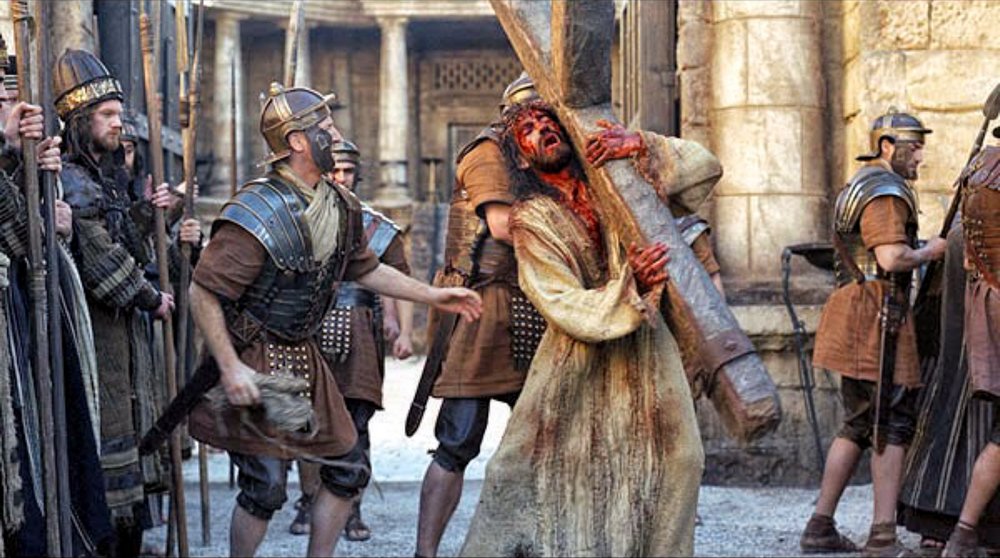
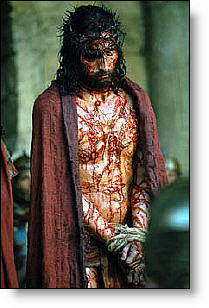
The Roman scourging (including the use of a cat-of-nine-tails, which is not a Biblical certainty but a good educated guess). The Crown of Thorns, the mocking, the spitting. The crowd choosing the murderer Barabbas rather than Jesus in the Passover prisoner-release. Pilate finally giving up, literally “washing his hands” of the matter, and assenting to the crowd’s chant of “crucify him.” Pilate says that he’s innocent of the blood of this man (he isn’t, of course). [In an early cut of the film, Caiaphas responds with “His blood be on us, and on our children,” which is taken from Matthew 27:25. The inclusion of those “blood curse” words drew strong objections from some Jewish leaders, and the nature of the final cut was in doubt. In the theatrical version, an unidentified person (not shown on screen) responds to Pilate, but the dialogue isn’t subtitled, so only someone who knows the language can tell us whether the response was the “blood curse” or not.]
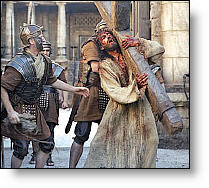
Simon of Cyrene being forced to help Jesus carry the cross. The nailing. The two thieves crucified along with Jesus, one angry and defiant, and the other expressing faith. Several of Jesus’ words on the Cross. The darkening of the sky. The earthquake, and the veil (curtain) in the Temple being torn in two (Matthew 27:51). [The veil in the Temple separated the Holy Place from the Most Holy Place, where at one time the Ark of the Covenant was kept. The symbolism of the veil, and of many other things in Temple worship, was the separation between God and sinful man.
Hebrews 10:1-22 makes the point that Jesus’ flesh was ALSO a veil between God and man (paralleling it with the Temple veil), and that when Jesus’ flesh was torn (which occurred at the same time the Temple veil was torn), the blood sacrifice of Jesus opened up a way for man to have direct fellowship with God. The animal sacrifices of the Law of Moses, which were inadequate to solve the problem of sin, foreshadowed and were replaced by the all-sufficient sacrifice of Jesus, which forever takes care of the sin problem in anyone to whom it’s appropriated by faith.]
Jesus’ teachings (most seen in flashback), including those about forgiveness and loving your enemies, and about how no one takes His life from Him, but He’s voluntarily laying it down, how He has power not only to lay it down but to take it up again.
The Resurrection—It’s EXTREMELY brief, but it’s there. And it seems to indicate Jesus having “dematerilized” out of the constricting graveclothes and then “rematerialized” (John 20:3-8).
What we have here is a film taking the position that Jesus WAS exactly Who He said He was. Before considering any negatives, we need to step back a moment and appreciate how rare that is!
Okay, now for the possible negative
The violence is extreme. The special effects of Jesus being beaten with rods, scourged, and nailed to the Cross leave nothing to the imagination. Not only that, but both the Jewish Temple Guard and the Roman Soldiers take pleasure in pummeling Jesus CONSTANTLY. From the time of His arrest on, whenever they’re walking Him anywhere, they can’t take two steps without whacking Him one. This content is there from the beginning, broken only by flashback scenes to somewhat happier times. In the second hour of the film, beginning with the Scourging, it becomes overwhelming.
Ordinarily, even in a worthwhile film like “Saving Private Ryan,” where a constant drum of violence is somewhat inherent to the plot, the violence itself is a minus. But this isn’t ordinarily. One of the complaints of negative reviews is that not enough time is spent on Jesus’ teachings. But that’s not the film’s purpose nor focus. In John 3, Nicodemus (a ruler of the Jews) came to Jesus by night and admitted that they (he and the other rulers) knew Jesus was a Teacher come from God. In what seemed like a major change of subject, Jesus said that Nicodemus needed to be born again. The point is that Jesus’ ESSENTIAL role was not that of a Teacher, but of a Savior. OUR essential NEED is not to understand more and more doctrine, but to be born again. And without the blood sacrifice of Jesus, it would not be POSSIBLE for us to be born again.
Gibson is giving us a look at what that blood sacrifice actually was. In Romans 5:6-10 we’re taught that it’s a rare thing for one man to die for another, even if the other man is “righteous” and deserving of the sacrifice. But in the case of the Cross, Jesus died for us while we were His ENEMIES, in order to make a way for us to become His friends and to be converted from unrighteousness to righteousness. Of all the violent acts that have occurred in the history of the world, the Cross was by far the most important.
If any event deserves the full Hollywood treatment, this one does. Therefore, I do not consider the graphic nature of this presentation to be a negative. Of course, it’s not appropriate for young children.
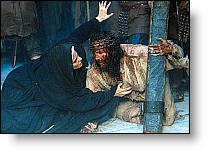
Not surprisingly, certain scenes in the film (such as Mary cradling Jesus’ body as it’s taken down from the Cross) have a distinctly Roman Catholic flavor. But not so distinctive that they’re an impediment to anyone else’s faith. I commend Gibson for giving the film a broad general appeal among Bible believers of all stripes.
Some content is either based on the writings of those two Nuns that we’ve heard so much about, or is Gibson’s own creative license. To someone who’s familiar only with the Biblical record, those snippets of content come out of nowhere, without warning, and then go away again.
Certain details which we know could have been improved over other Passion dramas, such as putting the nails through the wrists rather than through the palms of the hands, or having Jesus carry only the crossbar instead of the entire Cross, were NOT fixed. Reportedly, this was to preserve familiarity with the story as most people visualize it. Other details, such as not emphasizing asphyxiation, or omitting a Greek version of the title “King of the Jews” fastened to the Cross, are incorrect, but tolerable. The essence of this story is Jesus’ sacrifice—the BLOOD that so many of our songs sing about.
Q & A
What about the objections of anti-Semitism?
Groundless. If anything, Gibson shows even-handedness and restraint in that matter. It’s clear that the Sanhedrin was not unanimous in condemning Jesus. And while the Temple Guard engages in some gratuitous violence, all the really bloody torture of Jesus is done by the Romans.
The liberals say Pilate must actually have been the primary mover in killing Jesus. They say this, because they want it to be so. Was Pilate sometimes a bloodthirsty murderer? It sure sounds like it, from Luke 13:1. But the factual historical record (found in the Scriptures) is that Jesus was really no threat to Rome, the Jewish leaders were the ones who conspired to put Jesus to death, and they forced Pilate into carrying out their wishes.
See John 11:46-53. In this amazing passage, Caiaphas says that one man (Jesus) should die for the people, so that the whole nation doesn’t perish.
Caiaphas was a murderer who THOUGHT he simply meant that he was going to have Jesus bumped off for political reasons, to avoid trouble with Rome. But because he was the High Priest, God was at the same time speaking through him and giving a second sphere of meaning to his words. Jesus’ death was to be a Substitutionary Atonement for sin, so that other people wouldn’t have to die in their own sins.
Some Scripture passages, such as I Thessalonians 2:14-16, name “the Jews” as the killers of Jesus. But other passages spread the blame more generally. In Acts 4:24-28, the Apostles quote Psalm 2, and interpret it to mean that pretty much EVERYONE — Herod (an Idumean, remember), Pilate, the Gentiles, and the people of Israel—were gathered TOGETHER against Jesus, TO DO WHAT GOD’S COUNSEL HAD FOREORDAINED TO BE DONE.
The most important point, as Gibson has said, is that WE’RE ALL GUILTY. And that no one took Jesus’ life from Him, but He laid it down of Himself. Anyone who tries to use the Biblical record, or a dramatization of the Biblical record, as a justification to persecute someone, just doesn’t get it. God will be the judge of all unbelief. Until Jesus returns, our message centers on God’s offer of mercy and forgiveness.
If the essential message of this film is true, and if everyone needs to believe on Jesus, then regardless of the objections that are voiced, the number one ACTUAL objection against this film by any unbeliever is that it’s showing a truth that he does not acknowledge. The person may not KNOW that that’s his primary objection—it may be lodged in his spirit rather than in his brain—but yet it is.
So many of the voiced objections betray a double standard. This film is being judged by a different set of rules than any other. And the people who always proclaim that movies are just entertainment and don’t really change behavior or beliefs—where are those people now? I don’t hear them. The silence is deafening.
I’m sure that I’ll acquire a copy of this film for my own video or DVD library. And at some point, when she’s a teenager, I’d like my daughter to see it. Of course, some people couldn’t handle this content. The Gospel has done just fine for 2000 years, without the Holy Ghost needing help from this film or from any other dramatization. “The Passion” is NOT an indispensable addition to anyone’s witnessing tool kit. But there ARE ways in which it could be used effectively.
I HIGHLY recommend this film for anyone of appropriate age, maturity and stamina.
Violence: Extreme | Profanity: None | Sex/Nudity: None
Answering a question from a Christian visitor
“What would you say to a Jewish person about ‘The Passion…’?”
If the person seems honestly fearful that the film will produce an outbreak of anti-Semitism in America, I would share what an American Orthodox Jewish Rabbi reminded us of. America is probably the world’s safest haven for Jews. America’s Bible Belt is Israel’s “safety belt.” The Christian Gospels are not a threat to Jews. “The Passion…” which tells part of their story is not a threat. The few misguided Jewish leaders that have made charges of anti-Semitism against Mel Gibson and other cast members are simply wrong. The leading source of these charges even admitted this recently on television.
Speaking of “The Passion of the Christ,” Michael Medved (movie critic, observant Jew and longtime president of an Orthodox congregation) has said:
“The film seemed to me so obviously free of anti-Semitic intent that I urged Gibson to show the rough cut to some of his Jewish critics as a means of reassuring them… Contrary to the fears and expectations of some Jewish leaders, an agnostic, left-leaning college professor at an Ivy League university is much more likely than a Southern Baptist preacher to harbor anti-Jewish attitudes.” (“The Passion and Prejudice,” Christianity Today, March 2004)
In an interview, Medved went on to say,
“…I don’t think there is going to be any anti-Semitic backlash based upon the film… there has been an increasingly strong coalition between committed Jews and committed Christians, to defend the United States, to defend the values that we care about, to defend the traditional family, and to defend Israel. And there are people in this country, particularly on the Left, who don’t like that, who are very suspicious of it. And so this has been used, it seems to me in a very political way, by certain people on the Left to try to drive Jews and Christians apart. And it is our job, particularly those of us in the Jewish community, to not allow that to happen. This movie is an affirmation of Christian faith, and I am one of those Jews who believes that the more Christian America there is, the better it is for America, and the better it is for America’s Jews, and for Jews around the world.” (part of a televised interview on the CBN network, The 700 Club)
Rabbi Daniel Lapin (President of Toward Tradition) said,
“…it isn’t the film that threatens the sense of community [between Jews and Christians]; it is the arrogant and intemperate response of [certain] Jewish organizations that does so… Many Christians who, with good reason, have considered themselves to be Jews’ best (and perhaps, only) friends also feel bitter at Jews believing that Passion is revealing startling new information about the Crucifixion. They are incredulous at Jews thinking that exposure to the Gospels in visual form will instantly transform the most philo-Semitic gentiles of history into snarling, Jew-hating predators.”
If you are trying to help a Jewish friend realize that Jesus Christ is their Messiah, see this page for help… Judaism section in our Effective Evangelism section.

Comments from Ray Comfort, Living Waters, a Team Member of ChristianAnswers.Net
Nowadays, most Christians are rejoicing that amidst the filth of Hollywood, suddenly another movie has been produced that flies in the face of everything for which Hollywood stands. That movie is “The Passion of the Christ.” But some are deeply concerned that it was also directed and produced by a Roman Catholic. It also contains artistic license. It has scenes that are from Catholic mysticism rather than from Scripture (the appearance of a raven at the cross, Judas being tormented by children, etc.).
Another concern that some people have is that an onscreen depiction of Jesus is a form of “graven image,” and therefore a transgression of the Second Commandment. Those who think that making an image of Jesus on film is breaking the Commandment should read it in full. We are not to make graven images of “any likeness of any thing that is in heaven above, or that is in the earth beneath, or that is in the water under the earth.”
That means that we shouldn’t make film images (movie or still photos) of any person, animal, fish, flower, bird, mountain, etc. That doesn’t make any sense… until we read the whole Commandment: “You shall not bow down yourself to them, nor serve them” (Exodus 20:4-5). The Commandment forbids the creation of any image for the purpose of worship.
While we could argue about these issues, I would rather ask you an important question. If someone says, “I’m not a Christian, but I did see the film. Wow! What was all that brutality about?” are you going to reply, “I didn’t go to the movie because it was directed and produced by a Roman Catholic. It’s idolatrous, and it contains things that cannot be corroborated by Scripture, and I therefore think it was evil”? I hope not. I should hope that you instead use the movie as a springboard to explain the way of salvation.
See all »Comments from Mark Looy, Answers in Genesis, a Team Member of ChristianAnswers.Net
…The movie is absolutely gripping. It has the added benefit that it is apparently true to Scripture, although some poetic license was used (for example, there is a scene where Christ is flung off a bridge, which cannot be found in the Gospels--that account may have its origin in a book written by a nineteenth-century mystic).
The second half of the movie, though, is, in a word, “torture.” Not only does the movie graphically depict the torture of Christ, from His scourging to the Crucifixion, I found it to be also torturous to watch. The “R” rating in the US (meaning “Restricted—young people under 17 must be accompanied by a parent or guardian to enter the theater”) is merited because of how vividly it reconstructs Christ’s brutal, bloody torture. Some have argued that, in a culture that is so desensitized to screen violence, “The Passion” had to be so graphic to make its point about His immense suffering. I will not, however, be taking my 11 and 13-year-old sons to see it.
Others have commented that these incredibly horrific ordeals shown in the second hour of the movie could have been done in 15-20 minutes and still convey something of the immense suffering that our Savior must have experienced. (And, of course, no movie could ever depict the internal/spiritual suffering of our Lord as He bore the sins of the world while on the Cross.) Such shortening could, in turn, have left more time at the movie’s end to present the glory of His Resurrection three days later (which the film presents very briefly). After all, the validity of the Christian faith is based on the Resurrection, the most important event in history: “And if Christ be not risen, then is our preaching vain, and your faith is also vain” (1 Corinthians 15:14). In the film preview shown to the media, the depiction of the Resurrection was maybe a minute in length. This parallels the emphasis that some non-Protestant religions (that generally accept the Bible) place: i.e., a focus on Christ still on the Cross as opposed to Christ off the Cross—as a risen Savior. After such a remarkable build-up, I believe the film lost an opportunity to proclaim something quite glorious when it glossed over the Resurrection. It was like listening to Handel’s magnificent Messiah and then hearing only one bar of the “Hallelujah chorus” at the end…
But this drawback is not why the movie is so controversial…It’s clear that the filmmakers were not trying to blame any one person or an entire group. At the same time, however, we should add what the film does not really mention: God the Father is the One responsible for planning and allowing the Crucifixion of His Son, Jesus. This was prophesied all the way back in Genesis 3:15 and also Isaiah 53—and many other places in the Old Testament.
See all »After being blessed with the opportunity to watch a preview …I along with the host of individuals in the room sat in an uncomfortable silence contemplating the images which had just passed before us. The visuals were intense, disturbing, provoking, intelligent, and engaging as Mel weaved together aspects of the Gospel, his imagination, and elements of his religious tradition.
 Gracious enough to join us at the screening, Mel expressed that he was pleased with the film, because, to him,
“the film worked… I think it was fairly faithful to the Gospel, but at the same time I was able to use my imagination to a degree…”
Mel stated like a proud parent.
As for the negative press, it seems completely unfounded, as the film plays extremely evenhandedly to all of its character groups… the key is to view this film for what it is intended to be: a work of art, an expression of Mel Gibson and those who worked on the film as a gift to the viewer. Rather than a tool to manipulate, Mel stated that his greatest dream for what to happen in the theaters was that,“It would be free, and afterwards everyone would have ice cream.”
Yet he acknowledged the power of art:
And while the film almost demands that the audience come with some foreknowledge of the event, the central themes of Christ’s struggle during the last hours of his life are painfully clear.See all »“Art has the power to transcend many things, and that’s why during the Renaissance and all the religious art work over the centuries is amazing stuff and has inspired people, and I think that this can do the same thing, it can inspire, and can just make people aware of who they are in relationship to the world and what has gone on before them, I mean civilization has been changed forever by Christ, …nothing was the same ever after that, whether you’re a believer or not it’s effected your world and there’s no getting around that.”
[Excellent!/4½]
I explained it this way to my wife and friends… it felt as if I had been transported through time to the actual crucifixion. I watched as my Lord and Saviour was scourged, beaten, spat upon, and crucified for me. Tears rolled down my cheeks in rivers. This film has the power to heal the wounded sin filled heart and destroy any notion that this was an easy things for Jesus to have done… Mel Gibson can be considered a hero of the faith, and I hope that he will be remembered as such, because at least for me I am closer to Jesus now after witnessing his sacrifice for me in it’s full horror and brutality. My hope is that somehow this film will be taken as a witnessing tool around the world, like the Jesus film, because I believe in this film there is the power to bring millions to Christ…
[Average/5]
Many are saying that the violence is not needed, but I disagree. It reinforces what Jesus was willing to endure for the people he loved so much. We can ask ourselves, “if we were just told that the Holocaust was an unfortunate by-product of the second world war where some innocent people were killed, would it justify the reality of the terror that actually happened?” No. We need to be exposed to some horrors to make an educated opinion of the subject.See all »
[Good/5]
I found this movie to be very scriptural. There may have been a few petty things that may not have been, but all in all, it was straight to the Bible. I have heard and read a lot of negative things about the movie and that Mel Gibson (and viewers) were blaming the Jews for Jesus’ death.See all »
[Excellent!/5]
[Excellent!/5]
[Excellent!/5]
…The film has drawn criticism on two accounts: that it is anti-Semitic and that it is too violent. Of the first charge I will refer readers to a National Review article by Rabbi Daniel Lapin and merely say that a number of anti-Christian organizations are anxious to diminish this film because they recognize its greatness. “The Passion” will energize the Christian community and it has set a standard by which all future Christian films will be judged. Singlehandedly, Mel Gibson has created a Christian genre that will inspire more films and will provide Christians of the future with a visual gospel for the future. Anti-Christians are nervous because they fear not just this film, but the films which will follow in its path.
…by contemporary standards, the film is not so much violent as it is bloody. Jesus’s blood is everywhere: in pools in the courtyard, on the faces of the sadistic Roman guards, on the cloth of Veronica, on Simon of Cyrene and, most poignantly, on his mother. Christian emphasis on the redeeming power of Jesus’ actual blood is both a powerful and puzzling symbol. To non-Christians and non-Jews it may seem almost ghoulish. But it is the power of the blood that saves, and to save so many for all time, much blood has to be shed. See all »
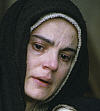

[Better than Average/5]
Smaller children most likely would have a hard time with “The Passion,” because it is extremely violent, just as Roman flogging, scourging, and crucifixion were extremely violent. It isn’t a “nice” experience, but it is a heart-breaking, life-changing experience.
If memory serves me correctly, these words appeared on the opening screen:
If you want a “feel good” film, stay at home. If you want to gain a much better understanding of just how much Jesus suffered for our sins, see the movie.“But because of our sins he was wounded,
beaten because of the evil we did.
We are healed by the punishment he suffered,
made whole by the blows he received” —Isaiah 53:5 GNB
[Excellent!/5]
Editor’s Response— We agree that it is the duty of true followers of Christ to share their faith with others. If you need some help and tips on how to be effective, see our Effective Evangelism section
[Excellent!/4]
For those concerned about children seeing this, I will reveal this. When the Roman soldiers scourged Him with the cat of nine tails, you actually saw His flesh being torn to shreds. And they wouldn’t stop flailing Him, either. They just kept going and going and going and going. Likewise, after Judas realized what he had done, you see him being tormented by children—who turn out to be demons, who reveal themselves as such. The rope he hung himself with came from a dead, decaying animal. Gross? Yes. Symbolic? Most definitely yes.See all »
[Good/5]
For those who are of appropriate age and can endure 100 minutes of pure torture out of only 126, with only short flashbacks to serve as relief, this will be the most important movie you have ever seen. After the screening was over, no one in the theater knew how to react—do you applaud? Cry? Go get coffee? What? I couldn’t, and still can’t decide. I think this film’s power will be lost on many, though, as such things always are; people seem to miss that the point of this movie is not to preach the message of God’s love spread by Christ, but to show the price he paid for spreading it. If you want the full experience, read his teachings before you enter the theater, but otherwise, do not complain that the movie was too much blood and not enough blessing.
I can’t say that I enjoyed this movie. All I can say that you should see it…
[Extremely Offensive/5]
This Jesus who belongs to ALL THE WORLD. This Jesus who never hurt a single person. This Jesus who was sinless took on our sins and paid the price for them all. Everyone’s sin that ever was committed, and ever will be committed. All ugly, dark, monstrous sin through all time. If those sins were to be made visible, they would be that bloody, ripped, torn, battered, unrecognizable body of Jesus depicted in Mel Gibson’s “The Passion of The Christ.” See all »
[Better than Average/5]
I cried from the very beginning in the garden to the very end where he leaves the tomb, not out of fear but out of shame and love for my Savior. Shame that it was me that put Him on that cruel cross, not the Jews, and love because I know of no one who would have done that for me except Jesus! Mel Gibson has done a wonderful thing in presenting Jesus to the world. He has stored his treasures in heaven and I for one will never ever be the same again. God bless this man and all those who will be changed and saved because of his movie.
[Excellent!/5]
…This subtitled film craftily weaves flashbacks to earlier periods in the life of Jesus. Through these episodes, viewers gain a deeper meaning to who this person known as Jesus of Nazareth really was. Viewers also understand more fully his torments, his relationships, and his message to humanity. It has been said that this is a story that transcends languages, and that is most definitely the case with Gibson’s version. Filmed entirely in the Aramaic and Latin languages, viewers are transported to a time and a place with such vivid realism that one could imagine a CNN ticker crawling across the bottom of the screen, while witnessing life unfold before their very eyes. See all »
[Excellent!/5]
After seeing the film I’d have to say that any worries about negative portrayals are misplaced. After some research I’d even come to realize that most of the people who are worried about it are Christian themselves and the Jewish community at large is rather supportive of the film. Throughout the film, one could clearly see that the motives of the Jewish people are understandable. I’d think that people would be more concerned about how the film portrays the Romans. See all »
[Excellent!/4]
I think Mel Gibson knew what he was doing, and I think he drew the line just at the right spot. Jesus died for our sins, and it was ALL of our sins that killed him. Everything you see up there on the screen he did for us, so that we could spend eternity with Him. As it was said in the movie, there is no greater love than for a man willing to lay down his life for his friend. I strongly urge anyone of age to see this movie. However, I don’t feel that it is for younger kids because of the violence, and I’m not quite sure they’ll understand it all. I am very pleased with the work of Mel Gibson, and I thank him for having the strength, conviction, and will power to make this film. This one will definitely be remembered.
[Average/5]
The anti-Semitism charge was always weak, even when influential rabbis and Catholic bishops expressed concern about the content of the film script. Today’s anti-Semitism does not spring from the Christian gospel. One need only look to Europe, let’s say to its more “sophisticated” cities to see what happens when Christianity loses ground to secularism. Anti-Semitism does not decline or disappear. It certainly hasn’t disappeared from the placards that are carried by elite demonstrators in the streets of Paris, or from the books that appear on Le Monde’s best seller list. It is not John’s gospel or old passion plays or “the religious right” that are fostering the latest waves of anti-Semitism. See all »
[Excellent!/4½]
[Excellent!/5]
[Excellent!/5]
[Excellent!/5]
I do not think that this film will convict a non-believer of the truth of the gospel, but I do believe that it will affirm the faith of one who is already convicted, and I also believe that it will convict those who know the story, but have not yet committed their lives to Christ. Having said that, I have to tell you this—I have an agnostic friend who asked me about the movie, and he sat and listened intently to my review, and then allowed me to present the gospel story to him. So maybe it will have an effect on non-believers. It at least has one listening.
For those who call the movie brutally violent, I just don’t understand you. Having done much study on the topic of crucifixion, I actually believe that this movie understates the violence found in such a scourging and death. Amazing, I wrote three whole paragraphs on a movie that truly left me speechless. Go see it for yourself, form your own opinion. Now.
[Excellent!/5]
See:
► “How did Jesus die? Learn the facts!”
► Viewer’s medical authenticity comment below
► What is crucifixion?
[Excellent!/5]
[Excellent!/5]
[Excellent!/5]
[Excellent!/5]
[Excellent!/5]
[Excellent!/5]
[Excellent!/5]
[Excellent!/5]
[Excellent!/5]
[Excellent!/5]
[Excellent!/5]
The other scene that made me cry was when the thief next to Christ asked him to remember him when he comes into his kingdom. All in all, a very wonderful film. My only complaint is that the ending was way too short. The hope of every Christian is the resurrection of Christ, and I thought that Mel Should have spent some more time on it. However, The brief ending, coupled with Mel Gibson’s comments that he wishes to make more religious films leads me to believe that Gibson might make a “sequel” to the Passion. But it is just a guess, anyway, GO SEE THE MOVIE!
[Excellent!/5]
The Jewish community is up in arms saying that the movie vilifies them as the ones who killed Christ. May I be so bold as to say that nobody “killed” Christ. Christ did not die by the hands of man. Christ died, and subsequently rose again, as a part of God’s plan. Jesus knew from the get-go that this was going to happen. However, he knew that his crucifixion was inevitable.
[Extremely Offensive/5]
This movie affected me in many ways. It made me want to dig into the Word straight away which I have been doing since I left the theater. I don’t think anyone can see this movie and not be affected, wherever you are spiritually. If you are a lukewarm Christian, be prepared to be convicted. None of us will ever feel like we can do enough for our Lord after seeing this film. You will also leave asking yourself, “where do I go from here, what now?” My husband and I both thought this and so I believe the Church needs to be there to answer those questions to all the saved and lost that will see this movie! It left me with an intense urge to share the good news with all and do whatever I can, even though I have been hearing my pastor preach this in church. When you feel like you’ve been an eye witness you can’t help but want to run and tell the world. See all »
[Excellent!/5]
MOST IMPORTANT, this is a movie about JESUS, not about persecution of the Jews. Why do we allow the Anti-Defamation League, Mr. Abraham Foxman, et al to steal the discussion and make it all about anti-semitism? Are we afraid to say, “Jesus”?
This is a Roman Catholic movie rather than a biblical movie. The basis of the movie is the 14 stations of the cross, each of which are shown, to the exclusion of important biblical events… “there’s no time to include eevvvry-thing!”
a) Mary senses through the floor stones where Jesus is imprisoned.
b) Mary and Mary Magdalene mop up His precious blood after the flogging.
c) Veronica and the face cloth
d) Mary and the cup on the Via Dolorosa
e) “Mother, behold, I make all things new” (taken from Rev. 21:5).
f) Peter, kneeling before Jesus’ mother, begs for forgiveness and restoration.
What happened to:
…the young man in the garden who fled naked when a soldier grabbed the linen cloth wrapped around him?
…the cock crow after Peter’s denial of Jesus?
…the interrogation by Annas, the father-in-law of Caiaphas (John 18:19-24)?
…the supernatural darkening of the sun from noon until Jesus died? That wasn’t storm clouds, it was the SUN (Amos 8:9; Luke 23:44,45).
…the priests blowing the 3 silver trumpets at the slaughter of the Passover lambs, at about 3 p.m., the same time that Jesus died?
…”His blood be upon us, and upon our children!” (Mt. 27:25). (We know: the ADL censored the caption.)
[Better than Average/4]
I felt the cinematography in general was excellent. I forgot about the subtitles. I was “there.” My heart was so touched, not only by Christ’s sacrifice, but by the scenes that showed the agony of Peter after the denial, the “flashbacks” to Jesus’ childhood of Jesus’ mother, Mary, and the faithfulness of Mary Magdalene and John the Apostle. See all »
[Excellent!/4½]
[Excellent!/5]
[Excellent!/5]
[Excellent!/5]
I was literally unable to walk following this movie. The emotional impact is like nothing I have ever experienced before. I am glad I was with my husband or I am not sure I would have been able to drive home afterward! It still amazes me though how some cannot connect the torture that Christ bore with the Christian message of His love. They go hand in hand and cannot be separated.
As for the criticisms that those viewing the movie get no context as to why Christ is being tortured, my response is simply this: Gibson’s purpose is in the title: the PASSION of the Christ—His suffering. For those not familiar with the rest of the story I say grab a Bible and find out. Let the alleged lack of context be your gateway to God’s Word. See all »
[Good/5]
[5]
I felt sick to my stomach pretty much the whole time. There were times when I had to turn away from the screen. Especially during the flogging, during Judas’ suicide, and also as the nails were being pounded into His hands and feet. I didn’t get much sleep after seeing this movie because every time I closed my eyes, I saw Jesus being mercilessly beaten and covered with blood. I got pulled in and forgot I was watching a movie. I felt like I was actually watching the Crucifixion of my Lord and Savior. I was moved to tears several times. See all »
[Good/5]
If He wouldn’t of done this, then it would have been us. When he was whipped, it wasn’t the Romans or the fault of the Jews that he was whipped. That was us, our sins, our iniquities. Throughout this movie, stop looking at the actors, or how violent this movie is. Instead, be thankful that because of everything he went through, he did it for love and he thought of everyone. The movie showed the last moments of His life while heading to the cross. However, now that He lives in us, show the world the Christ they long to see, the one that lives in us, and makes things new because he loves…
[Excellent!/5]
[Excellent/5]
The part that had the greatest effect on me was when Jesus cried out,
“Father, why has thou forsaken me?”In that moment I realized that Christ felt every pain and that God didn’t spare Him because He was His son. That was powerful for me.
Go and see this movie. You will never forget it and you will never feel more loved than you will when you walk out of the theatre. This is the only movie I have ever seen where the only sound you hear is sobbing and people don’t even speak when they leave the theatre. It is that powerful. Thank you, Jesus.
[Excellent!/5]
[Good/5]
All of that aside, I have a few things to say about all of the NEGATIVE reviews that I have read on this site. Why is this? Can we as Christians resort to being prudes about the violence in the film?! The crucifixion was not some G rated event. This was a horrific thing that happened. The violence has a purpose. The R rating is there for a reason. To say that you feel “convicted” over going to see this just can’t be possible.
How can a film about Christ give you that feeling of conviction? Simply can’t happen as far as I’m concerned.
Another thing: I read complaints about children apparently being horrified by the violence. This film IS rated R. They have no business being there in the first place. It’s something that we like to call “responsible parenting.” That’s why we have the ratings system …We as Christians should be promoting this film like no other. It’s a magnificent acheivement. Please, ignore the negative, and go support this, because we may never see another film like it.
[Excellent!/5]
[Excellent!/5]
To me, the sky did not fall black enough or fast enough on his death, the ending temple scene was not pronounced nor the people moved to enough to realization of what they had done. And the power of His resurrection was limited to him getting up and walking across the screen in less than 10 seconds. Christ is certainly the center focus of the movie and rightly so. See all »
[Good/3½]
[Average/3]
As for His demise on the cross, this also lacked the realism that I as a medical professional know to be true and had hoped would finally be there given the skills of movie makers in this century. First, the old story line of the nails actually being driven into His hands is false. When a person is crucified as the Romans did it, their death is from asphyxiation. Meaning to say that in the position of the person being crucified on the cross, the only way to be able to breathe, exhale that is, is by lifting and pulling oneself up. Then to inhale only requires the person to relax.“But He was wounded for our transgressions, he was bruised for our iniquities; the chastisement for our peace was upon Him, and by His stripes we are healed. —Isaiah 53:5 NKJV
This pulling at the nails in their hands would of ripped the skin and they would simply fall off the cross. The nails were actually driven into their wrists, and thus lock the hand in place, and not allow it to tear away. See all »
[Excellent!/1]
Editor’s Response—We agree that the movie’s depiction of the physical suffering of Christ is NOT medically accurate. The reality was actually much worse than the movie portrays. See:
There were too many missing pieces for this movie to stand alone. As a Christian, the flashbacks symbolized precious truth to me, but I think it would be very confusing for a non-Christian. I don’t think this is a great evangelistic tool, because I would have a hard time encouraging someone to sit through this graphic a film if they don’t have the relationship to connect with Christ’s suffering for them. I don’t want to limit the Spirit, but I’m just not sure about this.
[Better than Average/5]
[Average/4]
But, this time, the Father, …has turned away. Turned away from Jesus. He cried “Eloi, Eloi, lama sabach tani.” Jesus tasted our death for us. This point is not being driven strongly by the movie… Also, the devil scene is very disturbing to me, that is just plainly not in the same spirit as the gospel. The devil fears Jesus. The devil is just purely the fallen angel, it is still subject to the authority of the Son of Man… A better movie would be “The Gospel of Matthew” and “The Gospel of John” by the “Visual Bible” production, and also “THE HOPE” in which you can view from this Web site… We as Christians have to go out and share these four points to others. See all »
[Average/5]
I went to the movie expecting a huge spiritual revelation, as one who seeks to love her King and Savior with a passion. Instead, I felt like He was not glorified as He should have been, sold short of what He did for us, for me. And most of all disturbed that His Father was not glorified. In John 17, Jesus’ high priestly prayer is that His being glorified will glorify God the Father, because He did what God had Him come to Earth to do. Instead, I feel like Mary got glorified and even Satan to a certain extent.
I’ll skip recommending this movie believers and non-believers alike. The power of seeing a realistic portrayal of our Lord’s suffering on our behalf is overshadowed by mysticism that detracts from giving glory to the Father.
[Excellent!/5]
[Extremely Offensive/3]
I am sick from having seen this… Christians are bringing in their own mindsets that tell them this is good, but as a Christian myself, I found this terrible and well try and persuade anyone who will listen to me to avoid seeing this movie.
[Extremely Offensive/1]
[Average/2½]
[Very Offensive/3]
[Excellent!/5]
Moral rating: Extremely Offensive / Moviemaking quality: ½
[Excellent!/5]
[Excellent!/5]
[Excellent!/4½]
[Excellent!/5]
[Excellent!/5]
[Good/5]
[Good/5]
[Excellent!/5]
[Excellent!/5]
Satan was portrayed to be very evil and so unnerving that every time he was on the screen I would cringe just at the sight of him. He looks so sinister in the movie and I have no doubt that he is as bad if not worse than he is portrayed. Bottom line is that this movie is so amazing that I hope it does really well in the theaters and a lot of people buy it when it comes to video. (I know I will)
[Excellent!/5]
[Excellent!/5]
This movie is bloody, but not too gory, the only gory thing you see is when (brace yourself for this one) the “cat of nine tails” slashed into his skin and ripped off a large chunk, exposing his ribs. Now, if you see the movie, you will say “any normal person would of easily died” that is true, but Jesus was not an ordinary person, mind you! God waited for the right moment to take him into his kingdom, but only to rise again on the third day! Bring anyone (if you want to) ages 12+ up, because of the blood, because youngsters will take it wrong, and also not comprehend what Jesus went through… it is the best movie ever made, it moved me, it touched me, and it was an excellently made movie!
[Excellent!/5]
[Good/5]
[Excellent!/5]
None of these accusations are true. The purpose, I think, of Gibson’s film is not to teach us the Gospel. In fact, the entire presupposition of the movie is that we are already familiar with them, so Gibson doesn’t have to spend time putting all that into film. We can get that quite easily from our Bibles. Gibson’s goal is to give us an idea of just what our Savior suffered because of his love for us. We all know that Jesus was crucified to cleanse us from our sins, but we never really give much thought to just what that entails. We just assume that it was hard, painful, but necessary. We never take the time to consider the utter horror of the crucifixion, including the psychological and spiritual pressure. Even after having seen the film, I don’t think any of us can truly understand just how much Christ suffered for us. However, The Passion gives us at least some idea. It was a sobering experience, and it made me think about a lot of things I had never given much consideration. See all »
[Excellent!/4]
[Excellent!/5]
[Excellent!/5]
[Excellent!/5]
[Excellent!/5]
I really like this movie, and I would like to everyone who hasn’t seen it yet just to go, they won’t regret it. Just one thing, when you go to see it—take LOTS of tissue, you will need it:)
[Excellent!/5]
[Good/5]
[Good/4]
This is a very beautiful, but very intense movie of the last hours of Christ. My family watched this on Good Friday, partly to help us contemplate on the Passion and Sacrifice of Jesus, and believe me, it helped. It really puts into perspective how much God loves us and what He was willing to do for us to save us from our sins.See all »
Moral rating: Excellent! / Moviemaking quality: 5
Editor’s Response—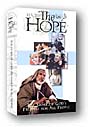 We agree that “The Passion…” does not provide a clear presentation of the Gospel. To learn the rest of the story of Jesus—or to share it with your friends—read the Bible and view the excellent Mars Hill video production, The HOPE. This high-quality, new motion picture superbly explains the rest of the story about Christ, and puts everything into context and perspective—beginning with the original creation of Paradise, mankind’s fall to sin, and God’s story of redemption which began thousands of years ago continues through Christ’s death and resurrection, and beyond. Share our special Web address with your friends: TheHopeVideo.com.
Description of THE HOPE.
Also see: Why start with CREATION and then proceed CHRONOLOGICALLY when teaching the Gospel?