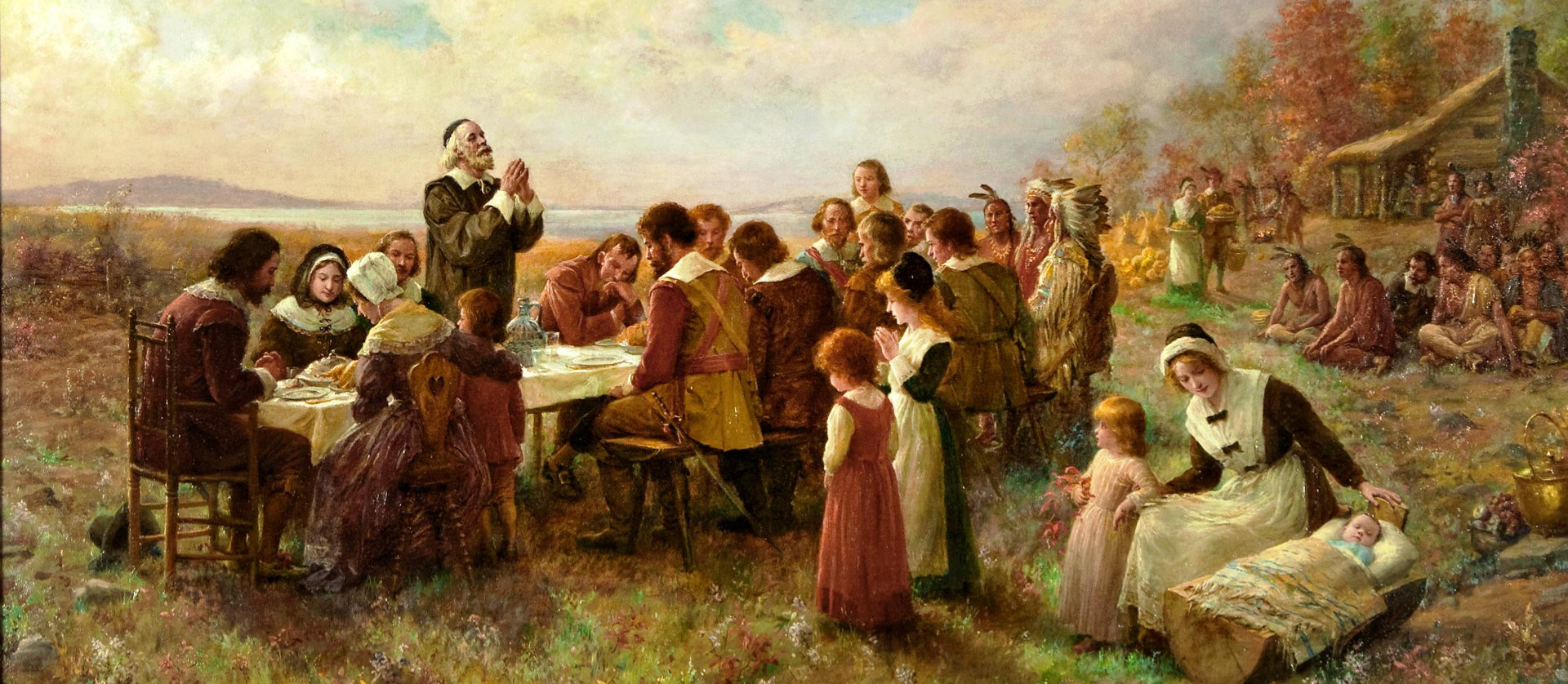
What is the origin of America’s annual Thanksgiving Day?
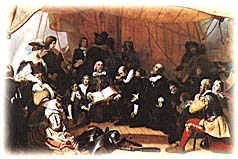
The Pilgrims left Plymouth, England, on September 6, 1620. Their destination? The New World. Although filled with uncertainty and peril, it offered both civil and religious liberty.
For over two months, the 102 passengers braved the harsh elements of a vast storm-tossed sea. Finally, with firm purpose and a reliance on Divine Providence, the cry of “Land!” was heard.
Arriving in Massachusetts in late November, the Pilgrims sought a suitable landing place. On December 11, just before disembarking at Plymouth Rock, they signed the “Mayflower Compact”—America’s first document of civil government and the first to introduce self-government.
 After a prayer service, the Pilgrims began building hasty shelters. However, unprepared for the starvation and sickness of a harsh New England winter, nearly half died before spring. Yet, persevering in prayer, and assisted by helpful Indians, they reaped a bountiful harvest the following summer.
The grateful Pilgrims then declared a three-day feast, starting on December 13, 1621, to thank God and to celebrate with their Indian friends. While this was not the first Thanksgiving in America (thanksgiving services were held in Virginia as early as 1607), it was America’s first Thanksgiving Festival.
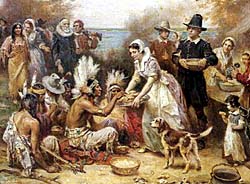 Pilgrim Edward Winslow described the Pilgrims’ Thanksgiving in these words:
“Our harvest being gotten in, our Governor sent four men on fowling [bird hunting] so that we might, after a special manner, rejoice together after we had gathered the fruit of our labors. They four in one day killed as much fowl as… served the company almost a week… Many of the Indians [came] amongst us and… their greatest King, Massasoit, with some ninety men, whom for three days we entertained and feasted; and they went out and killed five deer, which they brought… And although it be not always so plentiful as it was at this time with us, yet BY THE GOODNESS OF GOD WE ARE… FAR FROM WANT.”
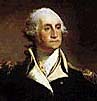
In 1789, following a proclamation issued by President George Washington, America celebrated its first Day of Thanksgiving to God under its new constitution. That same year, the Protestant Episcopal Church, of which President Washington was a member, announced that the first Thursday in November would become its regular day for giving thanks, “unless another day be appointed by the civil authorities.” Yet, despite these early national proclamations, official Thanksgiving observances usually occurred only at the State level.
Much of the credit for the adoption of a later ANNUAL national Thanksgiving Day may be attributed to Mrs. Sarah Joseph Hale, the editor of Godey’s Lady’s Book. For thirty years, she promoted the idea of a national Thanksgiving Day, contacting President after President until President Abraham Lincoln responded in 1863 by setting aside the last Thursday of November as a national Day of Thanksgiving. Over the next seventy-five years, Presidents followed Lincoln’s precedent, annually declaring a national Thanksgiving Day. Then, in 1941, Congress permanently established the fourth Thursday of each November as a national holiday.
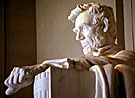 Lincoln’s original 1863 Thanksgiving Proclamation came—spiritually speaking—at a pivotal point in his life. During the first week of July of that year, the Battle of Gettysburg occurred, resulting in the loss of some 60,000 American lives. Four months later in November, Lincoln delivered his famous “Gettsysburg Address.” It was while Lincoln was walking among the thousands of graves there at Gettysburg that he committed his life to Christ. As he explained to a friend:
When I left Springfield [to assume the Presidency], I asked the people to pray for me. I was not a Christian. When I buried my son, the severest trial of my life, I was not a Christian. But when I went to Gettysburg and saw the graves of thousands of our soldiers, I then and there consecrated myself to Christ.
As Americans celebrate Thanksgiving each year, we hope they will retain the original gratefulness to God displayed by the Pilgrims and many other founding fathers, and remember that it is to those early and courageous Pilgrims that they owe not only the traditional Thanksgiving holiday but also the concepts of self-government, the “hard-work” ethic, self-reliant communities, and devout religious faith.
More information
- Why do Americans celebrate Thanksgiving? Answer for children
- What should we thank God for, and how should we praise Him? Answer
- Are YOU thankful to God? See what the Bible has to say about thanksgiving. Post your thanks to encourage others.
- Read Abraham Lincoln’s inspiring Thanksgiving Proclamation
- Issues related to government and God
Author: David Barton of WallBuilders. Photos supplied by Christian Answers. Article used with permission. Copyright © 1998, 1999, 2001, WallBuilders, Inc., All Rights Reserved—except as noted on attached “Usage and Copyright” page that grants ChristianAnswers.Net users generous rights for putting this page to work in their homes, personal witnessing, churches and schools.
