What kind of cross was Jesus crucified on?
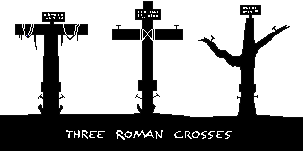
Pictured are three types of crosses commonly used by the Roman army in the first century A.D. Each carried an inscription stating the victim's capital offense and a seat-like projection, not designed for the victim's comfort, but to prolong their agony. Nails and ropes held the victim's legs and arms in place.
The cross on the left was called a “high tau” cross because it was shaped like the capital Greek letter tau (“T”). The middle cross was known as a “low tau” cross, shaped like the lower case tau (“t”). In both cases the central post was generally set permanently in the ground while the cross bar was carried to the site by the victim. The cross on the right was an actual tree still in the ground (dead or alive) with its limbs serving as the cross bar. Jesus was probably crucified on a “low tau” type cross.
“For what I received I passed on to you as of first importance; that Christ died for our sins according to the Scriptures, that He was buried, that He was raised on the third day according to the Scriptures” (I Cor. 15:3-4).
Further Information
What is crucifixion? Answer
Why do all four Gospels contain different versions of the inscription on the Cross?
How did Jesus die? Answer
Jesus Christ greatly humbled himself for us. How and Why? Answer
 Frequently-asked-questions about the death and resurrection of Jesus Christ
If Jesus is God, how could he die? If Jesus died on the cross, then how can he be alive today? Answer
Archaeology - Have any burial sites been found for the people involved in Christ's life and death? Answer
 JESUS CHRIST—Answers to frequently-asked-questions
Author: Provided by the Bible archaeology experts of Associates for Biblical Research. Drawing at top by Gene Fackler, Associates for Biblical Research
Copyright © 1995, Associates for Biblical Research, All Rights Reserved—except as noted on attached “Usage and Copyright” page that grants ChristianAnswers.Net users generous rights for putting this page to work in their homes, personal witnessing, churches and schools.