
Who is…
Diana
also known as: Artemis, Artimus, and numerous other names
Greek: Ἄρτεμις —transliteration: Artemis
This is the Roman name of a false goddess of ancient idol worshipers—a supposed daughter of Zeus and twin sister of Apollo. She was the Roman’s goddess of the hunt and wild animals, and a moon goddess.
Greeks called her Artemis. In Greek tradition, she is the daughter of Zeus and Leto, and twin sister of Apollo. Numerous myths were concocted about her powers, exploits and influence. Her symbols included the bow, quiver, deer or hound companions.
This supposed “great” goddess was worshipped and sacrificed to among heathen nations under various names. She was both loved and feared. Despite any attractive ancient depictions of her, ultimately there was likely a demonic being behind this false goddess which promoted her in the minds of men and women.
Artemis was one of the most widely venerated of the Ancient Greek deities; her worship spread throughout ancient Greece, with her multiple temples, altars, shrines, and local veneration found far and wide.
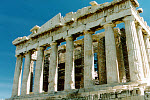
The Temple of Artemis at Ephesus (Artemision) was one of the Seven Wonders of the Ancient World, before it was burnt to the ground. Here she was worshipped as the equivalent of Mother Nature and typified fertility. Her temple here was the most admired and was built outside the city walls. It was a massive pilgrimage site with her statue bizarrely depicting many breasts emphasizing her fertility/motherhood aspects. Annual festivals included month-long celebrations (extended under Roman rule), processions, sacrifices, competitions, drama, music, dancing, and mysteries revealed to initiates (e.g., Kouretes).
The idol smiths of Ephesus shouted “Great is Artemis of the Ephesians!” when they rioted against the Apostle Paul.
For a man named Demetrius, a silversmith, who made silver shrines of Artemis, was bringing no little business to the craftsmen; these he gathered together with the workers of similar trades, and said, “Men, you know that our prosperity is from this business. And you see and hear that not only in Ephesus, but in almost all of Asia, this Paul has persuaded and turned away a considerable crowd, saying that things made with hands are not gods. And not only is there danger that this trade of ours fall into disrepute, but also that the temple of the great goddess Artemis be considered as worthless and that she, whom all of Asia and the world worship, is even about to be brought down from her majesty.” —Acts 19:27
“First and last it was the work of 220 years; built of shining marble; 342 feet long by 164 feet broad; supported by a forest of columns, each 56 feet high; a sacred museum of masterpieces of sculpture and painting. At the center, hidden by curtains, within a gorgeous shrine, stood the very ancient image of the goddess, on wood or ebony reputed to have fallen from the sky. Behind the shrine was a treasury, where, as in ‘the safest bank in Asia,’ nations and kings stored their most precious things. The temple as St. Paul saw it subsisted till 262 AD, when it was ruined by the Goths” (Acts 19:23-41). —H.C.G. Moule, The Epistle to the Ephesians: With Introduction and Notes (University Press, Cambridge: 1888)
Artemis was worshipped as one of the primary goddesses of marriage, childbirth and midwifery along with Eileithyia and Hera. There were initiation rites for girls. She was also a supposed patron of healing and disease and believed to send both good health and illness upon women and children. One supposedly needed to appease her for anything that brought her outrage.
Many festivals throughout Greece mainland and the islands, Asia Minor and south Italy honored Artemis and worshipped. The Dorians worshipped her in an orgiastic cult with lascivious dances. In ancient Laconia (Lakonia) in Greece, she was celebrated with hymns and an obscene dance called callabis. Young women transitioning from childhood to adulthood were featured worshipers during her festivals.
Artemis is also known as the leader of the nymphs, and she supposedly hunted surrounded by them.
The Sanctuary of Artemis at Brauron (Attica, Greece) focused on girls’ transition to womanhood. Young girls (ages 5–10) served as “little bears” (arktoi) in the Arkteia rite, involving year-long service, dancing in saffron robes, processions, and goat sacrifices.
Grove of Diana Nemorensis at Lake Nemi (Aricia, near Rome) was an iconic Roman site to her worship. There was an open-air grove with a unique priest (rex nemorensis), a runaway slave who held office until slain by a challenger. This site was also associated with Egeria (childbirth guardian) and Virbius.
The Temple of Diana on the Aventine Hill (Rome) was the oldest major Roman temple (traditionally 6th century BCE by Servius Tullius) and served as a federal shrine for the Latin League and supposed protector of lower classes/slaves.
In Asia Minor, Artemis Pergaea had a temple on the high ground of the city of Perga where her annual pagan festival was celebrated.
Modern times
Diana is reportedly revered in modern neopagan religions including Roman neopaganism, Stregheria, and Wicca. Folklore attached to her developed and was eventually adapted into neopagan religions, the mythology surrounding Diana grew to include a consort (Lucifer) and daughter (Aradia).
More information
- Not to be confused with Dinah
 Answers about idolatry and false gods in the Bible and history
- Answers about idols in the Bible
- What is an idolatrous worshiper?
- Who is Demetrius?
- What is Ephesus and what happened there?
- worshipers
 Answers about Ancient Greece in the Bible
- Answers about Ancient Rome in the Bible
- Answers about the true God