
what is…
Capernaum
also known as: Capharnaum, Kfar Nahum, Kefar Nahum, Talhum
Meaning: Nahum’s town
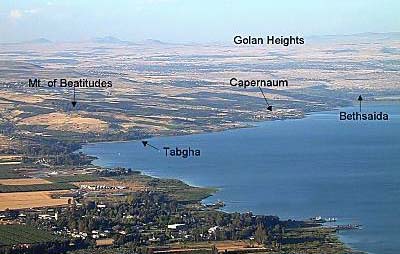
…Capernaum …You will descend to Hades; for if the miracles had occurred in Sodom which occurred in you, it would have remained to this day. Nevertheless I say to you that it will be more tolerable for the land of Sodom in the day of judgment, than for you. —Matthew 11:23-24 excerpt
Capernaum was a large Galilean fishing village and busy trading center. This place is of special interest to Christians because of its frequent mention in the history of Jesus Christ. Peter, Andrew, James and John also lived here. It played a unique and important part in Christ’s life and ministry, and in his outreach to the people of Israel. The inhabitants of Capernaum, including various high ranking citizens, were given unique and abundant opportunities to hear Jesus Christ’s message firsthand and witness His awesome power and love.
Location
2½ miles (4 km) from the Jordan River, Capernaum stood on the northwestern shore of the Sea of Galilee (modern Lake Kinneret, which the Bible also called the lake of Gennesaret, Sea of Chinnereth and the Sea of Tiberias). The ancient city of Capernaum was abandoned about a thousand years ago or more, and was rediscovered by archaeologists beginning in the 1800s. In modern times, it is called Kefar Nahum (Hebrew) and Talhum (Arabic).
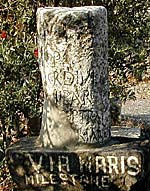
The Gennesaret area was one of the most prosperous and crowded districts of Israel. Capernaum lay on the great Via Maris highway between Damascus (Syria) and Caesarea Maritima on the Mediterranean Sea, and between Tyre and Egypt. Customs taxes were collected from travelers at this crossroads (Matthew 9:9). This was the job of Levi, the tax collector, who became Christ’s disciple and was later named Matthew. Jews criticized Jesus for befriending him and other tax collectors.
Caravans stopped at Capernaum to resupply themselves with produce and dried fish. At the lake shore, where Peter and other fishermen worked, archaeologists discovered a fish sales area.
This well-built structure measured 2 meters in width and 5 meters in length and contained two large, rather shallow, semicircular pools, one at each end, with a rectangular platform in the middle on which, presumably, the fish were cleaned and sold… The two pools had a thick coat of watertight plaster. —Herold Weiss, “Recent Work at Capernaum,” Bible and Spade, Vol. 10, No. 1 (Associates for Biblical Research, 1981), p. 24.
After our Lord’s expulsion from Nazareth (Matthew 4:13-16; Luke 4:16-31), Capernaum became his “own city.” It was the scene of many acts and incidents of his life (Matthew 8:5, 14,15; 9:2-6, 10-17; 15:1-20; Mark 1:32-34, etc.).
Synagogue
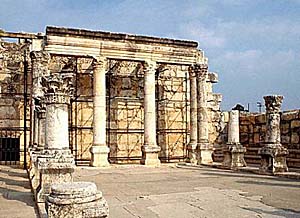
The Bible tells us that a Roman centurion built a synagogue here for the Jews (Luke 7:1-5). His servant was later healed from severe palsy by Jesus (Matthew 8:5-13; Luke 7:1-10). The remains of what must have been a beautiful basalt synagogue has been discovered by archaeologists. As expected for such a sacred building, it was found at the highest point in town.
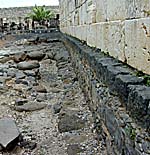
This is the synagogue where our Lord frequently taught (John 6:59; Mark 1:21; Luke 4:33). Here, Jesus cured a demon-posssed man (Mark 1:21-28) and delivered the sermon on the bread of life (John 6:25-59). He even restored the life of the daughter of one rulers of this synagogue (Mark 5:22; Luke 8:41).
The synagogue is near the lake, and is built so that when the Jews prayed here, they faced Jerusalem. It was destroyed along with Jerusalem’s temple, around 70 AD. Many years later, it was replaced with a white stone synagogue (perhaps 250-300 AD.) (shown above).
Peter’s House
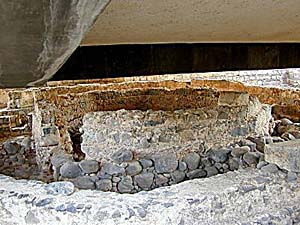
Only a few hundred feet from the synagogue, the stone house of the disciple Peter has also been found at Capernaum. This is where Jesus healed Peter’s mother-in-law and others (Matthew 8:14-16). Jesus may have lived with Peter while staying in Capernaum. In the years following Jesus' death and resurrection, the house apparently became a house-church.Centuries later, Christians honored the site by building a church here. It was destroyed in a later conquest of the city. Archaeologists have excavated both the church and the earlier house below. Stanislao Loffreda reported,
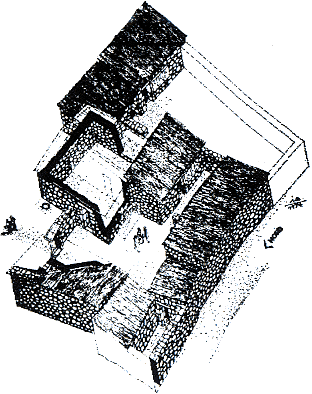
Literary sources and recent archaeological discoveries make the identification of the house of St. Peter in Capernaum virtually certain.
The house was built at the very end of the Hellenistic period (1st century BC). In the second half of the 1st century AD some peculiar features set apart this building from all the others so far excavated in Capernaum. Here, in fact, the pavements received floors of lime several times. Interesting enough, many pieces of broken lamps were found in the thin layers of lime. …131 inscriptions were found. They were written in four languages, namley: in Greek (110), Aramaic (10), Estrangelo (9), and Latin (2).
The name of Jesus appears several times. He is called Christ, the Lord, and the Most High God. An inscription in Estrangelo mentions the Eucharist.There are also symbols and monograms, namely: crosses of different forms, a boat, the monogram of Jesus. The name of St. Peter occurs at least twice: his monogram is written in Latin but with Greek letters. In another graffito St. Peter is called the helper of Rome. A third inscription mentions Peter and Berenike. This Peter, however, might be the name of a pilgrim. On several hundred pieces of plaster, decorative motifs appear.
The colors employed are: green, blue, yellow, red, brown, white and black. Among the subjects one can distinguish floral crosses, pomegranates, figs, trifolium, stylized flowers and geometric designs such as circles, squares, etc.
…At the beginning of the 5th century, the house of St. Peter was still standing, but it had been previously changed into a church. This we learn from Eteria, a Spanish pilgrim, who wrote in her diary:
“In Capernaum, the house of the Prince of the Apostles (= St. Peter) became a church. The walls, however, (of that house) have remained unchanged to the present day.” —Stanislao Loffreda, “Caperaum—Jesus' Own City,” Bible and Spade, Vol. 10, No. 1 (Associates for Biblical Research, 1981), pp. 12, 7-8.
Mary, the mother of Jesus, made her way to Capernaum with her other sons (Matthew 12:46, 48-49). It was here that Christ uttered the memorable words, “Who is my mother? and who are my brethren? And he stretched forth his hand toward his disciples, and said, Behold my mother and my brethren!”
Miracles of Christ in Capernaum
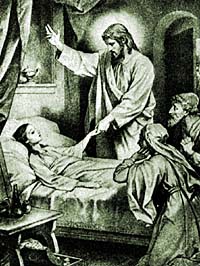
Partial list…
Cast evil spirit from a man in the local synagogue on the Sabbath (Mark 1:21-28; Luke 4:33-36) and the demon confessed “I know thee who thou art; the Holy One of God.” (Luke 4:34)
Simon’s mother-in-law instantly healed on the Sabbath of a serious fever and then she immediately helped serve Simon’s guests (Luke 4:38-39)
All the sick of Capernaum came to Simon’s house after the end of Sabbath (sunset), and all were healed by Jesus (Luke 4:40-41), as “all the city was gathered together at the door” (Mark 1:29-34)
Demons cast out of many people, and the devils confessed that Christ is the Son of God (Luke 4:41)
Paralyzed man let down through the roof and instantly fully healed (Mark 2:1-12)
Jesus caused 4 of disciples to catch fish in a miraculous way (Luke 5:1-11)
Through a fish, Jesus supplied tribute tax money needed by Peter (Matthew 17:24-27)
Healing of the centurion’s servant afflicted with palsy (Matthew 8:5-13)
Healing of the son of a nobleman in the King’s court (Herod Antipas) (John 4:46-54)
Despite the unique number of evidences our Lord presented to them, most of the people of Capernaum lacked faith in Him and remained unrepentant disbelievers. Because they turned so strongly away from the uniquely gracious light given, they were strongly judged.
“For unto whomsoever much is given, of him shall be much required…” —Luke 12:48
Thus, along with nearby Chorazin and Bethsaida, Capernaum received a very stern warning from Jesus (Matthew 11:21-24).
“It shall be more tolerable for the land of Sodom in the day of judgment, than for thee.”
Ultimately, the cities were all destroyed, and Capernaum became virtually uninhabited ruins for centuries.
Today, Capernaum’s inhabitants include a Greek Orthodox Church and a Franciscan Monastery.
Q & A
- What miracles are mentioned in the Bible?
- Christ’s miracles—Has science disproved the miracles associated with Jesus?
- Is it logical to believe that the biblical miracles really happened?
 About JESUS CHRIST—Answers to frequently-asked-questions
 What is the Sea of Galilee? and what is its significance in the Bible?
- What is Gennesaret?
- FISH—What does the Bible say about them?
- What does the Bible say about fishermen ?
- About the art of fishing in the Bible
- What is Bethsaida?
- What is Chorazin?
- Who is Peter? and what is his signifiance?
- Who is Andrew in the Bible?
- Who is Zebedee?
- Who is James in the Bible?
- Who is the Apostle John?
- Who is Cornelius?
- Who is Jairus?
- What is Nazareth?
- Who is the “Nobleman” mentioned in the New Testament?
- What is the Sermon on the Mount?
- What is Chorazin?
 What are the Cities of the Bible? Names, descriptions, locations and types
- About taxes in the Bible
- About taxing in the Bible
- About lime in the Bible
 Learn more about the discoveries of Bible archaeology