
The Graduate

Reviewed by: Brett Willis
CONTRIBUTOR
| Moral Rating: | Very Offensive |
| Moviemaking Quality: |
|
| Primary Audience: | Adults |
| Genre: | Romantic Drama |
| Length: | 1 hr. 46 min. |
| Year of Release: | 1967 |
| USA Release: |
December 21, 1967 |
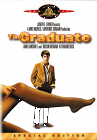


A disillusioned college graduate finds himself torn between his older lover and her daughter
Seduction of young man by a woman old enough to be his mother
What is sexual immorality?
Sexual lust outside of marriage—Why does God strongly warn us about it?
Is there a way to overcome illicit and excessive lust for sex?
Purity—Should I save sex for marriage?
Temptations—How can I deal with them?
Consequences—What are the consequences of sexual immorality?
What is SIN AND WICKEDNESS? Is it just “bad people” that are sinners, or are YOU a sinner? Answer

Learn how to make your love the best it can be. Christian answers to questions about sex, marriage, sexual addictions, and more. Valuable resources for Christian couples, singles and pastors.
HYPOCRISY IN THE CHURCH—“I would never be a Christian; they’re a bunch of hypocrites.”
What does the Bible say about HYPOCRITES?
| Featuring |
|---|
|
Anne Bancroft … Mrs. Robinson Dustin Hoffman … Ben Braddock Katharine Ross … Elaine Robinson William Daniels … Mr. Braddock Murray Hamilton … Mr. Robinson 22Elizabeth Wilson … Mrs. Braddock Buck Henry … Room Clerk See all » |
| Director |
|
Mike Nichols |
| Producer |
|
Lawrence Turman Lawrence Truman Productions |
| Distributor |
|
Embassy Pictures |
I first saw “The Graduate” in theatrical release in 1968 as a non-Christian, counterculture teen, and remember connecting strongly with its rebellious, anti-establishment message. The following year, shortly after I’d given my life to Jesus, I saw it again with a carload of my old friends; but it wasn’t the same at all. I had too much overflowing love in my heart to be anti-anything (except anti-sin), and I was annoyed at the film’s attempt to dictate my worldview and make me identify with an anti-hero.
Benjamin Braddock (Dustin Hoffman), just goofing off at home after graduating from college, is snared into an affair with next-door neighbor Mrs. Robinson (Anne Bancroft). She’s not interested in a real relationship, just wants sex with a young man (perhaps several young men) to help combat her feelings of loneliness and unattractiveness. But when Ben’s parents and Mr. Robinson arrange a date for Ben with Elaine Robinson (Katharine Ross), Mrs. Robinson is incensed—Ben is good enough for her but not good enough for her daughter.
Ben promises Mrs. Robinson that it’s just a formality, and at first he deliberately tries to sabotage the date by acting like a jerk. Somehow, he and Elaine not only salvage the date but begin to fall in love. To stop this, Mrs. Robinson threatens to tell Elaine everything. Actually she tells more than everything, falsely claiming that Ben raped her while she was drunk. Looks like it’s over; but both Ben and Elaine still care for each other, and eventually they reunite in very adverse circumstances.
Reviewers correctly identify this film (along with “Bonnie and Clyde”, which pioneered new special effects of violence and which manipulated its audience into sympathy with murderers and hatred of the Texas Rangers) as a turning point in American filmmaking. The use of French New Wave film techniques and anti-hero themes was exceptional when these two films were made, but by the early ’70s it became the norm rather than the exception and allowed Hollywood to start tapping deeply into the teenage market. These two films were also a major factor in forcing the creation of the MPA rating system.
Content warnings: mild by today’s standards but offensive in its theme. No actual nudity (though the DVD version may have some, see viewer comments below). Implied sex between Ben and Mrs. Robinson. In their first hotel room meeting, Ben touches Mrs. Robinson’s breast for a few seconds, then turns away and beats his head on the wall, ready to back out of what he’s about to do; but by questioning his manhood, Mrs. Robinson goads him into going through with it. In the date scene with Elaine, Ben takes her to a strip joint just to annoy her (the dancer is wearing stick-ons). No F-words (they weren’t allowed at that time), but plenty of other profanity. The tone is anti-upper class and anti-parents, implying that the younger generation must follow its own course in order to avoid becoming hypocrites like their elders.
The sarcastic theme song “Mrs. Robinson” by Simon and Garfunkel takes some potshots at Christianity itself.
Offensive content aside, this just isn’t a great story to begin with. The main “value” of this film is historical; it shows us the beginnings of a new cinematic style which has since been copied in untold numbers of other films, making studios rich while rotting the moral fabric of society.

Moral rating: Offensive / Moviemaking quality: 4
The one review states that the unedited version has full nudity, and this film should be clearly rated R. According to Wiki, many stars fought for the roles, but only Doris Day to her credit turned down her role for the right reasons. Hollywood stars wanted this movie. For them, adultery is common place, and there is really nothing wrong to them with practicing it. That is why divorce is so common among the Stars. This movie accurately portrays what is going on in the U.S. in society at that time. Adultery, Free Love, and Divorce were all starting to be accepted as normal in society.
Benjamin is concerned what Mr. Robinson or his parents would think about having an affair, but there is no mention of God. God sees our actions, and He has told us not to commit adultery. The Holy Spirit told me to turn the film off. I have seen many of the clips of this movie in my lifetime. The songs of Simon and Garfunkle, though beautiful sounding, contain references to drugs being fine (“Bridge Over Troubled Water”), adultery/darkness exalted (“The Sound of Silence,” and the song they wrote for this movie (“Mrs. Robinson”), clearly mocks our LORD and Savor Jesus Christ by name.
I agree with the reviews. A Christian should not see this movie. I even have a friend’s father that committed adultery, liking the song “The Sound of Silence” (played in the movie while Benjamin and Mrs. Robinson are having their affair), a “Christian”, and was divorced shortly after marrying the “Christian” woman he committed the adultery with.
A well acted movie, nice sounding songs, a wonderful job of Satan to get people to laugh at sin.