Flash of Genius
 for brief strong language.
Reviewed by: Kelye Odell
CONTRIBUTOR
| Moral Rating: | Average |
| Moviemaking Quality: |
|
| Primary Audience: | Adults |
| Genre: | Biography History Drama |
| Length: | 2 hr. 10 min. |
| Year of Release: | 2008 |
| USA Release: |
October 3, 2008 (1,000 theaters) DVD: February 17, 2009 |



Anxiety and Worry… What does the Bible say? Answer
Are there biblical examples of depression and how to deal with it? Answer
What should a Christian do if overwhelmed with depression? Answer
How do I know what is right from wrong? Answer
How can I decide whether a particular activity—such as smoking, gambling, etc.—is wrong? Answer

| Featuring |
|---|
| Greg Kinnear, Alan Alda, Dermot Mulroney, Jake Abel, Aaron Abrams, London Angelis, Dylan Authors, Warren Belle, Grant Boyle, Ashton Doudelet, Tim Eddis, Andrew Gillies, Lauren Graham, Josette Halpert, Tim Kelleher, Gavin and Ben Kuiack, Victoria Learn, Isaac Lupien, Tatiana Maslany, Duane Murray, Landon Norris, Shae Norris, Kate Parr, Mitch Pileggi, Simon Reynolds, Daniel Roebuck, Chuck Shamata, Bill Smitrovich, Kristian Truelsen, Steven Woodworth, Liam and Owen Wright |
| Director |
|
Marc Abraham “Children of Men” (Producer), “Dawn of the Dead” (Producer), “Air Force One” (Executive Producer) |
| Producer |
| Intermittent Productions, Spyglass Entertainment, Strike Entertainment, Universal Pictures, Gary Barber, Roger Birnbaum, Thomas A. Bliss, J. Miles Dale, Jonathan Glickman, Michael Lieber, Eric Newman |
| Distributor |

“Corporations have time, money, and power on their side. All Bob Kearns had was the truth.”
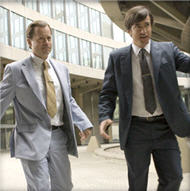
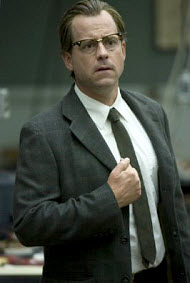
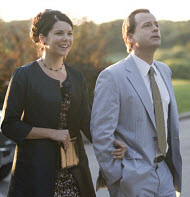
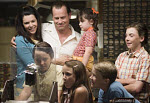
The movie “Flash of Genius” is based on the true story of professor/inventor Bob Kearns. Kearns (played convincingly by Greg Kinnear) and his family live in the city of Detroit, the “car capital of the world.” He is a university professor in the department of engineering, while his wife (played by Lauren Graham) stays home with their 5 children, and substitutes in the school system whenever possible. Devoted parents and practicing Catholics, Kearns and his wife spend as much time as possible with their children, playing games, going for drives in the city, working on the family car, etc.
Kearns’ inventive nature was piqued after an accident on his honeymoon involving his eye. Intrigued by its complex function, he is continuously pondering how its unique design might be useful in the field of engineering. One rainy evening on his way home from work, Kearns becomes frustrated with the wipers on his car. Later, he has a thought that, based on the blink of the human eye, it should be possible to “set” the wipers according to the amount of rain coming down at a given time. In other words, he sets out to design a mechanical device that will allow the wipers to function so that they clear the rain, but don't go at such a pace that causes the annoying squeaking sound.
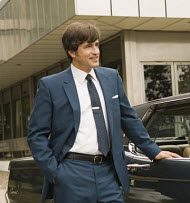
With the help and encouragement of his family, Kearns achieves his goal. He takes his idea to old friend, Gil Privick (played by Dermot Mulroney), who helps him secure the necessary patents for his invention. Privick's high position in a car dealership and connections in the auto industry allow Kearns to eventually pitch the device to the Ford corporation. After having his idea accepted by Ford, he finally allows their scientists to look at his design. Shortly thereafter, Ford pulls out of the deal.
Kearns, unwilling to give up his dream, continues his attempts to complete the deal with Ford. He finally realizes what has happened when he passes a newer model Ford on the road with his invention operating the wiper system. The rest of the movie is an account of his life as he tries to get Ford to admit to stealing his design. There are several comments using profanity as the writer attempts to bring you into the mind of Kearns and the frustration building in every aspect of his life.
Driven, not for monetary gain, but simply for the verbal recognition of his achievement, Kearns’ entire life becomes his pursuit of justice. A man who seemed to have everything, he loses it all because of his inability to deal with this injustice. The magnitude of the loss of his wife and family, the wasted years of not being involved in the lives of his children eventually come full circle as he finally has his day in court. Kearns is heralded as being heroic by the citizens of Detroit who applaud him for standing up to the big, bad corporation. He is asked, “If you don't do it, who will?”
Tragic, heart-breaking, and heroic are the words that came to mind as I watched “Flash of Genius.” Kearns’ love for his family and his overwhelming need to have his work acknowledged eventually become mutually exclusive forces, highlighting a conflict between the importance of “one flesh” and “turning the other cheek.” As a result, Kearns is unable to reconcile these well, and he endures much pain and tumult, as do those who love him. He is not able to leave justice in God's hands, and that is a powerful object lesson in this film.
In terms of content, the movie does an excellent job of portraying accurately the times roughly 40 years ago in American culture, with some smoking and partying behavior, but does so in a manner that does not really push on the envelope of inappropriateness. There is one sexually-oriented scene that occurs between Kearns and his wife, but it does not show any nudity or much erotic activity beyond suggestiveness, and in fact is cut short by Kearns coming up with the idea that is the premise of the movie.
Overall, I would say this movie does well at giving the empathic viewer the opportunity to wrestle with questions about what is really important in life, and the price that sometimes must be paid when one makes choices that place one's own interests at odds with the interests of others.
Violence: None / Profanity: Mild / Sex/Nudity: Minor
See list of Relevant Issues—questions-and-answers.

***Spoilers Alert*** This relatively good man, instead of improving himself and controlling his selfish desires gives into pride and ambition and brings his family to ruin. Is that necessarily a bad lesson? Probably not, except that the movie makers obviously think it's something to be proud of. I do think it can be an excellent tool to teach your (older) children how not to wrap themselves up in their work and leave their families behind and make mistakes that end up ruining literally their entire life. How much more I would have respected him (I didn't really have any respect for him in the end) had he loved his wife like he loved himself and put his family above his self desires to be honored. What if he has seeked Him first and let all those things be added unto him? After all that, he didn't really get anything that moths couldn't corrupt. Actually, I understand he ended up with little, and it lasted at least 30, yes, 3-0 years of his life or more… What a waste of his life. What if he had let it go, loved his wife and kids more, died in his happy loving home… Wow, now that would be a great story.
My Ratings: Moral rating: Average / Moviemaking quality: 4