Elizabeth: The Golden Age
 for violence, some sexuality and nudity.
Reviewed by: Michael Karounos
CONTRIBUTOR
| Moral Rating: | Offensive |
| Moviemaking Quality: |
|
| Primary Audience: | Adults |
| Genre: | Historical Suspense-Thriller Biography Sequel |
| Length: | 1 hr. 54 min. |
| Year of Release: | 2007 |
| USA Release: |
October 12, 2007 (wide—1,900 theaters) |
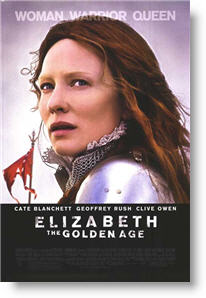
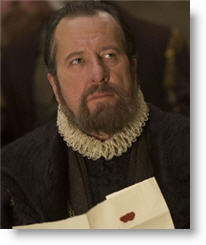
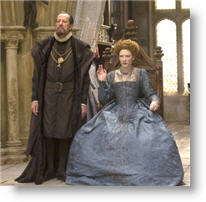
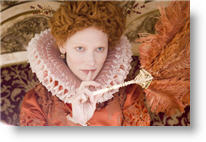
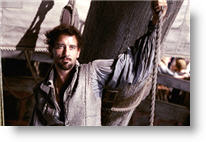
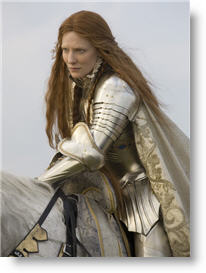

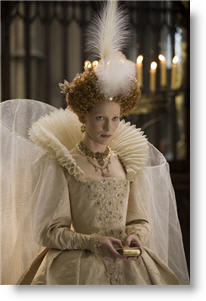

| Featuring |
|---|
| Cate Blanchett, Clive Owen, Geoffrey Rush, Samantha Morton, Abbie Cornish, Eddie Redmayne |
| Director |
|
Shekhar Kapur |
| Producer |
|
Tim Bevan Eric Fellner See all » |
| Distributor |

See our review page on the prequel to this film, Elizabeth (1998).
“Woman. Warrior. Queen.”
Here’s what the distributor says about their film: “Reprising the roles they originated in seven-time Academy Award®-nominated Elizabeth, Cate Blanchett and Geoffrey Rush return for a gripping historical thriller laced with treachery and romance—The Golden Age. Joining them in the epic is Clive Owen as Sir Walter Raleigh, a dashing seafarer and newfound temptation for Elizabeth.
‘The Golden Age’ finds Queen Elizabeth I (Oscar®-winner Cate Blanchett) facing bloodlust for her throne and familial betrayal. Growing keenly aware of the changing religious and political tides of late 16th century Europe, Elizabeth finds her rule openly challenged by the Spanish King Philip II (Jordi Molla)—with his powerful army and sea-dominating armada—determined to restore England to Catholicism.
Preparing to go to war to defend her empire, Elizabeth struggles to balance ancient royal duties with an unexpected vulnerability in her love for Raleigh. But he remains forbidden for a queen who has sworn body and soul to her country. Unable and unwilling to pursue her love, Elizabeth encourages her favorite lady-in-waiting, Bess (Abbie Cornish), to befriend Raleigh to keep him near. But this strategy forces Elizabeth to observe their growing intimacy.
As she charts her course abroad, her trusted advisor, Sir Francis Walsingham (Academy Award® winner Geoffrey Rush), continues his masterful puppetry of Elizabeth’s court at home—and her campaign to solidify absolute power. Through an intricate spy network, Walsingham uncovers an assassination plot that could topple the throne. But as he unmasks traitors that may include Elizabeth’s own cousin Mary Stuart (Samantha Morton), he unknowingly sets England up for destruction.
“The Golden Age” tells the thrilling tale of an era… the story of one woman’s crusade to control love, crush enemies and secure her position as a beloved icon of the western world.”
“Elizabeth: The Golden Age” is about Queen Elizabeth I (1533-1603) whose reign was filled with Protestant-Catholic conflicts, internally with her own Catholic population (constituting approximately half of England at that time), and externally with Spain. She was the daughter of Anne Boleyn, the second wife of Henry VIII, and her claims to the throne conflicted with that of an older half-sister, Mary Stuart who many believed should have been queen. Mary Stuart is not to be confused with the “Bloody” Mary who persecuted Protestants and imprisoned the 21-year-old Elizabeth in the Tower of London for her part in a plot to overthrow her.
The court intrigues with Mary Stuart comprise a sub-plot of the movie which serves as a justification for making the anti-Catholic theme a central aspect of the film, culminating in the defeat of the Spanish Armada. The film as a whole is a patchwork narrative, interspersed with a love story, which appears at times randomly told. Critics have overwhelmingly panned “Elizabeth.” The conglomeration of Rotten Tomatoes film critics gave it only 24% approval, while such films as “3:10 to Yuma” (87%), “Eastern Promises” (89%), and “Michael Clayton” (90%), films which are anti-Christian, pornographic, or anti-corporate, received glowing reviews.
Although the critics don’t say so, one suspects that the criticisms center around the film’s apparent lack of sex and violence and/or lack of a politically correct message. The critics further call the film a simplification of history, a Barbie drama, and condemn it for its extravagant costumes. Perhaps all of these criticism are valid in part, but it has nonetheless been popular with viewers and made more money in its first week than the contemporary drama starring George Clooney whose solo films, with the possible exception of “O Brother Where Are Thou,” are almost always political and almost never best sellers.
The film has some profanity, shows Blanchett nude (a distant shot from behind), and features some politically au courant scenes of torture (part of the endless Hollywood commentary on torture, as in “Goya’s Ghosts”), but is otherwise unobjectionable in its content.
More troubling from a Christian perspective, is the pervasive (one might say obsessive) anti-Catholicism that permeates the movie from start to finish. Indeed, the movie begins with the epigram “King Philip, a devout Catholic, has plunged Europe into a Holy War.” The film uses a distancing device of never providing subtitles for the Spanish or Latin conversations which take place throughout the movie, an effect which makes the Spanish seem alien and threatening. Their almost guttural speaking tone, their ubiquitous black costumes, black hair and beards, and glowering expressions, all contribute to a portrayal of the Spanish as evil, rather than as simply political and religious opponents.
In spite of all those negatives, I recommend the movie for those viewers not troubled by any of these elements solely for the purpose of watching Cate Blanchett turn in another great performance. She inhabits the strengths and weaknesses of Elizabeth I in so convincing a manner that as a psychological portrait of a person it is fascinating viewing.
From a Protestant perspective, Elizabeth is shown praying more than once and gives her famous Tilbury speech which reads in part:
“We have been persuaded by some that are careful of our safety, to take heed how we commit our selves to armed multitudes, for fear of treachery; but I assure you I do not desire to live to distrust my faithful and loving people. Let tyrants fear. I have always so behaved myself that, under God, I have placed my chiefest strength and safeguard in the loyal hearts and good-will of my subjects; and therefore I am come amongst you, as you see, at this time, not for my recreation and disport, but being resolved, in the midst and heat of the battle, to live and die amongst you all; to lay down for my God, and for my kingdom, and my people, my honour and my blood, even in the dust.”
There is also a story that news of her succeeding to the throne reached her while she was reading her Bible in the garden. Whether true or not, it is well-known that Elizabeth was a woman of strong Christian faith, leading a powerful nation at a time when subversive forces, social and political, were at work against her. She did so with legendary integrity and brilliance, and, if for no other reason, the movie is worth seeing for a glimpse into what Elizabeth might possibly have been like.
Supporting roles by Clive Owen, Geoffrey Rush, and especially Abbie Cornish were all excellent and (in my opinion) helped the film overcome those faults in story-telling that troubled so many critics.
Recommended for adult audiences.
Violence: Heavy / Profanity: Minor / Sex/Nudity: Moderate
See list of Relevant Issues—questions-and-answers.


Very Offensive / 4½
Average / 4
Average / 5
Moral rating: Better than Average / Moviemaking quality: 5
Moral rating: Average / Moviemaking quality: 4
Very Offensive / 4½
I was disappointed in this movie because it plays fast and loose with numerous aspects of the history of the period. Among other things, the real Elizabeth was not a 16th century version of the 21st century feminist, despite this movie’s portrayal. I should have known this would happen when I saw the advertising hype about Elizabeth being a 'woman, warrior, queen'. Historically, the real Elizabeth was always a queen first and foremost. She listened to her military staff, who by all accounts, were brilliant men, and she certainly was no warrior. She is portrayed in armor at one point, as if she is some kind of British Joan of Arc. As a side note, the most fascinating person in the real Queen’s military staff was Sir Francis Drake, the primary architect of the British naval victory. The movie makes only one fleeting mention of him. Sir Walter Raleigh was uninvolved in the naval battle.
The actual Queen was famous for having 3,000 gowns at the point of historical reference in the film, so I expected supremely lavish costuming, but was unprepared for this movie’s slavish emphasis upon it, to grotesque excess. Perhaps the real Elizabeth wore clothing that outlandish, but this movie just keeps grinding your face in it to the point of total distraction.
The way this movie portrays Elizabeth, one minute she’s a sobbing scatterbrain, the next minute she’s being elevated to godlike status, especially near the end. One scene reminded me strongly of the sequence from the movie “The Time Bandits,” where the devil spins on an axis while comically destroying opponents. At the end, I expected any second for Cate Blanchett to morph into the Lord Jesus returning from Heaven. I doubt if the real Queen ever had such a view of herself.
Needless to say, there is the inevitable lover’s triangle. Inexplicably, the movie briefly depicts a nude Elizabeth. This movie, although I would have never expected it, moves at breakneck speed. It just tries to cover way too much ground. If you aren’t a history buff, this movie could prove bewildering. I think many will be irritated by this alone. Great cinematography. Good music.
The most interesting character by far in the movie was Sir Francis Walsingham, played wonderfully be Geoffrey Rush. History says he was a staunch Protestant Christian, once involved in trying to save the Huguenots from French Catholics, and at the same time was a very complex man who had people tortured and was the brains behind British counter espionage efforts. You would never know he was a Christian from watching this movie.
The battle scenes feature lots of computer generated gore. All in all, I can’t recommend this movie, even though it’s very beautifully filmed.
Average / 5
Better than Average / 4½
Never before has an actress brought me to tears over Elizabeth’s plight of having to rule England alone, unmarried and without children, yet Blanchett does so on more than one occasion, with such raw vulnerability that you cannot help loving her despite her faults. I loved the early scenes with her, since they were full of a subtle kind of humor that came across as playful. It is nice to believe Elizabeth could have a deep friendship with someone, that she could be as overjoyed with discussing potential suitors with her favorites as she is formidable in times of overwhelming threat. The rest of the cast are excellent, particularly Rush as this time he presents a more humane and touching version of Walsingham. I do enjoy the original film but this one seems far more powerful because it connects in ways the other one did not. It’s not nearly as dark but deals with just as threatening of forces.
There are a few anti-religious elements (but they are historically based, such as Elizabeth’s consulation of an astrologer) and brief sexual implications (but these do have consequences, which are played out in the film). But the film is astounding from an artistic perspective, and should open up not only an interest in history in young adults, but also a discussion on Protestantism and Catholicism in the 15th century.
My Ratings: Better than Average / 5