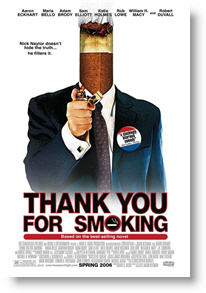
Thank You for Smoking
 for language and some sexual content.
Reviewed by: Chris Monroe
STAFF WRITER
| Moral Rating: | Offensive |
| Moviemaking Quality: |
|
| Primary Audience: | Adults |
| Genre: | Satire Comedy Drama Adaptation |
| Length: | 1 hr. 32 min. |
| Year of Release: | 2006 |
| USA Release: |
March 17, 2006 (limited) |

| Featuring |
|---|
| Aaron Eckhart, Robert Duvall, Katie Holmes, William H. Macy, Sam Elliott |
| Director |
|
Jason Reitman “Juno” (2007) |
| Producer |
| John Schmidt, Edward R. Pressman, Alessandro Camon |
| Distributor |
 Fox Searchlight Pictures, a sister company of 20th Century Fox, a division of The Walt Disney Company |
“Nick Naylor doesn’t hide the truth… he filters it.”
It is likely that a Starbucks barista will thank you when you buy a cup of coffee from them. It is not likely that someone from the tobacco industry would actually thank you for consuming their addictive substances. If it did happen, it may be as odd as the film Thank You For Smoking which explores various aspects of the tobacco industry through satire. This bold genre of storytelling is certainly an acquired taste, and one that moviegoers could choke on if they are not used to it.
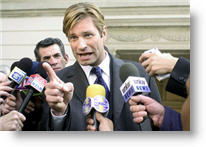
Nick Naylor (Aaron Eckhart) works for the tobacco industry as a mediator between smokers and non-smokers. He says that his best gift is to talk. For him, his work of talking happens to be in arguing and defending the business and dealings of the tobacco industry. As the spokesman and public face of this oft hated industry, Nick teaches his son Joey (Cameron Bright) not only to think for himself, but also the art of argument. Through opposition, attacks and betrayals, Nick must ultimately decide if his path is the best one for him and those around him.
Within this film, there is some offensive content. The f-word is used many times, Christ’s name is taken in vain, and there is other foul language, too. Also, there is a somewhat brief, but pretty explicit sex scene and other moments where sex is talked about in a very crass way.
Apart from these obvious offensive things, this film is intended to be offensive. Our main character, Nick (short for nicotine?) is not a likeable character. He is manipulative, deceiving and conniving and he knows it. Not only does he know how bad he operates, but he also teaches his son to do the same. In one scene Joey questions his dad, asking him questions about honesty and when to admit you are wrong. Nick’s lesson to his son is that if he argues correctly, then he is never wrong. In a following scene, Joey uses these tactics on his mother, Polly (Maria Bello) to get what he wants. These moments may really make you laugh and/or mad but that is the point and the desired effect of this genre.
Because it is satire, there is also a comedic element to this movie. There are some humorous moments, but there are some that really push the envelope. At one point there was a joke about a cancer patient. Again, the point must have been to not necessarily entertain us, but to provoke us. Still, some may find it to be too much.
There are some humorous moments, however, that do seem to work. For instance, in one scene Nick is the guest speaker for his son Joey’s grade school class and discusses the work that he does. He encourages the kids to think for themselves, and, as in many moments of the film, argues that it is okay to smoke if you want to. The moments are a bit ironic, and aren’t necessarily supposed to always be funny. It’s easy to want the comedy, but more often than not what we get is the satirical bite.
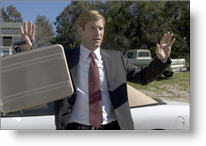
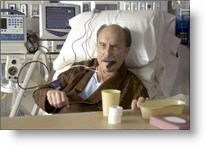
By the end, it was difficult to know what was the purpose of the film. It seemed like a campaign against the tobacco industry, but by the end the focus was really on Nick’s character. It wasn’t about smoking being good or bad, but upon how this man can talk his way into or out of anything. In one scene, he is able to convince a former Marlboro Man model that has been diagnosed with cancer to accept a briefcase full of money so he won’t badmouth the tobacco industry. Nick is being presented here as someone who could sell ice cubes to an Eskimo, but I didn’t always buy it. The desired effect of this film didn’t always have the punch it seemed to intend to have.
If you are interested in seeing a modern effort on satire, this may be worth the venture for you. It is a brave work, but overall not one that is easy to get into or enjoy. The production value is up to par, but it won’t necessarily give you a lot to walk away with.
Violence: Minor / Profanity: Heavy / Sex/Nudity: Heavy

The film centers around Nick Naylor (played by Aaron Eckhart), chief spokesman for the tobacco lobbyists. “Michael Jordan plays basketball. Charles Manson kills people. I talk.” Notice immediately that to Nick Naylor, these three activities are on the same level—one is no better than another. It makes no difference WHAT you do, because all you can do is what you can do. And that is the first of many thematic statements the film is making. He doesn’t have any cause or purpose in his life; that’s the only way he can do what he does. And when you have no cause or purpose, how long is it before you’ve eliminated any sense of right and wrong in your life? However long it takes, he’s gotten there. The only thing keeping him aware of any moral code is his son, to whom he gives the most irresponsible advice possible. But the scary part is that he isn’t wrong.
All of the acting in the film is great. Aaron Eckhart is, as usual, brilliant and funny and subtle. The MOD squad (rounded out by Maria Bello and Dave Koechner) is all great, and their scenes are some of the best in the movie, and look how many stars the movie has! There’s Rob Lowe in a great 2 scene performance! There’s J.K. Simmons and Sam Elliott! There’s Robert Duvall, as an aging tycoon. There’s William H. Macy in his 1,000th great performance! And Jason Reitman knows how to write (or adapt, in this case) and direct. He has made a mature, strong filmmaking debut. Tarantino’s debut wasn’t this good. Wes Anderson’s wasn’t. He got stellar performances out of all the actors (even Katie Holmes who is only kind of 'eh?' but still) and the movie LOOKS great.
Another observation the film makes is that we now live in the age of SPIN, where true/false, right/wrong are irrelevant. Where the way to win people to your side is to cleverly change the argument to undermine the opponent. You win by extension, not because what you say is true. So whoever has the cleverest argument wins the day. How many times does Christianity suffer from this? I’m just getting out of college and I recall numerous times in logic/philosophy classes where, instead of talking about what the Bible says, the professor would just make a joke. The class would laugh and he’d try to move on as if he had defeated my argument. So I would helpfully remind him that he hadn’t defeated my claim, or even addressed it!
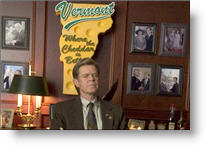
The film also takes an objective look at the lobbying that goes on in Washington. Whereas Nick Naylor has no cause, the William H. Macy character has one, but has lost sight of it in his desire to win. So that what Naylor says on the talk show about the health guy WANTING the kid to die is not far from the truth. This movie could have been made about the abortion issue (and kind of has been—see “Citizen Ruth”). Obviously, I am pro-life, but what is going on when Christians are bombing abortion clinics? Something’s not right here. What good is it to have a cause if you lose sight of it?
I tried to compile a list of great satires, and I didn’t get very far. “Dr. Strangelove” is at the top of the list. “Network” is up there, as is “The Player”. There aren’t many, a shame, I think. They’re tough to pull off. They involve characters making very bad moral decisions, and doing a number of reprehensible things. But that is the teaching technique. The characters do NOT learn their lessons, but the movies work because the audience recognizes that very fact. They see where the characters have gone wrong, and then they correct their own lives.
It is true, though, that a lot of people don’t GET this idea of satires, and so they come away confused, because they are unfamiliar with the convention. They leave the theatre thinking, that’s not right. That character was BAD, why wasn’t he punished? The interesting thing is that while they didn’t like the movie, the movie still had precisely the teaching effect on them that it intended. It’s just that some people don’t realize it. It is the artistic convention of using alienation as the way to get the audience to reflect on the material and the themes.
“Thank You For Smoking” has a lot to say, and it says it with intelligence and wit, style and charm. It is easily the best film so far this year.
Average / 5
…the film appealed to me because it was as much (if not more) about people in general and how they perceive the world than the character of Nick Naylor. I have observed sincere but misinformed people stake their claims for truth when all they really had was a poorly contrived worldview founded on unstable ground. Sadly, this is prevalent within many Christian circles. Not only do scores of Christians lack the ability to successfully defend their point of view, at times they do not even know why they believe something to be true. It is not wrong to question things in an attempt to better understand something. Belief in Christ is not a blind faith.
What I also found interesting about the film was how the character Nick Naylor, “The Sultan of Spin,” discovered the fallacy within his own self professed slogan; “If you argue correctly, you’re never wrong.” Clearly he didn’t feel “right” after successfully debating Senator Finistirre (William H. Macy) before a congressional hearing over the tobacco issue. It appeared “The Face of Cigarettes” had a sense of moral responsibility after all; at least when it came to his son.
While “Thank You For Smoking” won’t go down as one of the greatest satire films in cinema history, it is cleverly written and contains some truth in its message. However, like all Hollywood movies, this particular Tinsel Town offering won’t appeal to everyone. If strong profanity offends you, stay away from this movie. If you’re an adult who likes a film to provoke and stimulate thought, and you can stomach the unnecessary vulgarities, give this film a shot, you may enjoy it.
Offensive / 4
In fact, Nick’s relationship with his son dominates the film, and creates the tension that makes us care what happens. Will the relationship be destroyed if the son is disappointment as he learns the truth about Nick, or will the son follow Nick and turn into someone we don’t like, like the Senator? In fact, can you have family values in a world where people pay the mortgage by killing others? This grabs us more than whatever other issues are in the film.
Christianity is irrelevant to the world depicted in this film. While we can easily picture references to Christianity being included in the manipulative spin of either the tobacco industry or the politicians, it is barely mentioned, and there may be more Buddhism than Christianity on display in this film. Perhaps it is because the true religion of America is belief in the freedom to consume, which Nick constantly evokes. Or because if true Christianity appeared in this film, it would make us uncomfortable rather than smiling. If we love our neighbors, we do not sell them products that kill them. And if the Sermon on the Mount is the truth, then we cannot be influenced by spin.
And oft repeated theme in the film is that everyone is paying the mortgage. In other words there is no alternative (even the characters dying from tobacco, the cancer boy and the Marlboro man, eventually go along with Nick and the system) so we should just go along with our situation. A truly great satire, like “Dr. Strangelove” or “Network,” makes us uncomfortable so that we laugh through our discomfort. But we also leave feeling that things should be different. This film does not, but it does make us smile.
Average / 4
Very Offensive / 4
In the scene, where Eckhart’s character offers money to the retired Marlboro man so that the latter will not speak ill of cigarette companies, he tells the man he can’t take the money and badmouth them. He assumed the man has a sense of honor that Eckhart himself does not have and that the money itself seems to despise. So every people like Eckhart depend on others having morals. They depend on others not being like them. I thought that it would have been better to let the marlboro man take the money and denounce the companies. He could justify it by saying that he deserves their money after what they did to them. But the man takes the money and shuts up. So the message is everyone can be bought.
One disturbing thing was seeing how Eckhart was deliberately corrupting his son. I must say the son was perfectly cast. He did not look like Eckhart, but he had the kind of look I imagine Nero had, plumpish face with small features in the middle, redolent of self satisfaction and a bit of contempt. And, in the end when Eckhart says that he will buy his child cigarettes when he reaches 18, the child smiles with pride.
Offensive / 2½
Offensive / 2
My Ratings: Offensive / 5