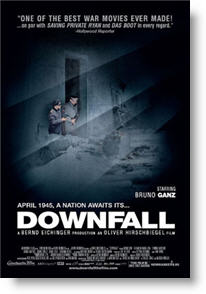
Downfall
 for strong violence, disturbing images and some nudity.
Reviewed by: Jonathan Rodriguez
CONTRIBUTOR
| Moral Rating: | Offensive |
| Moviemaking Quality: |
|
| Primary Audience: | Adults |
| Genre: | Foreign Drama |
| Length: | 2 hr. 34 min. |
| Year of Release: | 2004 |
| USA Release: |
February 18, 2005 (limited) |
Why does God allow innocent people to suffer? Answer
What about the issue of suffering? Doesn’t this prove that there is no God and that we are on our own? Answer
Does God feel our pain? Answer
ORIGIN OF BAD—How did bad things come about? Answer
Did God make the world the way it is now? What kind of world would you create? Answer
| Featuring |
|---|
| Juliane Köhler, Thomas Kretschmann, Ulrich Matthes, Heino Ferch, Christian Berkel |
| Director |
|
Oliver Hirschbiegel |
| Producer |
| Bernd Eichinger |
| Distributor |
| Newmarket Films |
“April 1945, a nation awaits its downfall”
Adolf Hitler is quite possibly the most hated man of the twentieth century. He was in a way responsible for the deaths of over 6 million Jews. As such, he has been deemed a monster, or a mad man who obsessed over exterminating the nationalities he deemed inferior. In a way, it is easier for us to view him that way, because viewing him as just another human like the rest of us is somehow unfathomable.
In “Downfall”, one of the 2004 Oscar nominees for best foreign language film, Hitler is seen in a much less notorious light. He is portrayed as a simple, sulking man, with cares and concerns like the rest of us. We see him mostly through the eyes of his secretary Traudl Junge, whose written accounts of her time with Hitler in the bunkers beneath Berlin inspired this film.
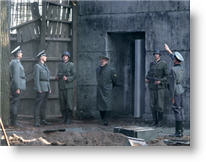
The majority of the film takes place in the winding, vast bunkers where Hitler, his mistress Eva Braun, and a number of others spent the final weeks of the war. While Hitler may be a quiet, caring man who looks out for the comfort and well being of those he is close to, his bouts of rage signal his slow descent into madness. He scours over maps of Germany, devising new schemes to halt the Russian advance. When he meets with his generals and commanders, he informs them of his plans and asks them to carry them out. They try to tell him that what he is saying isn’t possible, because the German forces simply aren’t as strong as Hitler makes himself believe, but he screams at them, accusing them of treason, and sentencing death to those who don’t carry out his plans.
As the end draws near, and as he falls further and further into madness, he slowly comes to realize the inevitable, and does what he can to prevent it.
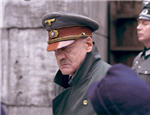
“Downfall” is a fascinating film because it takes a very unpopular approach to its portrait of Hitler. Bruno Ganz plays Hitler, and does an incredible job of making this version of Hitler seem very believable. He sulks around the bunkers, sits contemplating maps and pictures, shows concern for the women and children in the bunker, and explodes with rage and fury at the drop of a hat. I imagine this wasn’t a popular choice of roles, but Ganz succeeds in becoming the most hated man of the last one hundred years.
“Downfall” is certainly not going to appeal to many people. It is dreary, depressing, and at times horrifying. There is violence in the film—people being shot, or shooting themselves, body parts being amputated, bombs exploding. But the most horrifying, yet tragic, scene of the film shows a woman killing her children one by one with a poison capsule while they sleep. She is doing this because she feels that a world without Nazi government will be a world she doesn’t want her children living in, and when she knows the end is near, she takes matters into her own hands. She and her husband then shoot themselves.
There is a little bit of language, although it is subtitled. And we seem some brief nudity a few times; once, with corpses in a hospital, and the other is female nudity in a sexual scene.
“Downfall” is an interesting film that has intrigued me more since I watched it then it did while I was watching it. It is slowly paced, subtitled, and overwhelmingly depressing, which will turn many off to this film, and I can’t say I blame them. Whenever the news reporters interview the neighbors of a serial killer or child molester, you always hear the same words, “We would never have expected this from them, they seemed so nice.” We don’t want to view them as humans, but we find out that they seem to be human just like the rest of us. It is so much easier to imagine Hitler on some other level, as not even human because no human should be capable of doing what he did.
The most disturbing aspect of this film then, I suppose, is realizing that maybe he wasn’t some non-human monster, but simply a human with strong beliefs, and far too much power.
Violence: Extreme / Profanity: Moderate / Sex/nudity: Heavy


Without the above issues (nudity and killing children), the movie is almost perfect. All the actors, especially the one posing as Hitler, are so real, that the 2+ hour movie never feels long. I felt as if I also was in the bunker. And, there is nothing phony about the movie (no zombies; no space aliens; no time travelers). It begins like a documentary, and that gives it the feel of actual history.
Much of it is very likely historically true, but as a former investigator, when more than one person relates an account, the story changes, so we will never know the “real story” (not in this life).
Finally, I think it is similar to Saving Private Ryan, yet much, much better.
Moral rating: Offensive / Moviemaking quality: 5
Average / 4
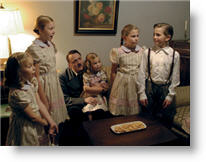
Evil is a lady too. Eva Braun is a hostess par excellence even when the world around her can’t find the vim to join in the fun. Frau Goebbels would make anyone’s best dressed list, and tucks her six children in with a kiss before administering each child an anesthetic drink and a cyanide capsule.
Her husband, in his too big coat and way too big hat, looks like a silly gangster in a forties noir film—remember Elisha Cook, Jr. in “The Maltese Falcon”—the type of thug who thinks he has taken a step up, but never quite fits into the new clothes or the new role that he aspired to. He always was, and always will be, out of place. The little guy who always has shoes that are too big to fill. Bruno Ganz is brilliant as Adolf Hitler.
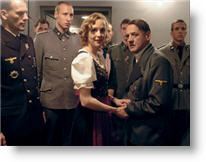
So is the rest of the cast. Ganz lets us see the wages of false promises, in the midst of Herculean efforts to propagate and justify those promises. The film’s soft touch makes this new take on the bunker story more chilling than the many other representations. It unfolds like a black mass, or a demonic parody of everything a Christian would deem sacred. Hitler celebrates the day he is born(Eva throws him a birthday party; she um-pahs while Berlin burns), he gets married(his vows include a promise to kill himself and his bride), and he passes on (by biting into cyanide and putting a bullet in his head).
The co-habitants of the bunker remained steadfast and loyal and even reverential. They were transfixed. The prince of darkness was, and is, indeed a gentleman. This film is a warning to us to stay awake.
My Ratings: Average / 4