Capote
 for some violent images and brief strong language.
Reviewed by: Chris Monroe
STAFF WRITER
| Moral Rating: | Offensive |
| Moviemaking Quality: |
|
| Primary Audience: | Adults |
| Genre: | Biography Drama |
| Length: | 1 hr. 38 min. |
| Year of Release: | 2005 |
| USA Release: |
September 30, 2005 (NY/LA) |


| Featuring |
|---|
|
Philip Seymour Hoffman Catherine Keener Chris Cooper Clifton Collins Jr. Mark Pellegrino |
| Director |
|
Bennett Miller |
| Producer |
| Dan Futterman, Philip Seymour Hoffman, Caroline Baron |
| Distributor |

“Just be honest in what you write” is a creed that the title character espouses to all of his friends and colleagues and simultaneously attempts to live by in the biography picture “Capote”. This man’s intriguing way of being vulnerable with everybody he meets helps bring down their defenses and causes them be open and honest with him. But whose interests does he ultimately have in mind?
Based on true events from the life of author Truman Capote, this story begins November 15, 1959 when Capote (Philip Seymour Hoffman) reads a newspaper article about the brutal murder of a family in Kansas. As a writer for The New Yorker, Capote initially intends on writing a piece for his magazine, but during his four years of research on the event decides to make his account into a non-fictional piece of literature, entitled In Cold Blood. His devotion to telling this story makes him a friend to not only the townspeople of Holcomb, but also an intimate acquaintance to one of the murderers.
Due to the nature of the event that Capote is researching, violent images and incidents are portrayed. Some are static shots or photos, while another sequence shows moments from the actual murder. They are quite explicit and pretty disturbing. There is also a scene depicting an execution by hanging. Aside from this, there are is also some foul language, including an instance of the Lord’s name being taken in vain.
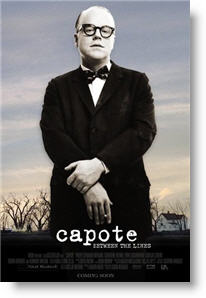
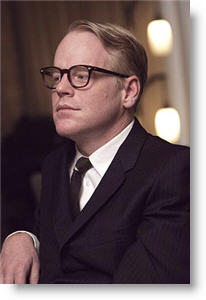
This film is clearly a character-driven piece, and Hoffman’s performance is ultimately center stage. He doesn’t seem to miss a beat, maintaining his chosen interpretation of Capote throughout the entire film. The strongest choice is with the effeminate voice that Hoffman chooses, depicting how Capote is said to have actually talked. In shots where Capote isn’t speaking, it was hard not to imagine Hoffman’s usual voice, but once he starts speaking that distraction tends to go away.
The screenplay is interesting, too, in that it weaves a clear plot into this slice of one man’s life. The writing for this movie successfully shares the nuances and characteristics of Capote with a clear story build up to the event of the Supreme Court’s decision on the fate of the murderers. The credits explain that this film is based on true events, but also admits that there are fictional elements included.
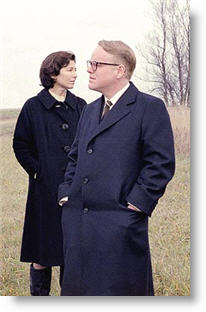
The biggest subtlety surrounding Capote’s character in this film is his relationship with Nelle Harper Lee (Catherine Keener), author of To Kill A Mockingbird, and with his friend and fellow writer, Jack Dunphy (Bruce Greenwood). In the beginning, Capote refers to Nelle as his assistant, but she is depicted as the best friend of Capote. The relationship with Jack is also a close friendship, but seems to have a kind of romantic tenor to it as well.
It was moving to see a man who could be such a sensitive and caring person, even to a brutal murderer. Capote was sincerely consumed with his research for this book and cared about those he interviewed, but eventually I began questioning some of his motives. Although Capote is depicted as very sincere and loving, he is also quite self-consumed.
“Capote” is a well made film and easily sustained my interest throughout. It doesn’t delve into much else of Truman Capote’s life, aside from the time he spent on this book, but does give some insight into just what he was like. Overall, I didn’t walk away with too much, but it did provide something interesting to think about.
Violence: Heavy / Profanity: Moderate / Sex/Nudity: None

And yet, even this man cannot remain impartial and objective about the events that he’s heard about. The Clutter killings were brutal and senseless, yet he, at first, approaches it just like anything else, saying that he doesn’t care if the killers are caught. But, as the case starts to overtake him, he finds it impossible not to get involved. His feeling of kinship with Perry Smith, one of the killers, resonates deep within him. In the right circumstances, could he have done what Perry did? This relationship builds, even as Capote tries to keep his distance.
It’s a fascinating paradox. Capote truly wants to help Perry, but also knows that it will benefit him more if Perry is executed. His ultimate choice haunts him for the rest of his life, and Truman Capote died of alcoholism at a fairly young age.
While it’s a bit cliche to say that this film is about choices, that is exactly what this movie is. Capote was faced with the choice between total self-centeredness, which involved the death of someone he cared about, and commitment to helping someone else. That the someone else was a killer is beside the point. Capote made his choice and lived with the overwhelming consequences. Given the choice he made, it is not a surprise that he did not live very long.
Average / 4½
Offensive / 5
Truman Capote is actually a character in To Kill a Mockingbird, the next door nephew visiting his Aunt “Dill”. And, of course, Mockingbird was semi-autobiographical of Harper Lee’s childhood.
The acting is great. Of course, Hoffman received the Oscar for Best Actor. …
Excellent! / 5
Extremely Offensive / 4
Average / 4
Offensive / 5
The filmmakers behind CAPOTE lack Capote’s insight and understanding of what heartland America is and why a crime such as the Cutter murder can resonate for decades after it happened. They don’t get under the skins of the Kansas people—they don’t even get near them. The camera which can’t get enough of Capote’s face can’t stay far enough away from the common folk. The scenes with the police, the investigator’s family, the prison warden, and the jailer’s wife go nowhere. Are the spouses of law enforcement officials, who have no doubt seen and heard it all, especially in the days when prisoners could be held in the sheriff’s own living quarters, really this star struck and blushing?
Phillip Seymour Hoffman’s performance carries the movie. It is a great performance by a great star. His earlier scene stealing supporting roles (I always wondered if actors weren’t uncomfortable working with him—he turns the tables on his costars more than kids or dogs would) make him a likely choice for this part, but his work here goes beyond grabbing the limelight. As Capote, he’s always fascinating, always revealing. But as in other bio dramas there is nothing behind the performance that would give it resonance. The drama of the writer desperate to get a story out at the expense of his subject works well, but here it hammers home not just Capote’s narcissism, but the self-absorption of the filmmakers as well.
One would think that writers Jack Dumphy and Harper Lee would have lived interesting lives and have been interesting people, but you’d never know it from this film. Their characters have been drained of so much here that they not only talk pallidly; they look pale too. Would Harper Lee really have behaved and dressed so blandly at the premier of the TO KILL A MOCKINGBIRD film?
Capote’s novel was chilling in many ways, especially in the way he interwove the lives of Hickock and Smith with those of the Cutters. We see a lot of Smith in the movie which is understandable since so much of Capote’s tale comes from what he brought from his relationship with Smith, but the Cutters are given short shrift. Justice may have been done in the courts and on the gallows, but once again Hollywood fascination and sympathy are with the rogues.
My Ratings: Offensive / 3½