
Motorcycle Diaries
 for language.
Reviewed by: Chris Monroe
STAFF WRITER
| Moral Rating: | Offensive |
| Moviemaking Quality: |
|
| Primary Audience: | Adults |
| Genre: | Adventure Biography Drama Adaptation |
| Length: | 2 hr. 6 min. |
| Year of Release: | 2004 |
| USA Release: |
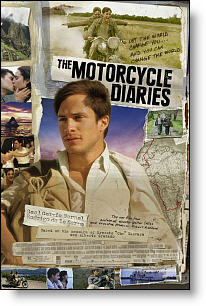
Film based on the books Notas de viaje by Ernesto ‘Che’ Guevara and Con el Che por America Latina by Alberto Granado
Che Guevara, the Argentine Marxist revolutionary, physician, author, guerrilla leader, diplomat, and military theorist who was a major figure in the Cuban Revolution
Communism’s terrible effects on the world
| Featuring |
|---|
|
Gael García Bernal Mia Maestro Rodrigo de la Serna Mercedes Moran Susana Lanteri |
| Director |
|
Walter Salles |
| Producer |
| Karen Tenkoff, Michael Nozik, Edgard Tenenbaum, Karen Tenkhoff |
| Distributor |

“Let the world change you… and you can change the world”
While a motorcycle is a vehicle that survives through only half this story, the portrayal of the mid-twentieth century Latin American revolutionary Ernesto “Che” Guevara as a blissful ideal is one that continues through to the very end. This slice of life drama displays a host of his experiences that purportedly solidified his convictions, avoiding any exhibition of his actual political exploits, and only briefly mentioning how his life ends.
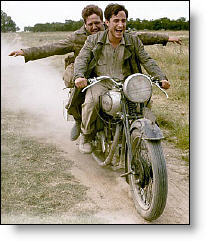
It’s early 1950’s Argentina when a med student, Ernesto (Gael Garcia Bernal) and his scientist friend, Alberto (Rodrigo De la Serna), set out on motorcycle to travel 10,000 miles around the South American continent before Alberto turns thirty and Ernesto finishes medical school. Intending to broaden their horizons, their journey consists of fun and adventure, but also a series of meetings with doctors and hospital patients and a host of struggling individuals who make up the specific countries. But more than plot, this story reveals the character of these two young men, emphasizing the opening narration by Ernesto that “This isn’t a story of heroic feats, but about two lives that ran parallel for a while.”

A couple of things to note: First of all, there is a fair amount of foul language used throughout this story. Too, there are several discussions involving talk of sex, and some situations that imply sexual relations (although none of it is shown). There is one involved moment where it seems two characters may have sex, but they refrain. Still, sex is referred to a lot, as it is one of Alberto’s goals for this trip.
This film is not driven by plot; it is clearly a character piece. The story is not about one big event, but is a accumulation of many different, small events where little choices and nuances are highlighted to reveal character. The character most obviously being highlighted here is Ernesto (“Che”), but they more aptly define him by contrasting him with his amigo Alberto. Throughout this story we see a saintly Ernesto as he tells the truth, does the right thing—even when it’s difficult—sacrifices, cares for people, experiences heartache, and even suffers with his own illness. Alberto, on the other hand, is more interested in money, having a good time, getting people to like him—even if he has to lie—and using people. They still seem to present Alberto as a good guy, but Ernesto is undoubtedly the better guy.
In one scene, Ernesto and Alberto are asked to read a book by a doctor whom they’re visiting. They follow through with it, and are questioned by the doctor about it before they leave for their next town. Alberto immediately lays on thick compliments about the book, even though it seems it is difficult for him to give his opinion. Ernesto, however, pauses, and then tells this doctor—who has been so nice as to house and feed these two men—that he doesn’t like the book. Ernesto tells their doctor friend plainly that his book isn’t good. Humbly, however, the doctor thanks him.
Two proverbs that come to mind in light of this are Proverbs 27:5 which says, “Better is open rebuke than love that is concealed,” and Proverbs 27:6 saying, “Faithful are the wounds of a friend, but deceitful are the kisses of an enemy.” Although it wasn’t easy, Ernesto still does the right thing by being honest.
There are many other noble things this film portrays about Ernesto “Che” Guevara, and while they are exemplary deeds, it felt like there is some political motivation behind it. Nevertheless, the film is very well made, entertaining and hosts many picturesque scenes of these Latin countries, especially with the black and white static shots of people.
Violence: Minor / Profanity: Heavy / Sex/Nudity: Mild

[Better than Average/3]
[Average/3½]
[Better than Average/5]
Beside being morally offensive and manipulative, the movie is dull and poorly structured, the writing is by-the-book, and the acting is rote.
[Extremely Offensive/1½]
[Good/4½]
[Offensive/3]
[Excellent!/5]
[Average/3]
[Average/4½]
Now to the movie. I am from the United States of America. I have been to Ecuador. I have seen the people, all the way from the village healer out in the middle of the rain forest to the highest fraction of a percent living in modern beach houses. And it was one of the saddest things I have ever seen, because the rich remind me of myself, fortunate by birth, and the poor despite the fact that they were oppressed (and they are) had so much pride in the smallest things. A hole in a wall becomes a way to allow light into a room and not a place were leaks plague their wellbeing.
I saw an accurate portray of a concerned global citizen in the way that Che addressed the problems he comes across. So legacy aside, the movie was very well done. It was not meant to climax but to be real and inspiring. And it was both and thus I give it a full 5 out of 5.
[Good/5]
Salles’ “Motorcycle Diaries” is wonderful too, but in a different way. It gives great insight into the development of a political consciousness without coming down too strong on one side or the other. I have a better understanding of a man’s coming to terms with himself and with the world, and I appreciate that Salles does not ask us to see Guevara as a great man or even a good one, just as a man. And he was an appealing and handsome man. No wonder his face continues to adorn T-shirts and dorm room posters. There is room left for judgment of his later exploits which we know all too well.
The man we see tending to patients in a leper colony in Salles’ film would several years later say things like “I am one of those people who believe that the solution to the world’s problems is to be found behind the Iron Curtain” or that hatred is “extremely useful,” and whose legacy includes opening Cuba’s first forced labor camp and shooting little boys who stole food from the Cuban army. The scenes in Peru were particularly beautiful (the cinematography is stunning).
I was reminded of another South American, Martin of Porres, the illegitimate son of a Spanish knight and a Panamanian refugee. Martin lived in the early 17th century and he saw many of the same injustices and inequalities that Che saw. Martin even witnessed the ravages of the slave trade which boomed in Peru at that time. He founded hospitals and orphanages and ministered to African slaves. Martin came from a somewhat similar background as Che, and saw similar things. How does one man deny himself for the good of mankind and the other exalt himself in the advance of evil?
My Ratings: [Average/4]