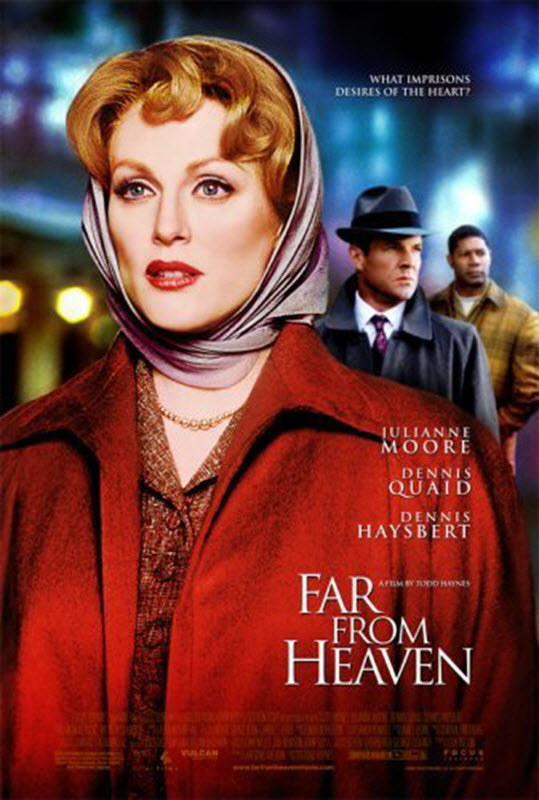
Far From Heaven
 for mature thematic elements, sexual content, brief violence and language.
Reviewed by: Halyna Barannik
CONTRIBUTOR
| Moral Rating: | Very Offensive |
| Moviemaking Quality: |
|
| Primary Audience: | Adults |
| Genre: | Drama |
| Length: | 1 hr. 46 min. |
| Year of Release: | 2002 |
| USA Release: |
September 22, 2002 (festival) November 8, 2002 (limited) |

What should be the attitude of the church toward homosexuals and homosexuality?
Can a gay person go to heaven?
Questions about Race and Racial Issues
More from our Sex, Love and Relationships homepage
Am I good enough to get to Heaven?
Tim Wilkins of Cross Ministry is a Contributing Specialist for ChristianAnswers.Net. Read more about how to minister to homosexuals by visiting Tim’s site.
| Featuring |
|---|
| Julianne Moore, Dennis Quaid, Patricia Clarkson, Viola Davis, Dennis Haysbert |
| Director |
|
Todd Haynes |
| Producer |
| Jody Patton, Christine Vachon, Pamela Koffler |
| Distributor |

I wish I could give this film more than a four star rating for its artistic achievement. The actors did their best with a script that does not present the depth of characterization that the themes addressed by “Far From Heaven” require.
Julianne Moore is splendid as Cathy Whitaker, the perfect housewife of Frank Whitaker, played by Dennis Quaid. They live in an upper middle class neighborhood in Hartford sometime in the 1950’s, when Eisenhower was president. The comparison with the “Leave It To Beaver” TV program is inevitable, with the seemingly perfect household and a mother who is always in high heels. However, the dark parts of their lives begin to overshadow the slick and polished look and feel of their daily lives.
Frank is drawn to men. Soon his homosexuality is discovered. Cathy, in turn, finds solace with an African-American gardener, Raymond (Dennis Haysbert), at a time when social contact between the races was not accepted even in the North. These are the two main themes presented.
Intended to be a provocative and provoking examination of the mores of American life in the 1950’s, the movie remains surprisingly shallow in its treatment of its subject matter. Yes, the lives of this couple do fall apart, as the couple faces Frank’s sexual life. Both Moore and Quaid eke as much out of their parts as they can. But the lack of adequate motivation for their actions, the inconsistencies and the stereotypes of the characters, give an unfortunate cartoon-like quality to this film, which has been very highly acclaimed by secular critics.

Maybe the acclaim comes because of the moral of this story, namely, that nature is superior to artifice, that gut feelings (homosexual urges) are superior to moral structure and self-restrained manners. This is the spiritual context in which this melodrama plays out. It concludes that living according to the truthfulness of your fleshly desires is better than any kind of moral order that would restrict raw emotion. The fallen world would agree with the message delivered by the screenplay; the Christian needs to remember the pitfalls of this kind of message.
See list of Relevant Issues—questions-and-answers.


DISCUSSION:
- Is the world of the Whitakers any different than our own? When trials come in our relationships, is there a background of honest dialogue upon which to share our pain and fear? Do we build and maintain community friendships rooted in deep love that will withstand any storm?
- Are we seeking approval from our friends based upon our place in society? Even in our society or churches, are we living “scripted” lives?
- Do you believe it is the place of society to provide “scripts” to its people on how to live their lives? If not, where will we find the guidance needed to live lives of lasting meaning and purpose?
- In the rearing of a child, many cultures have placed the responsibility on the family to bring up a child to be an “upstanding member” of the society. What happens when the society as a whole is distorted and the family must rear their children to be “counter-cultural?” It would be necessary for the child to exist in such a world to see other counter-cultural persons living in like manner. Do you agree or disagree?
- The ranking of sin into those which are more heinous than others has often created a judgmental attitude by those whose sins are ranked as less offensive. What do you believe this ranking does to relationships and religious expressions?
[Extremely Offensive / 3]
In the 1955 film, Jane Wyman causes a scandal in her staid New England town when she develops a friendship with a young gardener (Rock Hudson) after her husband dies. Sirk’s film acknowledges that there are boundaries of behavior that society needs to acknowledge in order to maintain itself. Christians might think of those boundaries as the Commandments which should be obeyed in order to preserve God’s law.
Sirk, however, was not a preacher. He studied the effects of those boundaries on people’s lives, and criticized society’s tendency to live according to rules merely on a superficial level. A lot of people laugh at films like “All That Heaven Allows” today—or at other Sirk films such as “Imitation of Life” which I admit is overstylized and at times overwrought, but it has a strong moral center, and has a character who speaks of heaven (quoting from Revelation) as a concrete, non-abstract entity—but I find it more rooted in reality than the confused nondescript “Far From Heaven” (I agree wholeheartedly with the reviewer’s assessment).
Haynes’ film glorifies the breaking of sexual codes and taboos (how original for a Hollywood movie!) and self-righteously condemns convention and social structure, as if the film community had no conventions or social rules of their own. Such cheap backhanding hurts the film by immediately ruling out any benefit to exploring the subtleties and the ambiguities of a culture.
This movie, and most Hollywood films, certainly are “far from heaven,” and they’re getting further away all the time.
[Very Offensive / 2]
PLEASE share your observations and insights to be posted here.
The fine acting and hauntingly beautiful cinematography and musical score combine to create a truly memorable cinematic experience.
My Ratings: Moral rating: Average / Moviemaking quality: 5