El Crimen del Padre Amaro
 for sexuality, language and some disturbing images.
Reviewed by: Jim O'Neill
CONTRIBUTOR
| Moral Rating: | Very Offensive |
| Moviemaking Quality: |
|
| Primary Audience: | Adults |
| Genre: | Foreign Romance Drama |
| Length: | 2 hr. |
| Year of Release: | 2001 |
| USA Release: |

| Featuring |
|---|
| Gael García Bernal, Sancho Gracia, Ana Claudia Talancón, Damián Alcázar, Angélica Aragón, Luisa Huertas, Ernesto Gómez Cruz, Gastón Melo, Andrés Montiel, Gerardo Moscoso |
| Director |
|
Carlos Carrera |
| Producer |
| Distributor |
“El Crimen del Padre Amaro” (“The Crime of Father Amaro”) takes place in a small Mexican pueblo called Los Reyes. Young Father Amaro (Gael Garcia Bernal of “Amores Perros” and “Y Tu Mama Tambien”) is sent to the Los Reyes parish after he graduates from the seminary. He is an ambitious and passionate priest. He is looking to rise in the Church ranks although he professes a desire to work amongst the people. He does not seem to have a burning devotion to the members of his flock save for one young girl, Amelia (Ana Claudia Talancon) whom he begins an affair with soon after he arrives in town.
 Father Benito, the pastor whom Father Amaro was sent to assist has, himself, been involved in a long term affair with Amelia’s mother, Sanjuanera (Angelica Aragon). Neither priest spends much time ministering to their parishioners. There are some stock scenes of confession (played, as per modern cinematic custom, for irony or cheap humor), the consecration of the Eucharist at Mass (irony, again), but these are peripheral to what the priests are really up to; that is, what the filmmakers believe Christianity, and specifically, the Catholic Church, are guilty of: hypocrisy and corruption.
Los Reyes may be a small town with a small population and a small church, but it has an infinite capacity for corruption. In this sense, it aspires to “Touch of Evil”, Orson Welles’ classic film, also set in Mexico, about lies and corruption, but it falls short. Unlike Welles’ film, “El Crimen” has no soul. It didn’t move me, even though it preached a good game. Indeed, it preaches to the point that the film looks winded and out of breath by the time it reaches its predictable end.
It’s no secret that the Catholic Church has been damaged by scandal. In this regard, “El Crimen” has nothing new to say. It already has an outdated look and feel. The director (Carlos Carrera) and the screenwriter (Vincente Lenero) had a chance to tell a story about the struggle between the flesh and the spirit in modern society. Carrera skips over the conflict. The priests waste no time arguing with themselves, not when they are surrounded by pretty and willing parishioners. They take the bait, and their sins do not stop with the breaking of their vows.
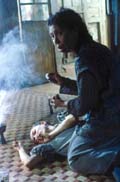 Father Benito is building a new health clinic in Los Reyes, mostly with laundered money diverted to the parish by a corrupt mayor and a murderous drug lord. Like the priests and the other parishioners, the mayor and the drug lord are stock characters. Everyone looks like he or she was pulled hurriedly from an old TV serial central casting department. Bernal, a shining presence in other movies, is dreadfully miscast here. His hands stuffed deep in his pockets, his eyes downcast and glum, he looks and acts no more like a priest than any castmember of the other recent film about worship (albeit of a different sort), “8 Mile”.
The priests’ fornication, calumny and deceit bring tragedy, illness and death to Los Reyes. No one is delivered from the enmity, and no one tries to make amends for his sins. In the final scene, a priest is saying mass, offering the soul of a parishioner to the Prince of Peace, but he has sacrificed his own soul to the prince of lies.
The film is doing big business in Mexico. The country plans to submit “El Crimen” as its entry for best foreign language film at this year’s Academy Awards. I believe the film is a failure. Mexico has a rich cultural heritage. Much of that culture is rooted in its religion, especially in its Baroque renderings of the life of Christ and the lives of the Saints. “El Crimen” skips over this tradition, except for the few instances in which it stops to defile it or mock it, and reaches for a kind of neoclassical purity and political correctness which falls flat. It can’t decide what it wants to say about religion.
I did not always agree with the Spanish master, Luis Bunuel who made films which were critical, even derogatory, of religion (“Simon of the Desert”, “Viridiana”), but his message was clear, and his films had heart. If “El Crimen” has a heart, it’s a cold one.
After I saw “El Crimen del Padre Amaro”, I watched an Australian movie called The Devil’s Playground. Made in 1988 by director Fred Schepisi, “Playground” is the story of a group of students and teachers who live in a religious boys’ academy run by an order of brothers. It honestly portrays the sacrifices one makes to lead a celibate life, and the human price which one must pay to make that sacrifice, but it never loses touch with the things that move a person’s spirit and make one yearn to accept a calling or make good on a promise. “El Crimen del Padre Amaro” is a tale of broken promises. The film’s own promise, to help us see something a little more clearly, is never fulfilled.
In Spanish with English subtitles.
See list of Relevant Issues—questions-and-answers.

My only complaint about this film is that it shows that every “religious” person has shades of grey. But it depicts the young non-church-going reporter as a symbol of purity and truth. Kinda biased in that respect. But a good film. Such sex scenes.
My Ratings: [Average / 4½]