Adaptation
 for language, sexuality, some drug use and violent images.
Reviewed by: Megan Basham
CONTRIBUTOR
| Moral Rating: | Very Offensive |
| Moviemaking Quality: |
|
| Primary Audience: | Adults |
| Genre: | Drama / Comedy |
| Length: | 2 hr. |
| Year of Release: | 2002 |
| USA Release: |
| Featuring |
|---|
| Nicolas Cage, Meryl Streep, Chris Cooper, Tilda Swinton, Cara Seymour |
| Director |
|
Spike Jonze |
| Producer |
| Jonathan Demme, Edward Saxon, Vincent Landay |
| Distributor |

Though you may not have heard much about “Adaptation” yet, odds are you will when it inevitably secures an Oscar nomination next February. The brainchild of indie dream team director Spike Jonze and writer Charlie Kaufman (the duo responsible for “Being John Malkovich”), the film picks up in Charlie’s life where Malkovich left off. So far it has received the highest recommendation from big guns like Roger Ebert and Richard Roeper, and even has some Christian critics offering it cautious praise, despite brief nudity and a couple sexual situations. While I agree with them that “Adaptation” is at the very least an original approach to story-telling, its clever maneuverings don’t make up for its unfulfilled promise of profundity, or for the way the story betrays itself in the last half of the film.
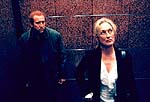 “Adaptation” tells the half-true/half-fiction story of Charlie Kaufman (Nicolas Cage), a screenwriter who, high off his success for “Being John Malkovich”, has been recruited to adapt a sprawling, sensitive novel titled “The Orchid Thief”. Inspired by the words of the Orchid Thief’s author (Meryl Streep), Charlie vows to write a screenplay as perceptive and authentic as the work he is adapting. Unfortunately, he’s besieged by doubt about his abilities as a writer. While he despises everything commercial in Hollywood, his encounter with a true work of art leaves him quivering at the possibility that he may, in fact, be the very thing he reviles most—namely, a hack. To make matters worse, his simple-minded twin-brother Donald (whose previous existence was apparently that of a sponge) decides to write his own pandering screenplay, which he quickly sells for a million dollars. While in real life Kaufman doesn’t have a brother, here the character obviously provides Charlie an alter-ego, the what-if should he decide to finally chuck all his ambitions for artistic integrity and just give the audience the car-chases and sex scenes they want.
Pretty brilliant sounding construction, right? And it is. Certainly as a writer and sometime neurotic, I was fully engaged by Kaufman’s struggle with self-doubt. Any one of us who has ever attempted to say something on paper has worried that we may be publicly revealed for the insecure, shallow-thinkers that we are. Or worse, that the public won’t even find our trivial little passions interesting. So, for a while it looked like “Adaptation” might provide the humorous, illuminating window into the writer’s soul alluded to in its trailers. Then I guess Kaufman got lazy, because in a bizarre turn of plot, he tacks on a disjointed ending that feels totally irrelevant and disloyal to the whole. The entire struggle between artistry and commercialism becomes one big joke on the audience as Kaufman ends his movie with everything his character condemned in the first place—a car chase, a steamy sex scene, an attempted murder, a gruesome death, and even drug running.
According to the film, adaptation is the process of an organism changing to become more compatible with its environment. And while this is apparently supposed to be a metaphor for the individual journeys of the characters, it’s an inappropriate choice as, instead of moving forward, each person regresses more and more into a state of depressing self-obsession leading to ever-greater self-destruction. At first, Charlie’s overly self-conscious and pseudo-intellectual crises are hilarious as we recognize the same tendencies in ourselves. And so we too feel his longing when he is so touched by a book that it seems it may be the catalyst to drive him out of his narcissistic lifestyle. That is until Kaufman reveals the punchline—that even after enlightenment, life is still cheap and dirty, and I realize I’ve spent two hours watching he and Jonze try to prove how much smarter they are than me.
Genuine art is not just a trick of mind-bending innovation nor a foray into some perversion never before explored; rather, it is the revelation of truth and beauty. Or, maybe Jonze and Kaufman are right. Maybe the ideas of art and life-changing moments of clarity really are just one big joke, but if so, I wouldn’t pay another eight bucks to be the butt of it.

- Often what reviewers are looking for in a film is novelty, a new way of presenting an old issue. However, for a film to improve the human condition and enrich our lives it can’t only be brilliant in some new limited way, but enlighten us spiritually and socially. Why do you think this film chose to portray such empty lives? Do you believe it is presenting the truth about the lives of those who are seeking to write and act in our films and on stage, or is this a distorted presentation?
- When you consider the impact others have on your life, how do you decide with whom you will spend your time? Is there a benefit from spending time with those who need your friendship to enrich their lives? If friendship is reciprocal what would we expect to happen in such relationships?
- It has been found that the greatest predictor of drug use is having a best friend who uses drugs. If this is true in this one area is it also true in others? How impactful is our choice of best friends?
[Very Offensive / 3]
[5]
[Very Offensive / 3]
My Ratings: [Average / 5]