Yours, Mine and Ours
Reviewed by: Brett Willis
STAFF WRITER
| Moral Rating: | Better than Average |
| Moviemaking Quality: |
|
| Primary Audience: | 8 to Adult |
| Genre: | Romance Comedy Drama |
| Length: | 1 hr. 54 min. |
| Year of Release: | 1968 |
| USA Release: |
April 24, 1968 |

| Featuring |
|---|
| Lucille Ball, Henry Fonda, Van Johnson, Louise Troy, Sidney Miller, Tom Bosley, Nancy Howard, Walter Brooke, Tim Matthieson, Gil Rogers, Nancy Roth, Gary Goetzman, Suzanne Cupito, Holly O'Brien, Michele Tobin, Maralee Foster, Tracy Nelson, Stephanie Oliver, Jennifer Leak, Kevin Burchett, Kimberly Beck, Mitch Vogel, Margot Jane, Eric Shea, Greg Atkins, Lynnell Atkins, Ben Murphy, Ysabel MacCloskey, Pauline Hague, Marjorie Eaton, Richard Angarola, Lilyan Chauvin, Robert P. Lieb, Ginny Gan, Eve Bruce, Susan Carr, Paul Potash, Stuart Nisbet, Patty Elder, George Jue, Arthur Peterson, Mary Gregory, Larry Hankin, Lawrence Heller, Marti Litis, Harry Holcombe |
| Director |
|
Melville Shavelson |
| Producer |
| Desilu Productions, Robert F. Blumofe |
| Distributor |

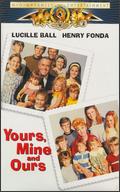
This worthwhile family classic about a large blended family, based on the book “Who Gets the Drumstick?” by the real-life Helen Beardsley, deals with a lot of touchy subjects in a fairly discreet way. After the success of the film, a pared-down version of this story was used to create the “Brady Bunch” TV series.
When widowed Navy officer Frank Beardsley (Henry Fonda), the father of ten children, meets Navy widow and dispensary nurse Helen North (Lucille Ball), the mother of eight, their “common interests” (which neither of them own up to at first) eventually persuade them to walk down the marriage aisle and take their families on a new adventure.
There’s no possible way for the film to develop the characters of all the children, much less to show how all of them “develop” (change) as the story progresses. But we get some sample glimpses of the jealousy, resentment and hostility that will eventually give way to cooperation and blending smoothly into one family. There are some interesting and probably true-to-life incidents such as one of Helen’s children deliberately being bad because after the death of his father, someone had tried to comfort him by telling him that “the good die young.” There’s also the issue of stepparent adoption, and a sequence where one of Frank’s sons wants to go into the Marines instead of the Navy.
Content, negative/positive: There are a few uses of d* and h*. There’s also a healthy sprinkling of suggestive language, but most of it is designed to go over the heads of younger viewers. While Frank is single, fellow officer Darrel (Van Johnson) offers to set him up with no-commitment dates, but he’s not interested. During Frank and Helen’s first date, several women in the officer’s club throw themselves at Frank, presumably because of his rank. After Frank and Helen confess to how many children they each have, they assume it was their first and last date. But Harrison, who is friends with both, sets each of them up with an incompatible partner and sends both couples to the same restaurant at the same time. His intent is that they’ll both decide that something lasting is better than cheap “romance”; and he’s right. Most of the film has only a light touch of comedy; Ball’s strongest “trademark” comedy bit comes when three of Frank’s sons mix Helen an overspiked drink (for which they’re forced to apologize later). After the marriage, there’s a sequence where Frank effectively reinforces to Helen’s teen daughter (who has a pushy boyfriend) that real love isn’t measured by going to bed with someone, but rather by getting up the next morning and facing life together.
I recommend this film.

[Excellent / 3]