The Delta Force
 for unspecified reasons.
Reviewed by: Brett Willis
STAFF WRITER
| Moral Rating: | Very Offensive |
| Moviemaking Quality: |
|
| Primary Audience: | Adults Mature-Teens |
| Genre: | War Action Adventure Drama |
| Length: | 2 hr. 5 min. |
| Year of Release: | 1986 |
| USA Release: |
February 14, 1986 (wide) DVD: September 19, 2000 |

terrorists / terrorism
highjacking
courage, bravery
self-sacrifice
war on terrorism
What is the Biblical perspective on war? Answer
FILM VIOLENCE—How does viewing violence in movies affect families? Answer
| Featuring |
|---|
| Chuck Norris, Lee Marvin, Martin Balsam, Joey Bishop, Robert Forster, Lainie Kazan, George Kennedy, Hanna Schygulla, Robert Vaughn, Shelley Winters |
| Director |
|
Menahem Golan |
| Producer |
| Menahem Golan, Yoram Globus, Rony Yacov |
| Distributor |
| The Cannon Group/MGM |
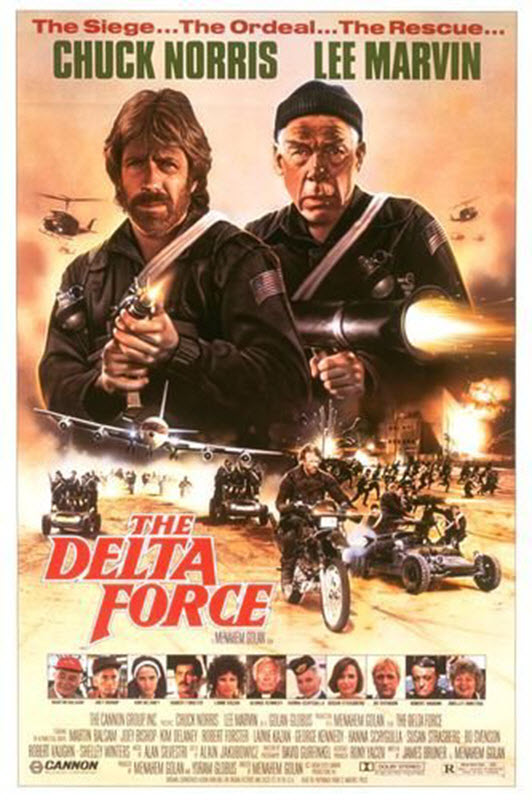
Although this film is more or less a Chuck Norris vehicle, it’s a little less excessive than “Invasion U.S.A.” or the “Missing in Action” series. The airplane hijacking is loosely based on an actual 1985 incident, but the Delta Force involvement is very fictionalized and the body count is quite one-sided. Nevertheless, it gives us a glimpse of what elite military units may be called on to do.
Arab/Muslim terrorists led by “Abdul” (Robert Forster) hijack a commercial airliner filled with Americans and reroute it from Europe to Beirut, Lebanon. They single out certain passengers—including some U.S. Navy divers and anyone who appears to be Jewish—for “special treatment.” Two of the Jewish couples are played by Joey Bishop, Lainie Kazan, Martin Balsam and Shelley Winters; the use of stars from an earlier era is probably an attempt to pull in a wider audience. Balsam’s character has a tattoo from a WWII concentration camp. A Roman Catholic priest, Fr. O'Malley (George Kennedy), identifies himself as Jewish; this is comic relief but is also part of the film’s design to put Jews, Roman Catholics, Eastern Orthodox and miscellaneous Protestants all on one side of the struggle and Arabs/Muslims on the other (slightly inflammatory). A flight attendant of German ancestry (Hanna Schygulla, “Dead Again”) balks at being ordered to “select” the Jews from the passenger list. The hijackers' response: six million was not enough.
A unit of the Delta Force (a super-elite American military organization which gets most of its recruits from the Rangers and Green Berets) is called into action against the hijackers. In an opening scene, that same unit had failed in an attempt to rescue American hostages in Iran in 1980 (this also is based on a true incident), and Capt. McCoy (Norris) had resigned in disillusionment. Now his Colonel (Lee Marvin) and the President order him back into service, though he maintains the attitude that he’s coming back only because he chooses to (a typical Norris slow-burn sequence). The first half of this film has some interesting drama; the second half is straight action.
The acting is sometimes corny and sub-par. Marvin, in his final film role, isn’t at his best; in one scene, he stops his dialogue in anticipation of his beeper going off. But most of the film successfully pushes all the hot-buttons it goes after. The flag-waving heroics are meant to move us, and they do.
Content Warnings: The violence is extreme, and some of the stunts are beyond credibility. There’s no sexual content or nudity. Some strong language. It sounds a bit strange to hear a terrorist leader say “God be praised” followed immediately by ordering his men to “Move your a*,” and that’s probably the intent.
Commentary: Elite military duty isn’t for everyone. I once had a young man in my church Youth Group (which consisted of anyone under 36 and single) who committed suicide, although he was a truly converted person. I believe one of the things that unbalanced him was military training on “special methods of interrogation” and “interrogation resistance.” In the continuing war on terrorism and in other conflicts around the world, elite forces probably do many things that the public approves of in theory, but doesn’t want to know too much detail about.
Followed by: “Delta Force 2: Operation Stranglehold” (1990) and “Delta force 3: The Killing Game” (1991)

PLEASE share your observations and insights to be posted here.
Unfortunately, however, the movie does contain its fair share of violence (especially in one torture scene). As a child, I watched the edited version of the movie, which I still today hold to be the best version of it, as the extra violence does nothing for the film. Whilst the movie DOES contain violence, it is not glorified, and is clearly shown to be RETRIBUTION, and done within a military context.
The film is made to seem harrowingly realistic (somewhat like today’s war movies—“Black Hawk Down,” et.al), with great attention paid to military accuracy (e.g. The “training” scene). Overall, the movie portrays a clear theme of good vs. Evil, where ultimately a PRICE HAS TO BE PAID to overcome evil.
The movie is very well-directed; as you really feel for, and understand the characters (on both sides). The plot line is gripping, and even the (now iconic) music soundtrack is rousing! The movie is peppered at times with subtle humour, catchy lines, and is clearly patriotic (wave that flag!). It is VERY well made for a movie of it’s age, yet I can’t help but wonder, if the extra violence would have been better left out, and if IT was what halted this movie in achieving a bigger following.
(NOTE: The subsequent movies are low-budget, and do not reflect the quality of the first movie).
My Ratings: Moral rating: Offensive / Moviemaking quality: 4½