House of Mirth
 for thematic material.
Reviewed by: Dr. Kenneth R. Morefield
CONTRIBUTOR
| Moral Rating: | Better than Average |
| Moviemaking Quality: |
|
| Primary Audience: | Teens Young-Adults Adults |
| Genre: | Romance Drama |
| Length: | 2 hr. 20 min. |
| Year of Release: | 2000 |
| USA Release: |
| Featuring |
|---|
|
Gillian Anderson Eric Stoltz Dan Aykroyd Eleanor Bron Terry Kinney |
| Director |
|
Terence Davies |
| Producer |
| Olivia Stewart |
| Distributor |

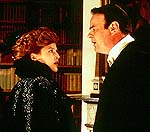
Lily Bart (Gillian Anderson) negotiates the expectations, spoken and unspoken, of turn of the century New York society in “House of Mirth”. She searches for a way to maintain both happiness and comfort in the face of increasingly narrower personal choices. Rated PG for adult situations and inferences.
Edith Wharton’s underappreciated masterpiece gets the full screen treatment in this art house release. Despite garnering strong reviews (one major entertainment magazine had it listed among its top two films of the year), “House of Mirth” has been slow to reach wide release. The production values are wonderful, with the photography and acting hitting just the right marks. Why then did this movie leave me so strangely cold? Wharton’s novel game at the tale end of American Literary Naturalism, was influenced by it and, arguably, participates in it. Naturalism was a literary style or movement undergirded by a belief in various forms of determinism, and it is this foundation that both gives the film its interest and robs it of its power. Certainly the most interesting parts of the film consist in watching an individual try to exercise free choice in an environment which, despite its luxuriant surface, is highly restrictive. But we live in an age that values and believes in personal freedom, so Lily’s lament that she is not only a “useless” person but has been trained to be one, loses much of its resonance.
There is a thread of literary realism in the novel as well, though. The decline and fall structure centers around Lily’s loss of material status, but much like Silas Lapham in the Howells novel, she grows morally by refusing to allow her material circumstances to lead to a key moral compromise. Still while the realists (at least some of them) saw a deliverance through moral perseverance, the naturalists see such gestures as futile, and so Lily’s refusal to blackmail a key rival who has injured her reputation cannot be seen as evidence of a higher moral consciousness or as leading to a future deliverance. It does, to be sure, add a layer of pathos over her deterioration, but one senses as though Wharton feels as though the hope provided by selling out was a false one anyway. Lily is destined to fail and the fact that she is able to choose one avenue of failure over another does not lessen the air of fatal resignation that hangs over the latter half of the film.I have already mentioned that the photography is wonderful in the film. The acting is strong but not outstanding. Anderson does a fair job of making you forget Agent Scully from the “X-Files” and Dan Aykroyd and Laura Linney are strong in support playing friends of Lily’s who turn out to have hidden streaks of cruelty. Much of the criticism surrounding the film has focused on Eric Stoltz as Lily’s love interest Lawrence Selden. Stoltz does seem miscast, but in his defense the film cannot decide whether it ultimately wants to make him a co-victim (like Lily unable to fly in the face of societal expectations despite his love for her) or a co-conspirator (like Gus and Bertha willing to use Lily for his enjoyment but unwilling to stand by her when it is not expedient). Fans of the book may balk at the casting of Anthony LaPaglia as Sim Rosedale, a character whose Jewish identity is a much emphasized part of the book. The film eliminates much of the book’s anti-Semitism through this casting, but it also makes Lily’s rejection of Sim seem more a matter of personal dislike rather than racial disgust instilled by a racist society.
There is much to praise in Terence Davies’s film, but like films based on naturalist or realist novels, the excellence seems more technical than emotional, leading to an artistic appreciation of a finely drawn character or situation instead of a moving experience. “The Spirit of the Sovereign Lord is on me, because the Lord has anointed me to preach good news to the poor. He has sent me to bind up the brokenhearted, to proclaim freedom for the captives and release from darkness for the prisoner, to proclaim the year of the Lord’s favor and the day of vengeance of our God, to comfort all who mourn and provide for those who grieve in Zion—to bestow on them a crown of beauty instead of ashes, the oil of gladness instead of mourning, and a garment of praise instead of despair” (Isaiah 61:1-3).
My Grade: B+

[Better than Average / 4]
My Ratings: [Better than Average / 3½]