True Crime
 for language and some violence.
Reviewed by: Brett Willis
CONTRIBUTOR
| Moral Rating: | Very Offensive |
| Moviemaking Quality: |
|
| Primary Audience: | Adults |
| Genre: | Crime Mystery Drama |
| Length: | 2 hr. 7 min. |
| Year of Release: | 1999 |
| USA Release: |
March 19, 1999 |



| Featuring |
|---|
| Clint Eastwood, Isaiah Washington, Denis Leary, Lisa Gay Hamilton, Diane Venora |
| Director |
|
Clint Eastwood |
| Producer |
|
The Zanuck Company Richard D. Zanuck Lili Fini Zanuck Malpaso Productions See all » |
| Distributor |

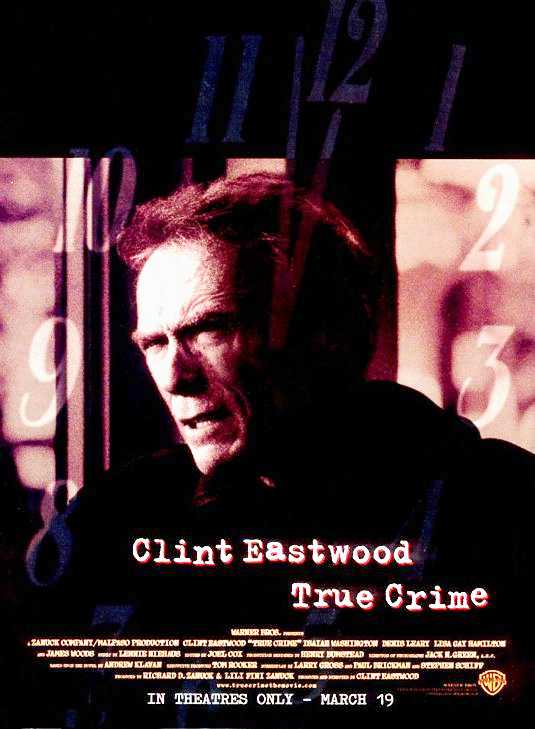
“True Crime” isn’t one of Clint Eastwood’s best films, as either actor or director, but the subject of capital punishment and last-minute appeals holds the viewer’s attention (at least it did mine).
Steve Everett (Eastwood) is an aging reporter who was fired from one paper because he dug up dirt on the mayor of New York that the paper wouldn’t print, and fired from another for seducing the owner’s underage daughter. Or maybe these were two partial explanations of the same firing. In any case, Everett is a womanizing dry drunk whose only asset is his nose for news. As the film opens, he’s in a bar hitting on a 23-year-old coworker (who is killed in a car wreck on the way home after turning him down). We next see Everett the following morning, getting dressed after sleeping with his boss’s wife. When he finally gets to the office, he inherits an assignment from the deceased reporter: a human-interest interview of a convicted killer scheduled to be executed at one minute past midnight. Doing his homework for the story, Everett quickly begins to question the conviction itself, and oversteps the bounds of his assignment by trying to prove his hunch and to effect a stay of execution.
The profanity is extreme. Also, when Everett is alone with his editor-in-chief (James Woods) the two engage in disgusting adolescent sexual bragging that treats women as objects. There’s no visible sexual activity or nudity, but the whole theme of Everett neglecting his family for “other pursuits” is offensive. A bloody murder is reenacted several times in Everett’s on-screen thoughts as he reconstructs how it actually happened. A dishonest prison chaplain claims that the condemned man, Frank Beachum (Isaiah Washington), has confessed to the crime when in fact he has not. Beachum’s own pastor is presumably honest, but his character is not developed.
The most positive content is provided by Beachum and his wife and daughter (Lisa Gay Hamilton and Penny Rae Bridges). Beachum has a solid faith in Jesus that has changed him from the street hoodlum he once was and allows him to face death without fear. Although he’s advised to confess and express remorse as an appeal technique, he refuses to confess to something he didn’t do. The scenes of the family bravely facing the final hours are very moving. There are certainly better films in which to find a Christian witness; but here it is, in a film that’s more likely to be watched by those most needing such a witness.

The scenes of Beachum with his family are touching, the family’s expression of their faith appears genuine. It does not seem that Christianity is being discredited in the film, as it is in many movies these days, although the actors in their roles might express very negative personal opinions (i.e. Eastwood’s comment cited in the former “Viewer Comments”).
The portrayed contrast between the prison chaplain’s faith and that of Beachum’s family and pastor is a very good way to get into a discussion of what true faith is and how it is lived. My Ratings: [2/3]