Is the unborn human less than human?
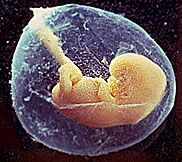
The abortion debate rests on the moral status of the unborn: if the unborn are fully human, then nearly every abortion performed is tantamount to murder. Most “pro-choice” advocates argue, however, that although the unborn entity is human (belonging to the species Homo sapiens), it is not a person and hence not fully human.
Those who argue in this fashion defend either a decisive moment or gradualist approach to the status of the unborn.
Those who defend a decisive moment view argue that, although human life does begin at the moment of conception, it is at some later stage in the unborn human's development that it becomes worthy of our protection. It is at this moment that it becomes a person.
Other philosophers take a gradualist position and argue that the unborn human gradually gains more rights as it develops. Hence, a zygote has less rights than a 6-month-old fetus, but this fetus has less rights than an adult woman.
In order to understand decisive moment and gradualist theories, it is important that we carefully go over the biological facts of fetal development. While going over the facts of prenatal development. I will present the case for the pro-life view that full humanness begins at conception. I will deal with objections to this view when I critique the decisive moment and gradualist views.
The Facts of Pre-natal development
First Month
Pregnancy begins at conception, the time at which the male sperm and the female ovum unite. What results is called a zygote, a one-celled biological entity, a stage in human development through which each of us has passed (just as we have passed through infancy, childhood, and adolescence).[1]
It is a misnomer to refer to this entity as a “fertilized ovum.” For both ovum and sperm, which are genetically each a part of its owner (mother and father, respectively), cease to exist at the moment of conception. There is no doubt that the zygote is biologically alive. It fulfills the four criteria needed to establish biological life: (1) metabolism, (2) growth, (3) reaction to stimuli, and (4) reproduction. (There is cell reproduction and twinning, a form of asexual reproduction, which can occur after conception. For more on twinning, see below.)
But is this life fully human? I believe that the facts clearly reveal that it is.
First, the human conceptus -- that which results from conception and begins as a zygote—is the sexual product of human parents. Hence, insofar as having human causes, the conceptus is human.
Second, not only is the conceptus human insofar as being caused by humans, it is a unique human individual, just as each of us is. Resulting from the union of the female ovum (which contains 23 chromosomes) and the male sperm (which contains 23 chromosomes), the conceptus is a new—although tiny—individual.
It has its own unique genetic code (with forty-six chromosomes), which is neither the mother's nor the father's. From this point until death, no new genetic information is needed to make the unborn entity a unique individual human.
Her (or his) genetic make-up is established at conception, determining her unique individual physical characteristics—gender, eye color, bone structure, hair color, skin color, susceptibility to certain diseases, etc. That is to say, at conception, the “genotype”—the inherited characteristics of a unique human being—is established and will remain in force for the entire life of this individual.
Although sharing the same nature with all human beings, the unborn individual, like each one of us, is unlike any that has been conceived before and unlike any that will ever be conceived again.
The only thing necessary for the growth and development of this human organism (as with the rest of us) is oxygen, food, and water, since this organism—like the newborn, the infant, and the adolescent—needs only to develop in accordance with her already-designed nature that is present at conception.
This is why French geneticist Jermoe L. LeJeune, while testifying before a Senate Subcommittee, asserted:
To accept the fact that after fertilization has taken place a new human has come into being is no longer a matter of taste or opinion. The human nature of the human being from conception to old age is not a metaphysical contention, it is plain experimental evidence. [2]
There is hence no doubt that the development of a unique individual human life begins at conception. It is vital that you—the reader—understand that…
You did not come from a zygote.
You once were a zygote.
You did not come from an embryo.
You once were an embryo.
You did not come from a fetus.
You once were a fetus.
You did not come from an adolescent.
You once were an adolescent.
Consequently, each one of us has experienced these various developmental stages of life. None of these stages, however, imparted to us our humanity.
Within one week after conception, implantation occurs—the time at which the conceptus “nests” or implants in her mother's uterus. During this time, and possibly up to fourteen days after conception, [3]a splitting of the conceptus may occur resulting in the creation of identical twins. In some instances the two concepti may recombine and become one conceptus. (I will respond below to the argument that the possibility of the conceptus twinning and the subsequent concepti recombining refutes the pro-life claim that full humanness begins at conception.)
At about three weeks, a primitive heart muscle begins to pulsate. Other organs begin to develop during the first month, such as a liver, primitive kidneys, a digestive tract, and a simple umbilical cord. This developing body has a head and a developing face with primitive ears, mouth, and eyes, despite the fact that it is no larger than half the size of a pea.
Toward the end of the first month (between 26 and 28 days) the arms and legs begin to appear as tiny buds. A whole embryo is formed by the end of the first month.
From the eighteenth day after conception, substantial development of the brain and nervous system occurs.
This is necessary because the nervous system integrates the action of all the other systems. By the end of the twentieth day the foundation of the child's brain, spinal cord, and entire nervous system will have been established. By the sixth week, this system will have developed so well that it is controlling movements of the baby's muscles, even though the woman may not be aware she is pregnant. At thirty days the primary brain is seen. By the thirty-third day the cerebral cortex, the part of the central nervous system which governs motor activity as well as intellect, may be seen. [4]
Second Month
Despite its small size, the unborn child by the beginning of the second month looks distinctly “human” (although it is human from conception). At this point it is highly likely that the mother does not even know she is pregnant. Brain waves can be detected in the unborn at about forty to forty-three days after conception.
During the second month, the eyes, ears, nose, toes, and fingers make their appearance; the skeleton develops; the heart beats; and the blood—with its own type—flows. The unborn at this time has reflexes and her lips become sensitive to touch. By the eighth week her own unique fingerprints start to form, along with the lines in her hands.
A vast majority of abortions are performed during this time, despite the scientific facts which clearly show that an individual human life is developing, as it would after birth, from infant to child to adolescent to adult.
In an important article, Professor John T. Noonan argues that it is reasonable to infer that toward the end of the second month of pregnancy the unborn has the ability to feel pain. [5] It is crucial to remember that the end of the second month (7 to 8 1/2 weeks) is in the first trimester, a time at which a great majority of abortions are performed and at which the Supreme Court said a state may not prohibit abortions performed by a licensed practitioner.
From the facts of brain and nerve development, the pained expressions on the faces of aborted fetuses, the known ability to experience other sensations at this time, and the current methods by which abortions are performed, Noonan concludes from his research that as soon as a pain mechanism is present in the fetus—possibly as early as day 56—the methods used will cause pain.
The pain is more substantial and lasts longer the later the abortion is. It is most severe and lasts the longest when the method is saline poisoning.
"Whatever the method used, the unborn are experiencing the greatest of bodily evils, the ending of their lives. They are undergoing the death agony. However inarticulate, however slight their cognitive powers, however rudimentary their sensations, they are sentient creatures undergoing the disintegration of their being and the termination of their vital capabilities. That experience is painful in itself." [6]
Third Month
Movement is what characterizes the third month of pregnancy. Although she weighs only one ounce and is comparable in size to a goose egg, the unborn begins to swallow, squint, and swim, grasp with her hands, and move her tongue. She also sucks her thumb. Her organs undergo further development. The salivary glands, taste buds, and stomach digestive glands develop—as evidenced by her swallowing and utilization of the amniotic fluid. She also begins to urinate. Depending on the unborn's sex, primitive sperm or eggs form. Parental resemblance may already be seen in the unborn's facial expressions.
Fourth and Fifth Months
Growth is characteristic of the fourth month. The weight of the unborn increases six times—to about one-half her birth weight. Her height is between eight and ten inches long [20.32 and 25.4 centimeters] and she can hear her mother's voice.
In the fifth month of pregnancy the unborn becomes viable. That is, she now has the ability, under our current technological knowledge, to live outside her mother's womb. Some babies have survived as early as twenty weeks.
The fifth month is also the time at which the mother begins to feel the unborn's movements, although mothers have been known to feel stirrings earlier.
This first movement was traditionally called quickening, the time at which some ancient, medieval, and common-law scholars thought the soul entered the body. Not having access to the biological facts we currently possess, they reasoned that prior to quickening it could not be proven that the unborn was “alive.” Current biology, by conclusively demonstrating that a biologically living human individual is present from conception, has decisively refuted this notion of “quickening,” just as current astronomy has refuted the geocentric solar system.
During the fifth month, the unborn's hair, skin, and nails develop. She can dream (rapid eye movement [REM] sleep) and cry (if air is present).
It is, however, perfectly legal under Roe v. Wade and Doe v. Bolton to kill this unborn human being by abortion for any reason her mother so chooses.
In the remaining four months of pregnancy the unborn continues to develop. The child's chances of survival outside the womb increase as she draws closer to her expected birthday. During this time she responds to sounds, her mother's voice, pain, and the taste of substances placed in the amniotic fluid. Some studies have shown that the child can actually learn before it is born. [7]
The child is born approximately 40 weeks after conception.
 In summary, the pro-life advocate believes that full humanness begins at conception for at least four reasons:
At the moment of conception a separate unique human individual, with its own genetic code, comes into existence—needing only food, water, shelter, and oxygen in order to grow and develop.
Like the infant, the child, and the adolescent, the conceptus is a being who is in the process of becoming. She is not a becoming who is striving toward being. She is not a potential human life but a human life with great potential.
The conceptus is the sexual product of human parents, and whatever is the sexual product of members of a particular mammalian species, is itself a unique individual member of that species.
The same being that begins as a zygote continues to birth and adulthood. There is no decisive break in the continuous development of the human entity from conception until death that would make this entity a different individual before birth. This is why it makes perfect sense for any one of us to say, "When I was conceived…"
Decisive Moment Theories: A Critique
Throughout the history of the abortion controversy, many have put forth criteria by which to judge whether a human organism has reached the point in its development at which it is fully human. Some criteria are based on so-called “decisive” moments in fetal development. Others are based on certain conditions any entity—born or unborn—must fulfill in order to be considered “fully human.” And others argue that there is no “decisive” moment but that the unborn's rights increase as its body develops.
All these views are flawed. The pro-life view that full humanness begins at conception is the most coherent—and is more consistent with our basic moral intuitions.
In order to defend this position adequately, I will critique a number of decisive moment and gradualist theories, whose defenses contain many objections to the pro-life view.
The Agnostic Approach: “No One Knows When Life Begins”
It is often claimed by abortion-rights advocates that “no one knows when life begins.” Right away it must be observed that this formulation is imprecise. For no one who knows anything about prenatal development seriously doubts that individual biological human life is present from conception (see above).
What the abortion-rights advocates probably mean when they say that “no one knows when life begins” is that no one knows when full humanness is attained in the process of human development by the individual in the womb. Thus, from a legal perspective they are arguing: since no one knows when full humanness is attained, abortion should remain legal. I believe, however, that there are at least four problems with this argument.
It is a two-edged sword. If no one knows when full humanness is attained, then we cannot prevent a Satan-worshipping neighbor, who believes that full humanness begins at the age of two, from sacrificing his one-and-a-half-year-old son to the unholy one. After all, who knows when life begins?
If it is true that we don't know when full humanness begins, this is an excellent reason not to kill the unborn, since we may be killing a human entity who has a full right to life. If game hunters shot at rustling bushes with this same philosophical mind-set, the National Rifle Association's membership would become severely depleted. Ignorance of a being's status is certainly not justification for killing it.
As the above biological facts of prenatal development indicate, we have excellent reason to believe that full humanness is present from the moment of conception, and that the nature of prenatal and postuterine existence is merely the unfolding of human growth and development which does not cease until death. In other words, the unborn—like the rest of us—are not potential human beings, but human beings with much potential.
By permitting abortion for virtually any reason during the entire nine months of pregnancy, abortion-rights advocates have decided, for all practical purposes, when full humanness is attained. They have decided that this moment occurs at birth, although some of them—such as Peter Singer and Michael Tooley—also advocate infanticide. [8]
The very abortion-rights advocates who claim that “no one knows when life begins” often act as if protectable human life begins at birth. Since actions speak louder than words, these “pro-choicers” are not telling the truth when they claim they "don't know when life begins."
Is life-at-conception a “religious belief”?
Some abortion-rights literature, which I am certain is quite embarrassing to the more sophisticated proponents of this cause, claims that "personhood at conception is a religious belief, not a provable biological fact." [9]
What could possibly be meant by this assertion? Is it claiming that religious claims are in principle unprovable scientifically? If it is, it is incorrect—for many religions, such as Christianity and Islam, believe that the physical world literally exists, which is a major assumption of contemporary science. On the other hand, some religions, such as Christian Science and certain forms of Hinduism,[10] deny the literal existence of the physical world.
But maybe this “pro-choice” assertion is simply claiming that biology can tell us nothing about values. If this is what is meant, it is right in one sense and wrong in another.
It is right if it means that the physical facts of science, without any moral reflection on our part, cannot tell us what is right and wrong. But it is wrong if it means that the physical facts of science cannot tell us to whom we should apply the values of which we are already aware. For example, if I don't know whether the object I am driving toward in my car is a living woman, a female corpse, or a mannequin, biology is extremely important in helping me to avoid committing an act of homicide. Running over mannequins and corpses is not homicide, but running over a living woman is.
Maybe the “pro-choice” assertion is saying that when human life should be valued is a philosophical belief that cannot be proven scientifically. Maybe so, but this cuts both ways. For isn't the belief that a woman has abortion rights a philosophical belief that cannot be proven scientifically and over which people obviously disagree? But if the pro-life position cannot be enacted into law because it is philosophical (or religious), then neither can the abortion-rights position.
Now the abortion-rights advocate may respond to this by saying that this fact alone is a good reason to leave it up to each individual woman to choose whether she should have an abortion. But this response begs the question, for this is precisely the abortion-rights position. Furthermore, the pro-lifer could reply to this abortion-rights response by employing the pro-choicer's own logic. The pro-lifer could argue that since the abortion-rights position is a philosophical position over which many people disagree, we should permit each individual unborn human being to be born and make up his or her own mind as to whether he or she should or should not die. In sum, it seems that the appeal to ignorance is seriously flawed.
Implantation Theory
There are some pro-life advocates, such as Dr. Bernard Nathanson,[11] who argue that full humanness begins when the conceptus is implanted in its mother's womb, which occurs within one week after conception. There are four basic arguments for this position to which I will respond.
Not human life until it is recognized by another human? Nathanson argues that at the moment of implantation the unborn "establishes its presence to the rest of us by transmitting its own signals—by producing hormones—approximately one week after fertilization and as soon as it burrows into the alien uterine wall."
For Nathanson implantation is significant because prior to this time the unborn "has the genetic structure but is incomplete, lacking the essential element that produces life: an interface with the human community and communication of the fact that it is there." [12]
So, for Nathanson the unborn's hormonal communication to its mother is essential for humanness. I believe that this argument is flawed for at least two important reasons…
First, how is it possible that one's essence is dependent on whether others are aware of one's existence? It seems intuitively correct to say that it is not essential to your being whether or not anyone knows you exist, for you are who you areregardless of whether others are aware of your existence. One interacts with a human being, one does not make a being human by interacting with it. In philosophical terms, Nathanson is confusing epistemology (the study of how we know things) with ontology (the study of being or existence).
A second objection, which supports my first objection, is mentioned by Nathanson himself. He writes,
"If implantation is biologically the decisive point for alpha's [the unborn's] existence, what do we do about the ‘test-tube’ conceptions? The zygote in these cases is seen in its culture dish and could be said to announce its existence even before it is implanted."
Nathanson responds to these questions by asserting,
"It seems to me that when it is in the dish the zygote is already implanted, philosophically and biochemically, and has established the nexus with the human community, before it is 're'-implanted into the mother's womb."[13]
This response, however, does not support Nathanson's position, for he is admitting that there is no real essential difference between the implanted and the nonimplanted zygote, just an accidental difference (the former's existence is known while the latter's is not). Hence, just as there is no essential difference between a Donald Trump who is an unknown hermit and a Donald Trump who is an entrepreneur and billionaire (there are only accidental differences between the two Trumps), there is no essential difference between an unknown conceptus and a known conceptus. In sum, it seems counterintuitive to assert that one's essence is dependent on another's knowledge of one's existence.
-
Do such things as hydatidiform moles, choriocarcinoma, blighted ovum, and clones prove that human life does NOT begin at conception?
There is a second argument for implantation as the decisive moment: If we say that full humanness begins at conception, we must respond to the observation that "some entities that stem from the union of sperm and egg are not ‘human beings’ and never will develop into them," and that there may be some human beings who come into being without the union of sperm and egg. [14]
Nathanson gives examples of nonhuman entities that result from the sperm-egg union:
hydatidiform mole ("an entity which is usually just a degenerated placenta and typically has a random number of chromosomes")
choriocarcinoma ("a ‘conception-cancer’ resulting from the sperm-egg union is one of gynecology's most malignant tumors")
blighted ovum ("a conception with the forty-six chromosomes but which is only a placenta, lacks an embryonic plate, and is always aborted naturally after implantation").
A clone is an example of a human entity that may come into being without benefit of a sperm-egg union.[15]
The problem with Nathanson's argument is that he confuses necessary and sufficient conditions. One who holds that full humanness begins at conception is not arguing that everything which results from the sperm-egg union is necessarily a conception. That is, every conception of a unique individual human entity is the result of a sperm-egg union, but not every sperm-egg union results in such a conception. Hence, the sperm-egg union is a necessary condition for conception, but not a sufficient condition.
Furthermore, Nathanson is correct in asserting that it is possible that some day there may be human beings, such as clones, who come into existence without benefit of conception. [16]
But this would only mean that conception is not a necessary condition for full humanness, just as the sperm-egg union is not a sufficient condition for conception.
In sum, Nathanson's argument from both nonhuman products of sperm-egg unions and the possibility of clones is inadequate in overturning the pro-life position that full humanness begins at conception.
Spontaneous abortions. It is estimated that twenty to fifty percent of all conceptions die before birth. Thirty percent, it is estimated, die before implantation.[17] Some people argue that these facts make it difficult to believe that the unborn are fully human in at least the very earliest stage of their development prior to implantation. But this is clearly an invalid argument, for it does not logically follow from the number of unborn entities who die that these entities are not by nature fully human.
Suppose the pro-choice advocate responds to this by arguing that if every fertilized ovum is human, then we are obligated to save all spontaneous abortions as well. But if we did, it would lead to overpopulation, death by medical neglect, and starvation. The problem with this response is that it confuses our obvious prima facie moral obligation not to commit homicide (that is, to perform an abortion) with the questionable moral obligation to interfere with natural death (that is, to permit the conceptus to abort spontaneously).
Protecting life is a moral obligation, but resisting natural death is not necessarily a moral duty…There is no inconsistency between preserving natural life, opposing artificial abortion and allowing natural death by spontaneous abortion.[18]
Admittedly, the question of interference in spontaneous abortions provokes the pro-life ethicist to think more deeply and sensitively about his or her position and to make distinctions and nuances that may not be pleasing to all who call themselves pro-life. But just as the difficult question of whether to pull the plug on the irreversibly comatose who are machine-dependent does not count against the position that murdering healthy adults is morally wrong, the question of how we should ethically respond to spontaneous abortions does not count against the pro-life ethic which says that we should not directly kill the healthy and normally developing unborn.
Twinning and recombination. Some people argue that since both twinning (the division of a single conceptus) and recombination (the reuniting of two concepti) occur prior to implantation, individual human life does not begin until that time. However, a careful examination of the nature of twinning and recombination reveals that there is no reason to suppose that the original pre-twinned conceptus or any pre-recombined conceptus was not fully human.
First, scientists are not agreed on many aspects of twinning.
Some claim that twinning may be a nonsexual form of parthenogenesis or “parenting.” This occurs in some animals and plants.
Others claim that when twinning occurs, an existing human being dies and gives life to two new and identical human beings like himself or herself.
Still others claim that since not all human concepti have the capacity to twin, one could argue that there exists in some concepti a basic duality prior to the split. Hence, it may be claimed that at least in some incipient form two individual lives were present from the start at conception.
In any event, the fact of twinning does not seem to be a sufficient reason to give up the belief that full humanness begins at conception.[19] Second, every conceptus, whether before twinning or recombination, is still a genetically unique individual who is distinct from his or her parents. In other words, if identical twins result from a conceptus split or one individual results from two concepti that recombine, it does not logically follow that any of the concepti prior to twinning or recombining were not human.[20]
To help us understand this point, philosopher Robert Wennberg provides the following story:
Imagine that we lived in a world in which a certain small percentage of teenagers replicated themselves by some mysterious natural means, splitting in two upon reaching their sixteenth birthday. We would not in the least be inclined to conclude that no human being could therefore be considered a person prior to becoming sixteen years of age; nor would we conclude that life could be taken with greater impunity prior to replication than afterward. The real oddity—to press the parallel—would be two teenagers becoming one.
However, in all of this we still would not judge the individual's claim to life to be undermined in any way. We might puzzle over questions of personal identity… but we would not allow these strange replications and fusions to influence our thinking about an individual's right to life. Nor therefore does it seem that such considerations are relevant in determining the point at which an individual might assume a right to life in utero." [21]
Does Life Begin Only When the Fetus “Looks Human”?
Some argue that the unborn becomes fully human at the time at which it begins to take on the appearance of a child. Professor Ernest Van Den Haag [22] is sympathetic to this criterion, though he combines it with the criterion of sentience which I will deal with below.
He writes that when the unborn acquires a functioning brain and neural system soon after the first trimester (though brain waves can be detected at 40 to 42 days after conception, which Van Den Haag does not mention), it “starts to resemble an embryonic human being.” After this point, "abortion seems justifiable only by the gravest of reasons, such as the danger to the mother; for what is being aborted undeniably resembles a human being to an uncomfortable degree."[23]
There are several problems with this argument.
First, though appearance can be helpful in determining what is or is not fully human, it is not a sufficient or a necessary condition for doing so. After all, mannequins in stores resemble humans and they are not even remotely human. On the other hand, some human oddities—such as the elephant man or the bearded lady, who some might think more closely resemble nonhuman primates—are nonetheless fully human. The reason why we believe that the bearded lady and the elephant man are fully human and the mannequin is not is because the former are functioning individual organisms that genetically belong to the species Homo sapiens. The latter is an inanimate object.
Second, Davis points out that "this objection assumes that personhood presupposes a postnatal form. A little reflection, however, will show that the concept of a ‘human form’ is a dynamic and not a static one. Each of us, during normal growth and development, exhibits a long succession of different outward forms."
An early embryo, though not looking like a newborn, does look exactly like a human ought to look at this stage of his or her development. Thus, to insist that "the appearance of an 80-year-old adult differs greatly from that of a newborn child, and yet we speak without hesitation of both as persons. In both cases, we have learned to recognize the physical appearances associated with those development stages as normal expressions of human personhood." [24]
It may be true that it is psychologically easier to kill something that does not resemble the human beings we see in everyday life, but it does not follow from this that the being in question is any less human or that the executioner is any more humane.
Once we recognize that human development is a process that does not cease at the time of birth, then…
…to insist that the unborn at six weeks look like the newborn infant is no more reasonable than to expect the newborn to look like a teenager. If we acknowledge as ‘human’ a succession of outward forms after birth, there is no reason not to extend that courtesy to the unborn, since human life is a continuum from conception to natural death.[25]
Hence, Van Den Haag, by confusing appearance with reality, may have inadvertently created a new prejudice, “natalism.” And, like other prejudices such as sexism and racism, natalism emphasizes nonessential differences (“they have a different appearance”) in order to support a favored group (“the already born”).
Does Life Begin Only When There Is Human Sentiment for the Embryo/Fetus?
Some pro-choice people argue that since parents do not grieve at the death of an embryo or fetus as they would at the death of an infant, the unborn are not fully human.
As a standard for moral action, this criterion rests on a very unstable foundation. As Noonan has observed,
Feeling is notoriously an unsure guide to the humanity of others. Many groups of humans have had difficulty in feeling that persons of another tongue, color, religion, sex, are as human as they. [26]
One usually feels a greater sense of loss at the sudden death of a healthy parent than one feels for the hundreds who die daily of starvation in underdeveloped countries. Does this mean that the latter are less human than one's parent? Certainly not.
Noonan points out that "apart from reactions to alien groups, we mourn the loss of a ten-year-old boy more than the loss of his one-day-old brother or his 90-year-old grandfather." The reason for this is that "the difference felt and the grief expressed vary with the potentialities extinguished, or the experience wiped out; they do not seem to point to any substantial difference in the humanity of baby, boy, or grandfather."[27]
Does Life Begin Only When the Fetus Moves?
Quickening has traditionally referred to the first movement of the unborn felt by her mother. It was at this time in fetal development that some ancient, medieval and common-law scholars thought it could be proved that the unborn was “alive” or that the soul had entered her body. Not having access to the biological facts we currently possess, they reasoned that prior to quickening it could not be proved that the unborn entity was “alive” or fully human.
Current biology, which has conclusively demonstrated that a biologically living human individual is present from conception, has decisively refuted this notion of “quickening,” just as current astronomy has refuted the geocentric solar system.
Now, does this mean that our ancestors were not pro-life? Not at all. Legal scholar and theologian John Warwick Montgomery notes that when our ancient, medieval, and common-law forefathers talked about quickening as the beginning of life…
They were just identifying the first evidence of life they could conclusively detect… They were saying that as soon as you had life, there must be protection. Now we know that life starts at the moment of conception with nothing superadded.[28]
Hence, to be consistent with contemporary science, legal protection must be extended to the unborn entity from the moment of conception.
Furthermore, we now know that the ability to feel the unborn's movement is contingent upon the amount of the mother's body fat. It seems silly to say that one's preborn humanness is contingent upon whether one is fortunate to have been conceived in a body that frequents aerobics classes.
Does Life Begin Only at Birth?
Some people argue that birth is the time the human entity becomes fully human. They usually hold this position for two reasons: (1) our society calculates the beginning of one's existence from one's day of birth; and (2) it is only after birth that a child is named, baptized, and accepted into a family.
This argument is subject to several criticisms.
First, that our society counts one's beginning from one's birthday and that people name and baptize children after their births are simply social conventions. One is not less human if one is abandoned, unnamed, and not baptized. Some cultures, such as the Chinese, count one's beginning from the moment of conception. Does that mean that the American unborn are not fully human while the Chinese unborn are?
Second, there is no essential difference between an unborn entity and a newborn baby, just a difference in location. As Wennberg writes, "surely personhood and the right to life is not a matter of location. It should be what you are, not where you are that determines whether you have a right to life."[29]
In fact, abortion-rights philosophers Peter Singer and Helga Kuhse write,
The pro-life groups are right about one thing: the location of the baby inside or outside the womb cannot make such a crucial moral difference. We cannot coherently hold that it is all right to kill a fetus a week before birth, but as soon as the baby is born everything must be done to keep it alive.[30]
Third, as Wennberg points out, a newborn chimpanzee can be treated like a human newborn (i.e., named, baptized, accepted into a family), but this does not mean that it is fully human.[31]
Does Life Begin Only When the Brain Starts Functioning?
Some bioethicists, such as Baruch Brody, believe that full humanness begins when the brain starts functioning, which can first be detected by the electroencephalogram (EEG) at about 40 to 43 days after conception.[32]
Although Brody has moral problems with abortion on demand prior to brain functioning, this is not because he believes the unborn is fully human. Brody maintains that in order to decide when something is fully human,
“we must first see… what properties are such that their loss would mean the going out of existence (the death) of a human being.”[33]
He concludes that since at brain death a human being goes out of existence (at least in this mortal realm), the presence of a functioning human brain is the property which makes one fully human. Hence, it would only follow that the start of brain functioning is the beginning of full humanness.
The fundamental difficulty with this argument "is that brain death indicates the end of human life as we know it, the dead brain having no capacity to revive itself. But the developing embryo has the natural capacity to bring on the functioning of the brain."[34]
That is to say, an entity's irreversible absence of brain waves after the brain waves have come into existence indicates that the entity no longer has the natural, inherent capacity to function as a human being, since our current technology is incapable of “reactivating” the brain. However, the unborn entity who has yet to reach the stage in (his or) her development at which brain waves can be detected, unlike the brain dead individual, possesses the inherent capacity to have brain waves. She is like a patient with a temporarily flat EEG.
The two stages of human life are, then, entirely different from the point of view of brain functioning. The embryo contains the natural capacity to develop all the human activities: perceiving, reasoning, willing and relating to others. Death means the end of natural growth, the cessation of these abilities.[35]
Brody responds to this criticism by presenting the following science-fiction case:
Imagine that medical technology has reached the stage at which, when brain death occurs, the brain is removed, “liquified,” and “recast” into a new functioning brain. The new brain bears no relation to the old one (it has none of its memory traces, and so on). If the new brain were put into the old body, would the same human being exist or a new human being who made use of the body of the old one? I am inclined to suppose the latter.
But consider the entity whose brain has died. Is he not like the fetus? Both have the potential for developing into an entity with a functioning brain (we shall call this a weak potential) but we can conclude, it seems to me, that an entity can go out of existence even if it retains a weak potential for having a functioning brain, and that, analogously, the fetus is not a human being just because it has this weak potential.
What is essential for being human is the possession of the potential for human activities that comes with having the structures required for a functioning brain. It is this potential that the fetus acquires at (or perhaps slightly before) the time that its brain starts functioning, and it is this potential that the newly conceived fetus does not have. [36]
I do not believe that this response succeeds.
First, unlike the potential of the corpse's dead brain to be liquified and recast as a new brain, the unborn's potency to develop is within itself (intrinsic). "As in the case of other organisms," philosopher A. Chadwick Ray points out, the unborn's development "admittedly requires nourishment from outside and an appropriate environment (consider parasites), but still, the fetus has within itself the power to appropriate nourishment and grow."
On the other hand, the potential of Brody's corpse is utterly extrinsic. That is,
"it can be acted upon from the outside and brought to life, but without immediate surgery its life will not be restored, and it will simply rot."[37]
Second, the unborn has "interests of itself, in a straightforward, non-projective way, that go beyond the interests of its component parts—cells, tissues, etc.," just as I as a living organism have interests that go beyond the interests of my component parts—ears, nose, teeth, etc. On the other hand, the corpse "has no interests beyond those of its parts. The component cells may have an interest in continuing to live, but the corpse itself has none."
For example,
"there would be no loss in the corpse's organs, all being donated to different patients (imagine donating every living cell if you prefer), whereas in a living fetus's being chopped up for spare parts its own interests would be sacrificed." [38]
In summary,
"the growth of the fetus is in its own interest and is the realization of its intrinsic potential, in which realization its identity is preserved."However,
"the implanting of a new brain into a brainless corpse would constitute the genesis of a new organism with its own new telos and interests where there were none." [39]
Therefore, since the prebrain-functioning unborn entity has a natural inherent capacity for brain functioning while the corpse does not, they do not have the same kind of weak potential that Brody claims they have.
Does life begin only when the fetus is viable?
Viability is the time at which the unborn human can live outside her mother's womb. Some have argued that prior to this time, since the unborn cannot survive independent of her mother, she is not a completely independent human life and hence not fully human.
Bioethicist Andrew Varga points out a number of problems with the viability criterion.
First, "how does viability transform the nature of the fetus so that the non-human being then turns into a human being?" That is to say, viability is a measure of the sophistication of our neonatal life-support systems. Humanity remains the same, but viability changes. Viability measures medical technology, not one's humanity.
Second, "is viability not just an extrinsic criterion imposed upon the fetus by some members of society who simply declare that the fetus will be accepted at that moment as a human being?" [40]
In other words, the viability criterion seems to be arbitrary and not applicable to the question of whether the unborn is fully human, since it relates more to the location and dependency of the unborn than to any essential change in her state of being. This criterion only tells us when certain members of our society want to accept the humanity of the unborn.
And third, "the time of viability cannot be determined precisely, and this fact would create great practical problems for those who hold this opinion." [41]
For example, in 1973, when the Supreme Court legalized abortion, viability was at about twenty-four weeks. But now babies have survived 20 weeks after conception. This, of course, puts the pro-abortionist in a morally difficult situation. For some health care facilities are killing viable babies by abortion in one room while in another room heroically trying to save premature infants (preemies). It seems only logical that if the 21-week-old preemie is fully human, then so is the 28-week-old unborn who can be legally killed by abortion.
This is why philosopher Jane English, who is a moderate on the abortion issue (i.e., her position does not fit well into either the pro-life or pro-choice camp, although she seems closer to the latter), has asserted that…
the similarity of a fetus to a baby is very significant. A fetus one week before birth is so much like a newborn baby in our psychological space that we cannot allow any cavalier treatment of the former while expecting full sympathy and nurturative support for the latter… An early horror story from New York about nurses who were expected to alternate between caring for six-month premature infants and disposing of viable 24-week aborted fetuses is just that—a horror story.
English writes that "these beings are so much alike that no one can be asked to draw a distinction and treat them so differently."[42]
Many who defend the viability criterion argue in a circle. Take, for example, Supreme Court Justice Harry Blackmun's use of it in his dissenting opinion in Webster v. Reproductive Health Services (1989):
The viability line reflects the biological facts and truths of fetal development; it marks the threshold moment prior to which a fetus cannot survive separate from the woman and cannot reasonably and objectively be regarded as a subject of rights or interests distinct from, or paramount to, those of the pregnant woman. At the same time, the viability standard takes account of the undeniable fact that as the fetus evolves into its postnatal form, and as it loses its dependence on the uterine environment, the State's interest in the fetus' potential human life, and in fostering a regard for human life in general, becomes compelling.[43]
Blackmun first tells us that viability is the time at which the state has interest in protecting potential human life because the fetus has no interests or rights prior to being able to survive outside the womb. But then we are told that viability is the best criterion because it "takes account of the undeniable fact that as the fetus evolves… and loses its dependence on the uterine environment, the State's interest in the fetus' potential human life… becomes compelling."
In other words, Blackmun is claiming that the state only has an interest in protecting fetal life when that life can live outside the womb. But why is this correct? Because, we are told, prior to being able to live outside the womb the fetus has no interests or rights. But this is clearly circular reasoning, for Blackmun is assuming (that the fetus has no interests or rights prior to viability) what he is trying to prove (that the fetus has no interests or rights prior to viability).
This argument is no more compelling than the one given by the political science professor who argues that democracy is the best form of government because the best form of government is one run by the people (which, of course, is democracy). Such arguments are circular because they provide no independent reasons for their conclusions.
Does Life Begin Only When the Fetus Becomes Sentient?
Some ethicists argue that the unborn becomes fully human sometime after brain development has begun, when it becomes sentient: capable of experiencing sensations such as pain.
The reason for choosing sentience as the criterion is that a being that cannot experience anything (i.e., a presentient unborn entity) cannot be harmed. Of course, if this position is correct, then the unborn becomes fully human probably during the second trimester and at least by the third trimester. Therefore, one does not violate anyone's rights when one aborts a nonsentient unborn entity. [44]
There are several problems with this argument.
First, it confuses harm with hurt and the experience of harm with the reality of harm.[45] One can be harmed without experiencing the hurt that sometimes follows from that harm, and which we often mistake for the harm itself.
For example, a temporarily comatose person who is suffocated to death might experience no harm, but he is nevertheless harmed. Hence, one does not have to experience harm, which is sometimes manifested in hurt, in order to be truly harmed.
Second, if sentience is the criterion of full humanness, then the reversibly comatose, the momentarily unconscious, and the sleeping would all have to be declared nonpersons. Like the presentient unborn, these individuals are all at the moment nonsentient though they have the natural inherent capacity to be sentient.
Yet to countenance their executions would be morally reprehensible. Therefore, one cannot countenance the execution of some unborn entities simply because they are not currently sentient.
Someone may reply that while these objections make important points, there is a problem of false analogy in the second objection: the reversibly comatose, the momentarily unconscious, and the sleeping once functioned as sentient beings, though they are now in a temporary state of nonsentience. The presentient unborn, on the other hand, were neversentient.
Hence, one is fully human if one was sentient “in the past” and will probably become sentient again in the future, but this cannot be said of the presentient unborn.
There are at least three problems with this response.
First, to claim that a person can be sentient, become nonsentient, and then return to sentience is to assume there is some underlying personal unity to this individual that enables us to say that the person who has returned to sentience is the same person who was sentient prior to becoming nonsentient.
But this would mean that sentience is not a necessary condition for personhood. (Neither is it a sufficient condition, for that matter, since nonhuman animals are sentient.)
Consequently, it does not make sense to say that a person comes into existence when sentience arises, but it does make sense to say that a fully human entity is a person who has the natural inherent capacity to give rise to sentience. A presentient unborn human entity does have this capacity. Therefore, an ordinary unborn human entity is a person, and hence, fully human.
Second, Ray points out that this attempt to exclude many of the unborn from the class of the fully human is "ad hoc and counterintuitive." He asks us to "consider the treatment of comatose patients. We would not discriminate against one merely for rarely or never having been sentient in the past while another otherwise comparable patient had been sentient. …In such cases, potential counts for everything." [46]
Third, why should sentience “in the past” be the decisive factor in deciding whether an entity is fully human when the presentient human being "is one with a natural, inherent capacity for performing personal acts?" [47]
Since we have already seen that one does not have to experience harm in order to be harmed, it seems more consistent with our moral sensibilities to assert that what makes it wrong to kill the reversibly comatose, the sleeping, the momentarily unconscious, and the presentient unborn is that they all possess the natural inherent capacity to perform personal acts.
And what makes it morally right to kill plants and to pull the plug on the respirator-dependent brain dead, who were sentient “in the past,” is that their deaths cannot deprive them of their natural inherent capacity to function as persons, since they do not possess such a capacity.
Is There a Difference Between Being Human and Being a Person? Is an Unborn Child a Person?
Several ethicists, such as Michael Tooley,[48] Mary Anne Warren,[49] James Rachels,[50] and Virginia Ramey Mollenkott,[51] have put forth criteria that a being must fulfill in order to be considered fully human. For some these criteria apply to any entity, whether before or after birth. In fact, according to Tooley, birth has no bearing on the moral status of the newborn.[52]
Those who defend criteria for full humanness make a distinction between “being a human” and “being a person.” They argue that although the unborn are part of the species Homo sapiens, and in that sense are human, they are not truly persons since they fail to fulfill a particular set of personhood criteria.
Although the defenders of personhood criteria do not agree on everything, their underlying philosophical assumptions are similar enough that it is safe to say that if I can show that these assumptions are significantly flawed then no personhood criteria theory can succeed in supporting the abortion-rights position.
Since Mollenkott's view is the most clear and succinct example, I will use her article as my point of departure to critique the personhood criteria position. Although much of my critique of this view can be found in my criticisms of the other decisive moment and gradualist theories, its underlying philosophical assumptions, which are oftentimes not addressed by the proponents of this view, are deserving of a separate critique.
In order to fully grasp Mollenkott's position, let me quote her at length:
Kay Coles James of the National Right to Life Committee claimed that fetal personhood is a biological fact rather than a theological perception. But in all truthfulness, the most that biology can claim is that the fetus is genetically human… The issue of personhood is one that must be addressed through religious reasoning. Hence, the Lutheran Church in America makes “a qualitative distinction” between the claims of the fetus and "the rights of a responsible person made in God's image who is in living relationships with God and other human beings." Except in the most materialistic of philosophies, human personhood has a great deal to do with feelings, awareness, and interactive experience.[53]
Mollenkott's argument can be put in the following argument-outline:
Premise 1—A person can be defined as a living being with feelings, awareness, and interactive experience. (I assume she means some sort of consciousness.)
Premise 2—An unborn entity does not possess the characteristics of a person as defined in Premise 1.
Intermediate Conclusion—Therefore, an unborn entity does not possess personhood.
Final Conclusion—Therefore, killing an unborn entity is not seriously wrong.
Others, such as Tooley and Warren, give more elaborate criteria of human personhood. For instance, Tooley claims that a being "cannot have a right to continued existence unless he possesses the concept of a subject of experiences, the concept of a temporal order, and the concept of identity of things over time."
It follows that a nonself-conscious being with no desire for its own continued existence has no right to life.[54]
Hence, the unborn do not have a right to life. In any event, the philosophical assumption behind both Mollenkott's and Tooley's arguments, as well as the arguments of others such as Warren and Rachels, is that only an entity that functions in a certain way (e.g., in the case of Tooley, “is capable of desiring that p be the case”) is a person with a full right to life (i.e., fully human).
I maintain that this position has several flaws.
First, it does not seem to follow from the intermediate conclusion (that an unborn human is not a person) that abortion is always morally justified. Jane English has pointed out that "non-persons do get some consideration in our moral code, though of course they do not have the same rights as persons have (and in general they do not have moral responsibilities), and though their interests may be overridden by the interests of persons. Still, we cannot just treat them in any way at all." [55]
English goes on to write that we consider it morally wrong to torture beings that are nonpersons, such as dogs or birds, although we do not say these beings have the same rights as persons. And though she considers it problematic as to how we are to decide what one may or may not do to nonpersons, she nevertheless draws the conclusion that "if our moral rules allowed people to treat some person-like non-persons in ways we do not want people to be treated, this would undermine the system of sympathies and attitudes that makes the ethical system work." [56]
Second, one can question why one must accept a functional definition of personhood to exclude the unborn. It is not obvious that functional definitions always succeed. For example, when the Boston Celtics' Larry Bird is kissing his wife, does he cease to be a basketball player because he is not functioning as one? Of course not. He does not become a basketball player when he functions as a basketball player, but rather, he functions as a basketball player because he is a basketball player.
Similarly, when a person is asleep, unconscious, or temporarily comatose, or a newborn, he (or she) is not functioning as a person as defined in premise 2. Nevertheless, no reasonable person would say that this individual is not a person while in this state. [57]
Therefore, since a person functions as a person because he is a person and is not a person because he functions as a person, defining personhood strictly in terms of function is inadequate.
Of course, the abortion-rights advocate may want to argue, as was argued in the case of the sentience criterion, that the analogy between sleeping/unconscious/comatose persons and the unborn breaks down because the former at one time in their existence functioned as persons while the latter, the unborn, did not. Although this point is worth noting, the abortion-rights advocate fails to grasp the significant flaw in defining personhood strictly in terms of function.
As I pointed out in my criticism of the sentience criterion, to claim that a person can be functional, become nonfunctional, and then return to a state of function is to assume that there is some underlying personal unity to this individual that allows us to say that the person who has returned to functional capacity is the same person who was functional prior to being in a nonfunctional state. But this would mean that human function is a sufficient but not a necessary condition for personhood.
Consequently, it does not make sense to say that a person comes into existence when human function arises. Rather, it does make sense to say that a fully human entity is a person who has the natural inherent capacity to give rise to human functions. And since an unborn entity typically has this natural inherent capacity, (he or) she is a person.
As John Jefferson Davis writes,
"Our ability to have conscious experiences and recollections arises out of our personhood; the basic metaphysical reality of personhood precedes the unfolding of the conscious abilities inherent in it." [58]
Therefore, an ordinary unborn human entity is a person, and hence, fully human.
In other words, because the unborn human is a person with a certain natural inherent capacity (i.e., her essence), she will function as a person in the near future, just as the reversibly comatose and the temporarily unconscious will likewise do because of their natural inherent capacity. The unborn are not potential persons but persons with much potential.
Along the same lines, Ray has made the observation that the view of human person as a natural “kind” which provides a ground for certain functions, rather than as an emergence of certain functions, is more consistent with our general moral intuitions. For "the recognition of the rights of the young is less dependent on their actual, current capacities than on their species and potential [i.e., their natural inherent capacity].
For example, no one doubts that day-old human children have fewer actual capacities than day-old calves. Human infants, in terms of environmental awareness, mobility, etc., are rather unimpressive in comparison to the calves, especially if one calculates their ages from conception. But this comparison does not persuade us to believe that the calves have greater intrinsic worth and an inherent right to life. For if human infants were sold to butchers (let us suppose for the high market value of their body parts) in the same way that farmers sell calves to humane butchers, we would find such a practice deeply disturbing.
Yet if intrinsic worth is really contingent upon current capacities rather than natural inherent capacity, we should have no problem with the selling of human infants to butchers. But Ray points out why we do find such a practice morally repugnant:
The wrongness would consist not merely in ignoring the interest that society might have in the children, but in violating the children's own rights. Yet if those rights are grounded in current capacities alone, the calves should enjoy at least the same moral status as the children, and probably higher status." What follows is that "the difference in status is plausibly explained… only with reference to the children's humanity, their natural kind.[59]
THE GRADUALIST THESIS—Does the Fetus Gradually Become More and More Human and of Greater Value?
Those who defend the gradualist thesis, such as Daniel Callahan and Robert Wennberg, [60] argue that the unborn entity increases in value as it develops physically. Unlike the theories critiqued above, in this view there is no one decisive moment at which the unborn entity moves from nonperson to person. For example, the one-celled zygote has less value than the three-month fetus while the three-month fetus has a lesser right-to-life than the eight-month fetus.
There have been a number of critiques of this position which space does not permit me to articulate here. [61] However, our critique of the major decisive-moment theories is sufficient to refute gradualism. That is to say, since none of the decisive moments we have already gone over can be shown to eradicate the full humanness of the unborn entity at any stage of her development, it follows that there are no philosophical, scientific, or moral grounds by which to say that the unborn gradually becomes fully human. For she would still need to achieve full humanness at some decisive moment. That is, someone who is fully human cannot gradually become more fully human.
Certainly it is true that the unborn human physically develops gradually, as is true of humans at later stages (e.g., infancy, childhood, adolescence). But it does not follow from this fact that the unborn human is any less human than the infant, the child, or the adolescent. They are nonetheless fully human although they are gradually developing.
COMMON QUESTIONS
In my critique of the decisive moment theories, I dealt with a number of objections to the pro-life position. However, there are other common objections which should be answered. In this final section, I will briefly respond to five common questions asked about the pro-life position.
Why don’t sperm and ova have a right to life since they are also genetically human?
Sperm and ova do not have a right to life because they are not individual genetic human beings, but are merely parts of individual genetic human beings. They are only genetically human insofar as they share the genetic codes of their owners, but this is also true of their owners' other parts (e.g., hands, feet, kidneys, etc.). Sperm and ova cease to exist at conception when the zygote, an individual genetic human being, comes into existence.
-
Doesn’t this view “absolutize” biological human life?
Not at all. Although the pro-life advocate believes that biological human life is important, he or she certainly does not believe that it is absolute. For biological human life without the natural inherent capacity to function as a person is probably not fully human. And it is questionable whether the taking of such a life or the permitting of such a life to die can be classified as homicide. For example, I do not think it is homicide to pull the plug on a respirator that is biologically sustaining a brain-dead patient. Such a patient's natural capacity for personal acts is simply not present. Of course, other questions surrounding the problem of the withdrawal of certain forms of health care are much more complex and fall outside the scope of this series.[62]
In any event, the pro-life advocate does not absolutize biological human life and is willing to apply his principles critically and to think reflectively in morally challenging situations.
-
Aren't you absolutizing the unborn's right to life?
No, for there could be times at which abortion is justified. The pro-lifer is fully cognizant of the fact that we live in a world in which moral conflicts can occur. Take, for example, the case in which it is highly likely that a woman's pregnancy will result in her death, as with a tubal pregnancy. Because it is a greater good that one human should live rather than two die, the pro-lifer believes that in this case abortion is justified, since otherwise both unborn and mother would die.
However, abortion is not justified by appeals to reasons such as financial burden or the child's potential handicap, because if the unborn entity is fully human, one must respect her life as one respects the lives of those who are already born.
-
Wouldn't your position mean that some forms of artificial birth control result in homicide?
Yes. For example, forms of birth control that result in the death of the conceptus, such as the IUD and the “morning-after” pill (RU-486), would logically entail homicide if the pro-life position is correct. However, not every form of birth control results in the death of the conceptus. For example, the condom, diaphragm, some forms of the Pill, spermicides, and sterilization would not logically entail homicide if the pro-life position is correct, for they merely prevent conception.
This is why the pro-life advocate makes a distinction between contraception and birth control. Contraception literally means “to prevent conception.”
Therefore, all contraception is a form of birth control, since it prevents birth. But not all forms of birth control are contraceptive, since some forms—such as the ones cited above—prevent birth by killing the conceptus after conception. Hence, the pro-life advocate as such finds no problem with contraception as a form of family planning.
-
Isn't it true that some zygotes do not have forty-six chromosomes?
Yes. Although the normal number of chromosomes is 46, some people are born with less (e.g., people with Turner's syndrome have 45) and some people are born with more (e.g., people with Down's syndrome have 47). But don't forget that the case for the unborn's humanness does not rest necessarily on the number of chromosomes an individual may have, but on the fact that the entity in question has a human genetic structure. Consequently, a human genetic structure can still subsist in an abnormal number of chromosomes (genes are contained in the chromosomes within the nuclei of a person's cells).
That is to say, the Down's or Turner's syndrome child with human genes and an abnormal number of chromosomes is no more nonhuman than a child with an abnormal number of more obvious parts. For example, a person born with six fingers is human, as is a person born with one arm or one leg.
SUMMING IT UP
Justice Harry Blackmun (who wrote the majority decision in Roe v. Wade [1973]) has argued that the morality of abortion is completely contingent on the full humanness of the unborn.[63] The popular arguments for abortion rights either beg the question as to the full humanness of the unborn or ignore the question altogether. Both sound philosophical and scientific reasoning clearly establish the full humanness of the unborn from the moment of conception.
[For a discussion of the theological arguments against abortion rights, see my article "A Critical Appraisal of the Theological Arguments for Abortion Rights," Bibliotheca Sacra (July/September 1991).]
[Judith Jarvis Thomson argues that abortion is morally justified even if the unborn are fully human. I critique this argument in "Personal Bodily Rights, Abortion, and Unplugging the Violinist: A Critical Analysis," International Philosophical Quarterly (March 1992).]
REFERENCES
- The facts in this section are taken from the following: F. Beck, D. B. Moffat, and D. P. Davies, Human Embryology, Second edition (Oxford: Basil Blackwell, 1985); Keith L. Moore, The Developing Human: Clinically Oriented Embryology, Second edition (Philadelphia: W. B. Saunders, 1977); Andre E. Hellegers, “Fetal Development,” in Biomedical Ethics, editor, Thomas A. Mappes and Jane S. Zembaty (New York: Macmillan, 1981), pp. 405-409; and Stephen M. Krason, Abortion: Politics, Morality, and the Constitution(Lanham, MD: University Press of America, 1984), pp. 337-349. [up]
- Subcommittee on Separation of Powers, report to Senate Judiciary Committee S-158, 97th Congress, 1st Session, 1981, as quoted in Norman L. Geisler, Christian Ethics: Options and Issues (Grand Rapids: Baker, 1989), 149. [up]
- James J. Diamond, M.D., "Abortion, Animation and Biological Hominization," Theological Studies 36 (June 1975): 305-42. [up]
- >Stephen M. Krason, Abortion: Politics, Morality, and the Constitution(Lanham, MD: University Press of America, 1984), p. 341. [up]
- John T. Noonan, “The Experience of Pain by the Unborn,” in The Zero People, Jeff Lane Hensley, editor (Ann Arbor, Michigan: Servant, 1983), pp. 141-56. [up]
- Ibid., pp. 151-52. [up]
- See Mortimer Rosen, "The Secret Brain: Learning Before Birth," Harper's, April 1978, pp. 46-47. [up]
- See Michael Tooley, Abortion and Infanticide (Oxford: Clarendon Press, 1983); and Peter Singer and Helga Kuhse, “On Letting Handicapped Infants Die,” in The Right Thing to Do, James Rachels, editor (New York: Random House, 1989). [up]
- This is from a pamphlet distributed by the National Abortion Rights Action League, Choice—Legal Abortion: Abortion Pro & Con, prepared by Polly Rothstein and Marian Williams (White Plains, NY: Westchester Coalition for Legal Abortion, 1983), n.p. [up]
- On Christian Science, see Walter R. Martin, Kingdom of the Cults, Second revised edition (Minneapolis: Bethany House, 1977), pp. 111-146. On the Hindu denial of the physical world, see Elliot Miller, A Crash Course on the New Age Movement (Grand Rapids: Baker, 1989), pp. 16-18, 22. [up]
- Bernard Nathanson, M.D., Aborting America (New York: Doubleday, 1979), pp. 213-17. [up]
- Ibid., p. 216. [up]
- Ibid., p. 217. [up]
- Ibid., p. 214. [up]
- Ibid. [up]
- For a summary of the philosophical and scientific problems surrounding human cloning, see Andrew Varga, The Main Issues in Bioethics, Second edition (New York: Paulist Press, 1984), pp. 119-26. [up]
- As cited in John Jefferson Davis, Abortion and the Christian (Phillipsburg, NJ: Presbyterian and Reformed, 1984), p. 60. Cf. Thomas W. Hilgers, M.D., “Human Reproduction,” Theological Studies 38 (1977), pp. 136-52. [up]
- Norman L. Geisler, Christian Ethics: Options and Issues (Grand Rapids: Baker, 1989), p. 153. [up]
- Andrew Varga, The Main Issues in Bioethics, Second edition (New York: Paulist Press, 1984), pp. 64-65. [up]
- Ibid., p. 65. [up]
- Robert Wennberg, Life in the Balance: Exploring the Abortion Controversy (Grand Rapids: William B. Eerdmans Publishing Co., 1985), p. 71. [up]
- Ernest Van Den Haag, "Is There a Middle Ground?", National Review, 12 December 1989, pp. 29-31. [up]
- Ibid., p. 30. [up]
- John Jefferson Davis, Abortion and the Christian (Phillipsburg, NJ: Presbyterian and Reformed, 1984), p. 58. [up]
- Ibid., 59. [up]
- John T. Noonan, “An Almost Absolute Value in History,” in The Morality of Abortion, ed. and intro. John T. Noonan (Cambridge, MA: Harvard University Press, 1970), 53. [up]
- Ibid. [up]
- John Warwick Montgomery, Slaughter of the Innocents(Westchester, IL: Crossway, 1981), p. 37. For more on quickening,see ibid., pp. 103-119; and David W. Louisell and John T. Noonan,“Constitutional Balance,” in The Morality of Abortion, pp. 223-26. [up]
- Robert Wennberg, Life in the Balance: Exploring the Abortion Controversy (Grand Rapids: William B. Eerdmans Publishing Co., 1985), p. 77. [up]
- Peter Singer and Helga Kuhse, “On Letting Handicapped Infants Die,” in The Right Thing to Do, James Rachels, editor (New York: Random House, 1989), p. 146. [up]
- Robert Wennberg, Life in the Balance: Exploring the Abortion Controversy (Grand Rapids: William B. Eerdmans Publishing Co., 1985), pp. 77-78. [up]
- Baruch Brody, Abortion and the Sanctity of Human Life: A Philosophical View (Cambridge, MA: M.I.T. Press, 1975). [up]
- Ibid., p. 102. [up]
- Andrew Varga, The Main Issues in Bioethics, Second edition (New York: Paulist Press, 1984), pp. 61-62. [up]
- Ibid., 62. [up]
- Baruch Brody, Abortion and the Sanctity of Human Life: A Philosophical View (Cambridge, MA: M.I.T. Press, 1975), pp. 113-114. [up]
- A. Chadwick Ray, "Humanity, Personhood, and Abortion," International Philosophical Quarterly 25 (1985), p. 238. [up]
- Ibid. [up]
- Ibid. [up]
- Andrew Varga, The Main Issues in Bioethics, Second edition (New York: Paulist Press, 1984), pp. 62-63. [up]
- Ibid., p. 63. [up]
- Jane English, “Abortion and the Concept of a Person,” in Biomedical Ethics, Thomas A. Mappes and Jane S. Zembatty, editors (New York: McGraw-Hill, 1981), p. 430. [up]
- Webster v. Reproductive Health Services (1989) in United States Law Week 57 (July 1989): p. 5040. [up]
- For a defense of this view, see Richard Werner, "Abortion: The Ontological and Moral Status of the Unborn," Social Policy and Practice 3 (1974): pp. 201-202. [up]
- See Joel Feinberg, “Grounds For Coercion,” in Ethical Theory and Social Issues, David Theo Goldberg, editor (New York: Holt, Rinehart, and Winston, 1989), pp. 307-315. [up]
- A. Chadwick Ray, "Humanity, Personhood, and Abortion," International Philosophical Quarterly 25 (1985), p. 240. [up]
- Peter Kreeft, “Human Personhood Begins at Conception,” in Journal of Biblical Ethics in Medicine 4 (Winter 1990), p. 11. [up]
- Michael Tooley, Abortion and Infanticide (Oxford: Clarendon Press, 1983). [up]
- Mary Anne Warren, “On the Moral and Legal Status of Abortion,” in Biomedical Ethics, pp. 417-423. [up]
- James Rachels, The End of Life (Oxford: Oxford University Press, 1986). For a critical analysis of this book, see J. P. Moreland's review in The Thomist 53 (Oct. 1989), pp. 714-722. [up]
- Virginia Ramey Mollenkott, "Reproducive Choice: Basic to Justice for Women," Christian Scholar's Review 17 (March 1988), pp. 286-293. [up]
- See Michael Tooley, Abortion and Infanticide (Oxford: Clarendon Press, 1983). [up]
- Virginia Ramey Mollenkott, "Reproducive Choice: Basic to Justice for Women," Christian Scholar's Review 17 (March 1988), p. 291. [up]
- Michael Tooley, Abortion and Infanticide (Oxford: Clarendon Press, 1983), p. 167. In rebuttal, see David Clark, "An Evaluation of the Quality of Life Argument for Infanticide," Simon Greenleaf Law Review 5 (1985-86), pp. 104-108; and Richard A. McCormick, S.J., How Brave a New World? Dilemmas in Bioethics (Washington, DC: Georgetown University Press, 1981), pp. 157-59. [up]
- Jane English, “Abortion and the Concept of a Person,” in Biomedical Ethics, Thomas A. Mappes and Jane S. Zembatty, editors (New York: McGraw-Hill, 1981), p. 429. [up]
- Ibid., p. 430. [up]
- Some philosophers, such as Tooley (Abortion & Infanticide), “bite the bullet” and say that infanticide is not a form of murder since the newborn is not a person. [up]
- John Jefferson Davis, Abortion and the Christian (Phillipsburg, NJ: Presbyterian and Reformed Publishing Co., 1984), p. 57. [up]
- A. Chadwick Ray, "Humanity, Personhood, and Abortion," International Philosophical Quarterly 25 (1985), pp. 240-241. [up]
- Daniel Callahan, Abortion: Law, Choice, and Morality (New York: Macmillan, 1970); and Robert Wennberg, Life in the Balance: Exploring the Abortion Controversy (Grand Rapids, MI: Williams B. Eerdmans Publishing Co., 1985). [up]
- Philip Devine, The Ethics of Homicide (Ithaca, NY: Cornell University Press, 1979); Robert E. Joyce, “Personhood and the Conception Event,” The New Scholasticism 52 (Winter 1978), pp. 104-109; J. P. Moreland and Norman L. Geisler, The Life and Death Debate: Moral Issues of Our Time (Westport, CT: Praeger Books, 1990), pp. 31-34. [up]
- See Moreland and Geisler, The Life and Death Debate; and Francis J. Beckwith and Norman L. Geisler, Matters of Life and Death: Calm Answers to Tough Questions about Abortion and Euthanasia (Grand Rapids: Baker Book House, 1991), part 2. [up]
- Justice Harry Blackmun, in "The 1973 Supreme Court Decisions on State Abortion Laws: Excerpts from Opinion in Roe v. Wade," in The Problem of Abortion, Second edition, Joel Feinberg, editor (Belmont, California: Wadsworth, 1984), p. 195. [up]
Author: Francis J. Beckwith. Adapted from a series in Christian Research Journal, Spring 1991. Provided with permission by Summit Ministries and the author.
Copyright © 1995, 1998, Christian Research Institute, 1991, 1998, All Rights Reserved—except as noted on attached “Usage and Copyright” page that grants ChristianAnswers.Net users generous rights for putting this page to work in their homes, personal witnessing, churches and schools.
For further reading on abortion issues
Francis J. Beckwith, Politically Correct Death: Answering the Arguments for Abortion Rights (Grand Rapids, Michigan: Baker Book House, 1993).
Francis J. Beckwith, Abortion and the Sanctity of Human Life (Joplin, Missouri: College Press, 2000).
Stephen Schwarz, The Moral Question of Abortion (Loyola University Press, 1990).
Randy Alcorn, Prolife Answers to Prochoice Arguments (Sisters, Oregon: Multnomah Press, 2000).