Who does the Jesus Seminar really speak for?
- What is the Jesus Seminar?
- What did the Jesus Seminar conclude?
- Evaluating the Jesus Seminar’s work
- The false claim of a consensus
A Summary Critique
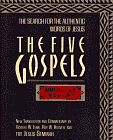
A major new work of scholarship raised eyebrows in many quarters in 1993: The Five Gospels: What Did Jesus Really Say? (Macmillan, 1993)[1] This is the product of six years of extensive consultation by a group of scholars known as the Jesus Seminar (hereafter JS), who have set out to determine the authentic words of Jesus. The result is a book that…
(1) provides a fresh, colloquial, and at times racy translation of the five gospels (Matthew, Mark, Luke, John, and the noncanonical Gospel of Thomas);
(2) colors every saying attributed to Jesus in these Gospels as either red, pink, gray, or black (red means Jesus said it; pink means it’s close to what He said; gray means He didn’t say it in this form but there are echoes of His teaching in it; and black means the saying didn’t come from Him at all); and
(3) provides passage-by-passage commentary explaining the JS’s rationale for its decisions. As the book jacket and popular press releases emphasize, only 20 percent of all the sayings of Jesus are colored red or pink and a good number of these come from Thomas!
What is going on here? Has there been some revolutionary new find that seriously discredits Christianity? No, not at all. The truth is that the JS is an anachronism—a throwback to nineteenth-century quests for the historical Jesus, and not even representative of mainstream contemporary New Testament scholarship.
What Is the Jesus Seminar?
The JS is the brainchild of well-known New Testament scholar and Greek grammarian, Robert Funk—for many years a professor at the University of Montana. Desiring to write a book on the historical Jesus as long ago as the 1970s, Funk wanted to incorporate reflections that represented a scholarly “consensus.” He came up with the idea of assembling a team of scholars that would vote on each saying of Jesus to create a new kind of red-letter edition of the Gospels—with only those sayings that really go back to Jesus colored red. In time the idea evolved into four different colors, since historical assessments involve varying degrees of probability.
As many as 200 scholars participated in the JS over the years, but the final group dwindled to 74. People dropped out for various reasons. Some expressed discomfort with how the most radical fringes of New Testament scholarship were disproportionately represented on the JS. Others voiced disagreement with Funk’s propagandistic purposes of popularizing scholarship in a way designed explicitly to undermine conservative Christian credibility.[2]
The final “Fellows” of the JS, as they are called, fall roughly into three categories. Fourteen of them are among the leading names in the field, including a few who have published major works on the historical Jesus in recent years (e.g., John Dominic Crossan of DePaul University and Marcus Borg of Oregon State). Two of these 14 are sympathetic to many evangelical concerns: Bruce Chilton (of Bard College, New York) and Ramsey Michaels (of Southwest Missouri State).
Roughly another 20 are names recognizable to New Testament scholars who keep abreast of their field, even if they are not as widely published. These, too, include several who have written important recent works on the Jesus-tradition, particularly in regard to various noncanonical gospels (e.g., Marvin Meyer of Chapman University and Karen King of Occidental College).
The remaining 40—more than half of the JS—are relative unknowns; most have published at best two or three journal articles, while several are recent Ph.D.s whose dissertations were on some theme of the Gospels. A computer-search of the ATLA and OCLC databases of published books and articles[3] turned up no entries relevant to New Testament studies whatsoever for a full 18 of the Fellows.
Overall, the Jesus Seminar is composed of Protestants, Catholics, and atheists, professors at universities and seminaries, one pastor, three members of the Westar Institute in California which sponsored the project, one filmmaker, and three others whose current occupations are entirely unidentified. Of the 74 there are three women and two Jews. Thirty-six, almost half, have a degree from or currently teach at one of three schools—Harvard, Claremont, or Vanderbilt—universities with some of the most liberal departments of New Testament studies anywhere. Only a handful come from outside North America; European scholarship is almost entirely unrepresented. Among the less well-known names are two or three additional evangelical sympathizers, but it is clear they were consistently outvoted by the “far left.”
What Did the Jesus Seminar Conclude?
The Five Gospels uses more black ink for the sayings of Jesus than red, pink, and gray put together. Only 15 sayings of Jesus are colored red—and then not always in all the different versions in which they appear in the various Gospel parallels. The red sayings are all short, pithy “aphorisms” (unconventional proverb-like sayings) such as, “turn the other cheek” (Matt. 5:39; Luke 6:29),“congratulations, you poor” (Luke 6:20; Thomas 54), and “love your enemies” (Luke 6:27; Matt. 5:44)[4]—or parables (particularly the more subversive ones) such as the Good Samaritan (Luke 10:30-35), the Shrewd Manager (Luke 16:1-8a), and the Vineyard Laborers (Matt. 20:1-15). The only saying that appears in more than two Gospels that was colored red each time was, “Pay to the emperor what belongs to the emperor and God what belongs to God” (Matt. 22:21; Mark 12:17; Luke 20:25; Thomas 100:2). This was also the only saying in the entire Gospel of Mark to be colored red.
Pink sayings are much more plentiful; an appendix lists 75. But again they are almost entirely limited to short, unconventional utterances such as one might expect from an Oriental sage or cryptic guru. Most of these come from sayings paralleled either in Matthew and Luke or in one of those Gospels plus Thomas. The gray sayings are not indexed but appear about twice as often as the pink. Indeed, the commentary explains that much of the gray matter came very close to being pink in the voting. At times over half of the Fellows voted red or pink, but the remaining black vote resulted in a gray “compromise.” Somewhat more than half of all the teaching attributed to Jesus in the Gospels, however, remains black, including virtually everything in the Gospel of John.
Sometimes longer passages are subdivided into various colors. For example, in Matthew’s version of the Lord’s Prayer (Matt. 6:9-13), “Our Father” is red. “Your name be revered,” “impose your imperial rule,” “provide us with the bread we need for the day”, and “forgive our debts to the extent that we have forgiven those in debt to us” are all pink. “And please don’t subject us to test after test” is gray, while “in the heavens,” “enact your will on Earth as you have in heaven,” and “but rescue us from the evil one” are all black. In other instances, even though the commentary notes that the Fellows found one part of a passage much more likely to be authentic than another, the text is not subdivided but all colored pink (red plus gray) or gray (pink plus black)—for example, the parable of the wedding banquet (Matt. 22:1-14). No explanation is ever given for this inconsistency.
Evaluating The Jesus Seminar’s Work
The Golden Rule (“Treat people in ways you want them to treat you”) gets only a gray coloring by the JS because it is potentially self-centered. The real Jesus, we are told, would more likely have said something like, “Treat people in the way they want to be treated.” Unfortunately, the JS did not apply this more “noble” approach to the Jesus of the Gospels. But even by the logic of the more “inferior” version of Matthew 7:12, it seems reasonable to apply the same method of color-coding to the work of these Fellows that they used on the five Gospels.
We shall therefore organize our critique under three headings: (1) red or pink material—that is, where almost all scholars would agree that the JS is probably correct in their presuppositions, methods, and conclusions; (2) gray material—that is, where the JS’s approach reflects views widely held in nonevangelical scholarship but suspect nevertheless; and (3) black material—that is, where the JS is out of sync even with the majority of nonevangelical New Testament scholarship. The percentages of material that fall into each category correspond roughly to the percentages of the various colors of ink that the JS itself employed!
Red or Pink Matter: Where the Jesus Seminar Speaks for Most Scholars
No doubt at least 20 percent and perhaps a little more of what the JS concludes is legitimate. Evangelical scholars widely agree with critics of other persuasions that it is appropriate to employ historical methods in analyzing the Gospel traditions. Christianity is a religion that makes uniquely historical claims. If a majority of the canonical Gospels' portraits of Jesus were unhistorical, the theological claims of our faith could not stand. The type of apologetics that requires belief as a presupposition for discussion fails to convince any but the already converted. So it is entirely appropriate to employ criteria of historical analysis that believers and unbelievers can share and see if the Bible can withstand such scrutiny.
In that light, we can agree with the JS and virtually all other modern scholars that the Gospels are a complex product of tradition and redaction. That is to say, the teachings of Jesus were not written down when He first spoke them but were passed along by word of mouth over a period of decades. In that process of oral tradition, they were paraphrased, abbreviated, combined together in small collections, applied to a wide variety of situations in the early church, and ultimately put in the form in which we now find them by the writers of the Gospels themselves. However, we believe that all of this took place under the superintendence of the Holy Spirit, and through His inspiration the writers accurately reported exactly what He wanted them to represent of the life and teachings of Jesus.
These writers functioned as “redactors”—that is, editors—choosing which teachings of Jesus they wanted to include, in what order, and in keeping with the distinctive theological purposes they considered most crucial for the Christian communities to which they were writing. Mark was probably the first Gospel written. Matthew and Luke each drew on Mark as well as probably on “Q” (from the German Quelle, meaning “source”)—a hypothesized document composed primarily of teachings of Jesus (which explains why Matthew and Luke have a lot of material in common not found in Mark, but almost always limited to Jesus' sayings). John, however, wrote later and more independently, accounting for the greater differences between his Gospel and the previous three “synoptic” Gospels.
This process of oral tradition plus written editorial activity accounts for why virtually any saying of Jesus of any length that is found in more than one Gospel does not appear word-for-word in exactly the same form. So also does the fact that Jesus spoke in Aramaic but the Gospels were written in Greek. Literal translation from one language to another inevitably breaks down at numerous points. The ancient world, moreover, had no symbol for quotation marks and no conviction that a verbatim account of someone’s speech was any more or less valuable than an accurate paraphrase. Missing, too, was any concept that detached objectivity was somehow a virtue for writers of history (although there was a concern for reporting facts faithfully and accurately [Luke 1:1-4]). What point was there in telling the stories of the teachings and actions of great individuals if not to learn something from their examples?
So we need have no objection in principle to the idea that some of Jesus' teachings are fairly literal translations of His actual words (red) and that others are more paraphrastic in nature (pink). We can even accept some of the JS’s reasons for coloring a saying gray, as, for example, when it believes that the words of a saying reflect a mixture of Jesus' wording and the later Gospel writer’s favorite vocabulary, so long as the essence of the teaching is faithful to Jesus' original intent. (In many instances, however, gray for the JS means that they find some part of a saying objectionable and not consistent with Jesus' original speech.)
Gray Matter: Where the Jesus Seminar Speaks Mostly for Liberal Scholars
There are at least 10 important areas in which the JS adopts assumptions and perspectives that are widely held in nonevangelical scholarship but which need to be challenged. Those assumptions include:
The authors of the four canonical Gospels are not Matthew, Mark, Luke, and John, as traditionally believed.
None of these four Gospels were written before the fall of Jerusalem in A.D. 70.
The oral tradition of Jesus' sayings was quite fluid. Simple teachings were often greatly expanded, embellished, and distorted in the process.
Various people in the early church, including the Gospel writers themselves, felt free to invent sayings of Jesus that had little or no basis in what He actually taught.
If a saying can be demonstrated to promote later Christian causes, it could not have originated with Jesus.
The historicity of John’s gospel is extremely suspect.
Historical analysis cannot admit the supernatural as an explanation for an event. Therefore, Jesus' words after His resurrection—like His earlier predictions about His death, resurrection, and return—cannot be authentic.
Jesus never explained His parables and aphorisms. All concluding words of explanation, especially allegorical interpretations of parables and metaphors, are thus inauthentic.
Jesus never directly declared who He was. All such “self-referential” material (in which Jesus says, “I am…” or, “I have come to…”) is therefore also inauthentic.
The burden of proof rests on any particular scholar who would claim authenticity for a particular saying of Jesus and not on the skeptic.
Space obviously precludes a detailed response to each of these 10 claims. But we can at least sketch out the broad contours of a reply.
The external evidence (i.e., the testimony of the early church) uniformly attributes authorship of the first three Gospels to Matthew, Mark, and Luke. It is not likely that the church would have ascribed two of these three Gospels to men who were not among the original twelve apostles (Mark and Luke), and the other one to the notorious ex-tax-collector (Matthew), unless there was strong reason for believing them to be the original authors. Modern-day objections to these ancient traditions have all been adequately answered in a variety of published works.[5]
The same external evidence suggests that Matthew and Mark should be dated at least as early as the 60s. Internal evidence places Luke in that time frame as well, since his second volume, the Book of Acts, ends abruptly with Paul awaiting the outcome of his appeal to the emperor in Rome. The best explanation of that abrupt ending remains the assumption that Luke was writing while Paul was still in house-arrest and hence no later than A.D. 62. Early Christian tradition, on the other hand, puts John’s gospel in the 90s but usually attributes it to John the apostle, one of Jesus' closest followers, so that here we have reputable eyewitness testimony.
In each case, the four Gospels were most probably written by people in a position to know and accurately preserve Jesus' teaching—Matthew and John because they had personally accompanied Jesus; Luke because he had talked with eyewitnesses and engaged in careful historical research (Luke 1:1-4); and Mark (again according to the church fathers) because he had ministered together with Peter in Rome (cf. also 1 Pet. 5:13).[6]
Careful studies of ancient Jewish culture and surrounding nations demonstrate that oral traditions held sacred were preserved with remarkable care. The New Testament world was an oral culture, producing prodigious feats of memory. Rabbis at times had memorized the entire Scriptures (our Old Testament). Such abilities did not preclude the freedom to retell stories with all kinds of minor variation in detail so long as the point of each story or teaching was left intact. The alleged tendency of traditions to develop from simple to complex has been repeatedly refuted; if anything, there was a slight tendency to abbreviate more lengthy narratives.[7]
There is not a single piece of hard data demonstrating that early Christians felt free to create out of whole cloth sayings of Jesus which He never spoke. The most common way this assumption has been defended is by the idea of prophecy: New Testament prophets spoke in the name of the risen Lord and their words were allegedly later intermingled with those of the historical Jesus. But while such practices may have occurred with other gods or historical figures in nearby cultures, every reference to the words of Christian prophets inside and outside the New Testament canon makes it clear that they were not confused with the words of the Earthly Jesus.[8]
Although it is widely believed that theological motives impugn historicity, such a belief rests on a patently false dichotomy. As already noted, ancient history was not written according to today’s standards of scholarly detachment. If sayings of Jesus relevant to the later church must be discounted, then so must the words of the Roman historians Tacitus and Suetonius, and the Jewish historian Josephus, when they help to promote Roman or Jewish causes. In such cases, we would be left with almost total agnosticism about ancient history, a conclusion few scholars are prepared to promote.
The fallacy, of course, is to imagine that telling a story for a purpose, even in service of a cause one believes in passionately, necessarily forces one to distort history. In our modern era, some of the most reliable reporters of the Nazi Holocaust were Jews passionately committed to seeing such genocide never repeated. In this case, it is the appalling later revisionism of those who claimed the Holocaust never happened that has distorted history, not the testimony of those passionately caught up in the events of the time.[9]
John is quite different than the Synoptics, but that does not make him any less historical. Precisely because he is largely independent of them, he has chosen to focus on different aspects of Jesus' teaching and career. Interestingly, John actually has more references to time and place—including details about first-century Palestine that have been strikingly corroborated by archeology—than do the Synoptics. I have elsewhere written in greater detail about the differences among the four Gospels (and the more general question of the historical reliability of the Gospels) and I refer the reader to that more extensive discussion.[10]
Antisupernaturalism is historically reductionistic (i.e., overly limiting what may have actually happened) and philosophically untenable. The historian may not personally be convinced by the testimony of Jesus' disciples that they saw Him alive again after His death. But that gives him or her no right to color all sayings of the resurrected Jesus black (i.e., in Matthew 28, Luke 24, and John 20-21). This the JS did on the highly debatable grounds that “words ascribed to Jesus after his death are not subject to historical verification.”
Since numerous credible eyewitnesses reported seeing and hearing Jesus on several occasions, historical verification is not really the problem. The problem rather is that no evidence for a resurrection will be satisfactory if one has concluded a priori that miracles cannot happen. But such a position is not based in historical research but rather in philosophical bias. Thus it provides no good basis for rejecting the words of the resurrected Christ.
Almost all rabbinic parables (of which over 2,000 have been preserved) have some kind of allegorical explanation. It is hard to believe, therefore, that Jesus the Jew did not give some kind of indication as to what His more pithy and controversial teachings meant. Indeed, the whole parable-Allegory dichotomy is another false one, and again I must refer the reader to my book-length discussion of the matter for further detail.[11]
It is inherently improbable that Jesus (or any other sage) would never talk about Himself in the first person. The real reason behind this claim is that many modern scholars are reluctant to believe that Jesus made the specific claims for Himself which the Gospels say He did. Often this is because they would then have to come to grips with His claims upon their lives—demands that they are not prepared to accept (e.g., “I am the way, and I am truth, and I am life…No one gets to the Father unless it is through me”—John 14:6).[12]
Applying the “believer’s burden of proof” criterion to historical inquiry in general would leave us with virtually no secure knowledge of anything in the ancient world. It is flatly contrary to the approach of ancient historians more generally, who assume that if writers prove trustworthy where they can be tested, they are given the benefit of the doubt where they cannot be tested. Repeatedly the Gospel writers have proved themselves reliable in this respect, so the burden of proof should fall squarely on the skeptics' shoulders.
Black Matter: Where the Jesus Seminar Speaks for Few Scholars
Perhaps the most striking feature of The Five Gospels is how out of touch it is even with mainline scholarship. In fact, a major movement among New Testament critics has generated what has been dubbed “the third quest” for the historical Jesus. This quest has been far more optimistic than its predecessors in claiming that substantial amounts of material about what Jesus said and did can be recovered from the canonical Gospels. Indeed, two of the major contributors to this quest—James Charlesworth of Princeton and E. P. Sanders of Duke—agree that “the dominant view today seems to be that we can know pretty well what Jesus was out to accomplish, that we can know a lot about what he said, and that those two things make sense within the world of first-century Judaism.”[13]
It is this final clause that the JS virtually ignores. Their Jesus does not make sense in the world of Judaism. Indeed, every time Jesus looks too much like other Jewish teachers of His day, His words are discounted as inauthentic for that very reason. The JS’s Jesus resembles a Greco-Roman philosopher; a cynic sage; an itinerant speaker who never refers to Scripture, who never speaks more than one short parable on any occasion, who engages in no extended dialogues or controversies with the religious leaders of His world.
The one historical fact that almost everybody agrees on—that Jesus was crucified—finds no adequate explanation in the Jesus that is left after the JS excises 80 percent of His teachings. As leading Catholic scholar John Meier puts it in his much more representative, recent work on the historical Jesus, “A tweedy poetaster who spent his time spinning out parables and Japanese koans, a literary aesthete who toyed with 1st-century deconstructionism, or a bland Jesus who simply told people to look at the lilies of the field—such a Jesus would threaten no one, just as the university professors who create him threaten no one.”[14]
On the other hand, the JS is far more optimistic than most scholars about the possibility of unearthing reliable, independent, presynoptic traditions in the Gospel of Thomas. Their dating of Thomas to about A.D. 50 is at least one century earlier than anything the external evidence (or the majority of scholars) supports. This noncanonical, Apocryphal document is a collection of 114 sayings attributed to Jesus. About one-third of them are clearly Gnostic in nature; about one-third are quite similar to short aphorisms and parables of Jesus in the canonical Gospels; and about one-third contain otherwise unknown teachings ascribed to Jesus that are not demonstrably unorthodox but which could lend themselves to Gnostic interpretations.
Many scholars have often wondered if a few sayings of Jesus in Thomas might reflect independent, authentic traditions not previously known. But most scholars believe a majority of the sayings reflect a later stage of the tradition, when a concern for special wisdom and elitist knowledge outstripped the concerns of the original Jesus.[15]
The JS implausibly inverts this sequence. Instead of an apocalyptic Jesus teaching about a future kingdom that is now at hand—heralding the arrival of a messianic age and fulfilling the hopes of the children of Israel, as twentieth-century scholarship has predominantly stressed—the Fellows' Jesus speaks only of a present, timeless kingdom and merely offers wise advice about how to live at peace in a hostile world. Any hint of apocalyptic is assigned to a secondary stage of the tradition.
This Jesus is more Gnostic—concerned primarily to impart true knowledge—than anything orthodox Christianity has ever accepted. Today we might call it “New Age.” But given the JS’s stated goal of discrediting orthodox Christianity and going beyond mainstream scholarship (despite their repeated claims that they represent a consensus), this conclusion should not be surprising.[16]
There are numerous other ways in which the JS is idiosyncratic even among nonevangelical scholars. We have room merely to list ten of them here; the implausibility of most of the following positions should be obvious. (1) The JS’s methodology is highly reductionistic: no teaching that cannot be separated from the narrative in which it is embedded (i.e., which could not have circulated by itself in the oral tradition) can be authentic. (2) No teaching that is neither a parable nor an aphorism can be authentic. (3) Anything with parallels in the “common lore” of the day is suspect; somebody else probably falsely attributed it to Jesus. (4) Jesus said nothing, however implicitly, to suggest a messianic consciousness (not even a merely human messianic consciousness). (5) Hence, Jesus never used the title “Son of man,” even though this passes all other criteria of authenticity with flying colors as the most distinctive and characteristic way in which Jesus spoke about Himself. (6) Almost all of the passion narrative sayings are colored black, since Jesus spoke nothing about His death or its significance. (7) Jesus never taught anything about final judgment or threatened people with God’s wrath. (8) He never debated with anybody, never preached sermons, never compared His teaching with what was found in the Law. (9) Our current Gospels are relatively arbitrary in the order in which they arrange Jesus' teachings. (10) Nevertheless, other historical sources from antiquity are quoted (e.g., Josephus on Jesus son of Ananias and on Eleazar the exorcist) as if they can be trusted implicitly. And in one place, based on no allegedly historical information of any kind—inside or outside the canon—the Fellows “regard it as probable that [Jesus] had a special relationship with at least one woman, Mary of Magdala,” so that they doubt Jesus was celibate![17]
The False Claim Of A Consensus
The JS claims to represent a consensus of “critical” scholars—that is, scholars whose conclusions are not already predetermined by religious confessions. In claiming such a consensus they are highly misleading. Adela Yarbro Collins, a leading New Testament scholar at the University of Chicago, wryly noted in a recent meeting of the Society of Biblical Literature that at some of the proceedings of the JS, two of its leaders would get together and, whenever they would agree on an opinion, they would announce to the rest: “There is a consensus among scholars…”!
We have noted above numerous ways in which the JS reflects the “radical fringe” of critical scholarship and generally does not include the most established scholars of a more moderate perspective. Once it is admitted that evangelical scholars can also be “critical” and not allow their beliefs to predetermine their historical conclusions (an admission the JS is unwilling to make), it becomes clear that the JS’s claims to represent consensus views on more than a small percentage of the issues they address are simply false.
Author: Craig L. Blomberg, Copyright 1994 by the Christian Research Institute, P.O. Box 7000, Rancho Santa Margarita, CA 92688-7000. Used by permission.
See also: Are “The Jesus Seminar” criticisms of the gospels and Jesus Christ valid?
References and Footnotes
- Ed. Robert W. Funk and Roy W. Hoover. [up]
- See Robert W. Funk and Mahlon H. Smith, The Gospel of Mark: Red-Letter Edition (Sonoma, CA: Polebridge, 1991), xvi-xvii. [up]
- The January 1993 CD-ROM of the American Theological Library Association indexes all articles in journals or multi-author works listed in Religion Index One and Two, a standard index of articles in the field. The Online Computer Library Center (OCLC) is the comprehensive database of books available for interlibrary loan in North America, including all major theological libraries. [up]
- All translations of gospel portions come from the JS’s “Scholars, Version,” not least to give the reader a feel for the nature of that translation. [up]
- Conveniently summarized, e.g., in the relevant sections of textbooks such as D. A. Carson, Douglas J. Moo, and Leon Morris, An Introduction to the New Testament (Grand Rapids: Zondervan, 1992). [up]
- See: Robert H. Gundry, Matthew: A Commentary on His Literary and Theological Art (Grand Rapids: Eerdmans, 1982), 599-622; idem, Mark: A Commentary on His Apology for the Cross (Grand Rapids: Eerdmans, 1993), 1026-45; Colin J. Hemer, The Book of Acts in the Setting of Hellenistic History (Tubingen: Mohr, 1989), 308-410; Leon Morris, Studies in the Fourth Gospel (Grand Rapids: Eerdmans, 1969), 45-92. [up]
- By far the most important study of these features of the oral tradition is Rainer Riesner, Jesus als Lehrer (Tubingen: Mohr, 1981), unfortunately never translated into English. See: his“Jesus as Preacher and Teacher,” in Jesus and the Oral Gospel Tradition, ed. Henry Wansbrough (Sheffield: JSOT, 1991), 185-216. See: also Kenneth E. Bailey, “Informal Controlled Oral Tradition,” Asia Journal of Theology 5 (1991), 34-54; and Leslie R. Keylock, “Bultmann’s Law of Increasing Distinctness,” in Current Issues in Biblical and Patristic Interpretation, ed. Gerald F. Hawthorne (Grand Rapids: Eerdmans, 1975), 193-210. [up]
- See: David Hill, New Testament Prophecy (London: Marshall, Morgan Scott, 1979); and David E. Aune, Prophecy in Early Christianity and the Ancient Mediterranean World (Grand Rapids: Eerdmans, 1983). [up]
- One of the best discussions of how a gospel can be both history and theology remains I. Howard Marshall, Luke: Historian and Theologian (Grand Rapids: Zondervan, 1970, rev. 1989). [up]
- Craig L. Blomberg, The Historical Reliability of the Gospels (Downers Grove, IL: InterVarsity Press, 1987). [up]
- Craig L. Blomberg, Interpreting the Parables (Downers Grove, IL: InterVarsity Press, 1990). [up]
- Cf., e.g., the candid admissions of Burton L. Mack, The Lost Gospel: The Book of Q and Christian Origins (San Francisco: HarperCollins, 1993), 245-58. Mack was not one of the final Fellows of the JS but his writing closely reflects their distinctive approach to Jesus. [up]
- E. P. Sanders, Jesus and Judaism (London: SCM, 1985), 2; quoted by James H. Charlesworth, Jesus within Judaism (New York: Doubleday, 1988), 205. [up]

- John P. Meier, A Marginal Jew: Rethinking the Historical Jesus, vol. 1 (New York: Doubleday, 1991), 177. [up]
- The two most detailed studies defending this conclusion are both in German: Wolfgang Schrage, Das Verhaltnis des Thomas-Evangeliums zur synoptischen Tradition und zu den koptischen Evangelienubersetzungen (Berlin: TUpelmann, 1964); and Michael Fieger, Das Thomasevangelium: Einleitung, Kommentar und Systematik (Munster: Aschendorff, 1991). More briefly, but in English, cf. Christopher M. Tuckett, “Thomas and the Synoptics,” Novum Testamentum 30 (1988), 132-57; and Meier, 123-39. [up]
- Funk’s agenda becomes obvious when he expresses disappointment that the JS colored only a handful of unparalleled sayings in Thomas pink. He is obviously not wanting to reflect an existing consensus but to move beyond it to bold, new historical judgments. See: especially Five Gospels, 524-25. [up]
- Ibid., 221. [up]
Part Two in a Three-Part Series on Liberation Theology, from the Book Reviews column of the Christian Research Journal, Fall 1994, page 32. The Editor-in-Chief of the Christian Research Journal is Elliot Miller.