What are some of the current new ideas and problems being discussed by Flood geologists?
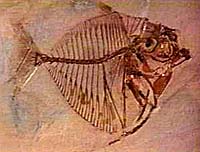
The answer provided below is for those who desire a deeper knowledge of geology, especially as it relates to the Flood and pre-Flood history.
[ To read the author's introductory summary of the history of geologic study, click here ]
In this article learn about:
- Developing young Earth creationist views about Flood geology
- Where does the geologic column fit with Flood geology?
- What is the real meaning of the geologic Periods?
- What is the significance of dinosaur tracks and egg nests?
- Common misconceptions about the Flood and geology
- Summary of early Earth history
- Flood model being replaced by Creation/Curse/Catastrophe Model for interpreting geologic facts
- Were significant geological changes and fossilization occurring before the Flood? After the Flood?
- Was some of Earth's geology a result of the Creation week events?
- Was the pre-Flood world a “time of exceptional Divine interventions upon the Earth”?
- Why the present "cannot be considered the key to the past regarding geological rates"
- What important questions remain unanswered?
- etc.
CONTENTS: The Geologic Column / Proposed Creation/Curse/Catastrophe Model / On Newly Created Earth / Eden and Its Garden / The “Very Good” Earth Becomes Tainted / The Curse Intensifies / Direct Divine Government / Change of Government / Easing of the Curse / An Exceptional Time / Other Geologic Implications / Correlation by Fossils / Homotaxis and Synchronism / Tracks and Nests / Genesis Flood Event and Stratigraphy / Acknowledgments / References / Author
by Bob Gentet, Creation Research Society
George McCready Price (1870-1963) can be credited with the renewal of Flood geology. Modern historians such as Numbers (1992, p. 73) label Price as probably “the greatest” of the “anti-evolutionists” early that century. Beginning in 1902 with Outlines of Modern Christianity and Modern Science, an almost catastrophic stream of Flood geology books/articles emanated from Price.
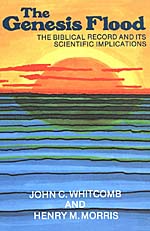
But the real impact of Flood geology literature did not begin until such books as The Flood (Rehwinkel, 1951) and The Genesis Flood (Whitcomb and Morris, 1961) appeared along with many others who followed in Price's steps.
Among current young-Earth creationists, particularly in America, variations of Price's Flood model dominate as explanations of the geologic record. In that model, the vast majority of fossiliferous strata is believed to have been formed as a result of the Deluge or its aftermath. In contrast, little geologic activity is pictured as occurring between Adam and the Flood. Furthermore, any pre-Flood deposits generated are viewed as probably destroyed by the Flood (Morris, 1994, p. 106; Austin and Wise, 1994, p. 39; Walker, 1994, p. 584).
Whitcomb and Morris (1961, pp. 239-243) list Scriptural references (Genesis 1:6-8; 2:5-6; 7:11) which to them imply "that the age between the fall of man and the resultant Deluge was one of comparative quiescence geologically." Wise (1992, p. 168), using the same Scriptures, urges caution, realizing that "to determine what the pre-Flood climate was truly like, it is necessary to supplement Scriptural data with physical data." Creationists must be certain that both Scriptural understanding and physical data coincide. Significantly, creationists, using the Flood model, have been unable to reach consensus regarding the extent of the Genesis Flood Event in the stratigraphic record.
The Uncertain Lines
The stratigraphic extent of the Genesis Flood Event has persisted in Flood geology as a major enigma:
Creationists differ on where the pre-Flood/Flood and Flood/post-Flood geological boundaries should be defined… Although many creationists would seem to include all Phanerozoic deposits less than Holocene among Flood deposits, others would tend to include all the Phanerozoic less the Neogene.
Others would tend to include only the Paleozoic and Mesozoic, others would include only the Paleozoic or Lower Paleozoic, while others would remind us that the boundary may have to be determined differently in different places. Much research is needed… (Wise, 1992, p. 170).
Since Wise's statement in 1992, much more discussion and research have appeared in creation literature. Nevertheless, a resolution has not been forthcoming. Without such resolution, the young-Earth creationist cannot understand the stratigraphic record in an orderly way.
Another critical aspect of this question is revealed by Wise during an interview in Bible-Science News (1995, p. 18):
To my knowledge, virtually all creation geologists accept the entire Cenozoic as post-Flood. The real debate among us is whether the Mesozoic should also be seen as post-Flood. The European creation geologists tend to want to make the Mesozoic post-Flood, whereas Steve [Austin], Andrew Snelling, and I would put the Mesozoic as Flood.
The Creation/Curse/Catastrophe model presents evidence showing that it is totally unrealistic to “accept the entire Cenozoic as post-Flood.” Not only is it Biblically unrealistic, it is also geologically unrealistic, assuming a young-Earth model is used.

The stratigraphic record often depicts very limited ecological environments. Fossil plants and animals from radically diverse environments are rarely found mixed in random patterns. This factor was often overlooked or rejected by early creationists such as George McCready Price who strongly felt that the geologic record did not present an orderly pattern (1926, pp. 71-72).
Many creationists today realize the geologic record is much more orderly than Price ever imagined. Harold W. Clark, one of Price's own students, is an early example (1968, p. 42):
Then, too, I found that there was much more regularity to the stratified rocks than Price had recognized, and this, too, was developed by explaining this order and system as due to the burial of the ancient life zones rather than to a succession of life during long geological ages.
Clark credited the fossil order to the Flood's ability to bury flora and fauna in sequence of the biozones present. This concept was a great step forward as it acknowledged the general fossil sequence without giving it an evolutionary interpretation.

Nevertheless, well-known creationist geologist Snelling (1995, p. 162) speaks of:
…the creationist 'myth' that the geologic column is the product of an evolutionary/uniformitarian 'conspiracy' and so essentially doesn't exist/isn't real… However, the physical reality of the strata of the geologic column cannot be ignored, as they do exist. The early geologists in Europe, for example, were able to physically trace the stacking of the continuous sequences of strata from country to country, and then later similar (and often identical) stacking of sequences was found on other continents. It is time for creationists to bury their 'myth', face up to the reality of the geologic record (not the time scale imposed on it, of course), and tackle the exciting task of building the Flood model of Earth history based on that record.
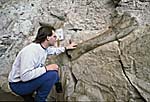
Wise echoes these same conclusions about the consistency of the order of fossils in the stratigraphic column:
Some creationists for a long time have been arguing that 'there ain't no such thing as the geological column.' But all the creation geologists I know disagree with that… the creation geologists are pretty uniform in their belief that the stratigraphic column is a valid order. But we can't convince the lay creationists community of that… It's an historical problem. It was George McCready Price's argument, and it's been repeated since then. But if you run up and down hills, looking at strata and beating on rocks, you'd be stunned by the consistency of the order (Bible-Science News, 1995, p. 18).
Watts (1984, p. 21) earlier had cautioned about drawing too much out of the Scriptural account of the Flood and thereby not allowing for the pre-Flood world as "a possible era of fossilization to be considered along with the Deluge year and the post-Flood era."
Creation/Curse/Catastrophe Model
The Creation/Curse/Catastrophe model advanced in this article acknowledges the reality of the order of the stratigraphic column. Among its postulates:
In agreement with the Flood Model:
biozonation as a characteristic of nearly all newly created life forms
a world-wide Flood of great geologic importance
In contrast with the Flood Model: considerable pre-Flood geologic evidence is preserved in the stratigraphic record.
Genesis One and Two reveal life needing time to “fill” the Earth.
The “Curse” on the pre-Flood Earth was God's direct method of dealing with sinful humanity. It was progressive in intensity and left a fossil record of God's acts in history. The lessening of the Curse after the Flood is promised in the Noahic Covenant and results in God establishing human governments to administer civil crime punishments.
Geologic “Periods” are, in reality, ecosystems each having characteristic life forms. All “Periods” (ecosystems) were present to some degree on the Earth immediately after Creation Week. Geologic events throughout the pre-Flood times locally stratified changing ecosystems (later interpreted as “Periods” by early geologists).
Man's life-sustaining ecosystem (“Cenozoic”) is seen in the Creation/Curse/Catastrophe Model as starting geographically very small and expanding during pre-Flood times allowing the growing human population to eventually fill the Earth.
Not all ecosystems (“Periods”) are seen as surviving until the Flood, and few except those of the “Cenozoic” appear to be post-Flood.
The “Periods” tend towards a similar worldwide stratigraphic sequence, because each local ecological succession tends to enlarge its food web, and this food web enlargement is “evolutionary” in appearance. “Evolutionary” geologic succession is actually a reflection of this ecological succession through the course of time since Creation Week (see Table I).
Fossil correlation between distant areas was made possible by the systematic changes of the Earth's past ecosystems. Burial and fossilization of these ecosystems resulted from the intensified Curse during the pre-Flood Earth, the Genesis Flood Event, and post-Flood happenings.
The fossil record has many time indicators such as footprints which can only rarely, at best, be placed into the Genesis Flood Event itself and most often represent pre-Flood or post-Flood geologic events.
According to the Creation/Curse/Catastrophe model, three major worldwide unconformities in the fossil record could be expected:
the end of Creation Week
the end of the pre-Flood world and the beginning of the Genesis Flood Event
the end of the Genesis Flood Event and the beginning of the post-Flood world.
Between the (a) and (b) local unconformities may also be found in the abundant, pre-Flood fossiliferous record.
The pre-Flood/Genesis Flood Event or Genesis Flood Event/post-Flood breaks cannot be expected at the same geologic “Period” worldwide and must be determined in each area through research.
Lack of proper understanding of the pre-Flood world is making location and/or recognition of the Genesis Flood Event within the stratigraphic record controversial with current Flood models. The Creation/Curse/Catastrophe model is presented in hopes of finding a more accurate interpretation of the geologic record through incorporating a different Scriptural understanding of the nature of the pre-Flood world.
On Newly Created Earth

By the end of the Sixth Day, God had prepared the Earth as a fit place for life. Klotz (1970, pp. 489-498; 1985, pp. 193-205) has nicely summarized how the solar system, the Earth and its flora and fauna are all arranged in a way to make the Earth extremely suitable for life.
To Adam and Eve God said: "Be fruitful and increase in number; fill the Earth and subdue it" (Genesis 1:28a NIV). Although He could have, Scripture reveals that God did not immediately create a world full of people. He reveals creation of one male directly from the dust of the Earth (Genesis 2:7) and then one female directly from one of Adam's ribs (Genesis 2:21-23). Human habitation was centralized in the beginning and only spread as population increased and opportunity arose.
Geologically, this means that human presence within the fossil record at any geographic location should not be expected unless there had been time and opportunity for human migration and the ecosystem would be one that could support human life. In addition, the longer life span for pre-Flood peoples would tend to delay the appearance of human fossils/artifacts in the fossil record.

Life forms other than Man were also created in limited numbers. They also needed time to increase in number before other areas of the Earth felt their presence. Notice specifically how the creation of sea creatures and birds is described: "Be fruitful and increase in number and fill the water in the seas, and let the birds increase on the Earth" (Genesis 1:23 NIV).
God's blessing on them, later repeated in His directive to humans, implies these creatures were restricted in number and location and required time to fill their ecological niches.
In addition, life forms can expand into other areas only when the ecosystem of the other areas can support them with proper food and environment. This principle, incorporating hundreds of years of pre-Flood time and geologic events and resultant changing ecosystems, is fundamental to an understanding of the Creation/Curse/Catastrophe geologic model.
While a restricted creation is not specifically mentioned in the Scriptures of land animals, we know by observation today—long after the redistribution of the animals after the Flood—that few animals actually have universal distribution. Klotz (1985, p. 135) speaks of six present-day areas of geographical distribution of plants and animals and mentions that "except for the earthworm and the ant, there are no plants or animals which are approximately universal in their distribution over the globe." While a few other examples might be cited, such contemporary observations indicate biozonation should be a norm since Creation Week. Biozonation is commonly accepted as part of the current Flood model (Morris, 1974, p. 117.)
These built-in ranges of habitats result in limited mixtures of flora and fauna in each environment or ecological niche. These restricted habitats play important roles in determining what life forms are available for preservation as fossils in each area at any given time.
Eden and Its Garden
Scripture provides some details regarding placement of Adam and Eve on the newly created Earth. Genesis 2:8-9a informs us:

Now the LORD God had planted a garden in the east, in Eden; and there He put the man He had formed. And the LORD God made all kinds of trees grow out of the ground—trees that were pleasing to the eye and good for food (NIV).
Adam and Eve were placed in a garden with trees that furnished them food. The trees producing fruit “good for food” for humans are classified as angiosperms and are the characteristic flora of “Cenozoic” strata. Also, angiosperms "supply nearly all the plant food for the mammals that now dominate all other life upon the Earth" (Dunbar, 1960, pp. 333, 336). Here is clear Scriptural evidence that at least this small portion of the newly created Earth was “Cenozoic” in its ecosystem/environment. This would demand some “Cenozoic” strata dating from pre-Flood and/or Genesis Flood Event times.
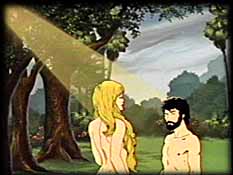
Where the Garden of Eden was located in reference to our modern-day political boundaries is unknown and open for research. The issue of Eden's extent and location of its Garden is critical and needs to be thoroughly researched. Its location provides a guideline of where to expect (or not expect, as the case may be) to find the earliest human remains in the fossil record.
If the Garden had been preserved in the early fossil record, the Creation/Curse/Catastrophe model predicts that Eden's location would be found on top of basement “Precambrian” strata and contain “Cenozoic” life forms, since clearly Eden is described as having plants and animals consistent with “Cenozoic” types.
We do not know from Scripture the exact geographic extent of “Eden,” but the Creation/Curse/Catastrophe model assumes this “Cenozoic” (angiosperm/mammal) land ecosystem was originally quite limited in extent at Adam's and Eve's creation. The geologic record may later prove useful in making this determination.
Only the area called “Eden” is assumed by the Creation/Curse/Catastrophe model as having a “Cenozoic” environment at the end of Creation Week. And as the characteristic flora and fauna associated with this ecosystem created for Man expanded in area, surrounding ecosystems became greatly affected. For example, as angiosperms invaded the dinosaur ecosystem (“Mesozoic”), great changes occurred, as we shall later explore.
A basic postulate of the Creation/Curse/Catastrophe model is that angiosperms and mammals (associated with humans from the ending of Creation Week) became more widely distributed as time passed in the pre-Flood world and human population increased and demanded a larger living area. Biozones expanded or contracted during pre-Flood time as environments changed due to geologic events, ecosystems matured, or other important factors such as migration. This point is crucial in evaluating the fossil record. And now we must examine some Scriptural reasons to expect fossil evidence from the pre-Flood world.
The “Very Good” Earth Becomes Tainted
Genesis One concludes with the announcement: "God saw all that He had made [the previous six days], and it was very good" (verse 31). God was well-pleased with His handiwork, and rightly so, but something was about to radically change.

Adam and Eve were created in harmony with their Maker. Furthermore, God saw to it that their every need was supplied. In spite of this, they yielded to the temptations and lies of the serpent (Satan). Their sin resulted in a four-fold, broken relationship:
The result [of sin] was a fall in four different areas. The relationship between God and man was now broken… The relationship between man and his fellow man was severed… The bond between man and nature also was broken, with the ground producing thorns and thistles and the animal world no longer being benevolent (Genesis 3:17, 18). Man also became separated from himself… (McDowell and Stewart, 1993, p. 69.)
In the Creation/Curse/Catastrophe model, we are principally interested in the effects of the Curse on the broken relationship between humankind and the Earth itself and its ecosystems. The first result of the Curse is found in Genesis 3:17-19:
To Adam He [God] said, “Because you listened to your wife and ate from the tree about which I commanded you, ‘You must not eat of it,’ cursed is the ground because of you; through painful toil you will eat of it all the days of your life. It will produce thorns and thistles for you… By the sweat of your brow you will eat your food until you return to the ground, since from it you were taken; for dust you are and to dust you will return” (NIV).
Mankind's certain return to the dust is only one aspect of sin. One of the major emphasis of the Genesis Curse is on the ground, the Earth itself. Sin breaks mankind's harmonious relationship with the Earth and its creatures. Ecology and geology immediately become linked to the Curse. The pre-Flood world became an unpleasant dwelling place. The Curse made it a very different world from the “very good” one pronounced earlier at the conclusion of Creation Week.
The Curse Intensifies
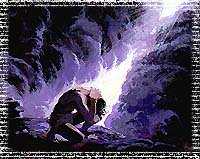
Later, when Cain killed his brother, Scripture reveals that the effect of the Curse would intensify:
Now you are under a curse and driven from the ground, which opened its mouth to receive your brother's blood from your hand. When you work the ground, it will no longer yield its crops for you. You will be a restless wanderer on the Earth (Genesis 4:10-12 NIV).
The Curse intensified: growing crops now became more difficult. Apparently, after Cain's sin, wandering and gathering became the norm for satisfying humankind's need for food. Something drastic seems to have happened to the pre-Flood Earth's ecosystem. Paradise was truly lost. God spared Cain's life, but the Earth itself provided the curse by driving Cain from the ground. Even in modern times, various events such as volcanism can disrupt food production and produce harsh environments (White and Humphreys, 1994). The Creation/Curse/Catastrophe model postulates that the pre-Flood world was filled with many such disasters.
Direct Divine Government
Cain grew very anxious thinking that a relative would kill him in revenge. God's response to Cain's concern holds an important Biblical principle about the pre-Flood world. When Adam and Eve sinned, God directly intervened and punished them. Later, when Cain killed Abel, God personally delivered the penalty. And when Cain worried that one of his relatives would take matters into his own hands, God's response is very revealing: "Not so, if anyone kills Cain, he will suffer vengeance [from Me] seven times over" (Genesis 4:15 NIV).
God not only personally meted out the punishment, but the punishment intensified as sin piled upon sin. And the punishment was directed at the Earth itself. There is no mention of God using capital punishment prior to the Flood event. People seemed to automatically understand that God personally took revenge for sin by increasing the penalty (the Curse) on the Earth. This seems understood by Lamech, because when he killed a man, he states: "If Cain is avenged seven times, then Lamech seventy-seven times" (Genesis 4:24 NIV).
Men prided themselves at fighting God and boasting about their evil deeds! In this regard, see Eusebius (1923, pp. 21-23.) In the long time span between creation and the Genesis Flood Event (at least 1656 years), Scripture tells us:
“Now the Earth was corrupt in God's sight and was full of violence. God saw how corrupt the Earth had become, for all the people [‘flesh’] on Earth had corrupted their ways” (Genesis 6:11-12).
It was a world of terror, violent people, and violent ecological disasters from the hand of God, ending in total human destruction at the Genesis Flood Event except for those in the Ark. Neither is there mention in the pre-Flood world of human government inflicting the penalty for civil crimes. That was yet to be authorized by God.
A Change of Government
As the few survivors from the Ark were about to venture out into the post-Flood Earth, for the first time the Lord institutes human government for purposes of punishing crime:
And for your lifeblood I [God] will surely demand an accounting. I will demand an accounting from every animal. And from each man, too, I will demand an accounting for the life of his fellow man. Whoever sheds the blood of man, by man shall his blood be shed; for in the image of God has God made man (Genesis 9:5-6 NIV).
This is the beginning of civil government empowered by God to keep the peace among peoples. St. Paul says in Romans 13:1-5:
Everyone must submit himself to the governing authorities, for there is no authority except that which God has established [apparently referring back to Genesis 9:5-6, the beginning of nations]… For he is God's servant to do you good. But if you do wrong, be afraid, for he does not bear the sword for nothing. He is God's servant, and agent of wrath to bring punishment on the wrongdoer (NIV).
While civil governments (city states) may have existed without God's sanction prior to the Flood, they are only mentioned as a God-given, post-Flood development (Genesis 10). Hence, there is a Scriptural reason to suppose that God's pre-Flood punishments were much more severe in their ecological and geological extent than after He instituted human government in the immediate post-Flood world to melt out punishments for civil wrongs.
Easing of the Curse
At Noah's birth, his father, Lamech, foretold the lessening of this Curse:
Lamech… said, "He [Noah] will comfort us in the labor and painful toil of our hands caused by the ground the LORD has cursed" (Genesis 5:28-29 NIV).
Lamech gives us a glimpse of the severity of the Curse in his day and the prophecy that the Curse would be eased in Noah's time. That it was eased is verified in the Noahic Covenant immediately after the Flood:
Then Noah built an altar to the LORD and… sacrificed burnt offerings on it. The LORD …said in His heart: 'Never again will I curse the ground because of man, even though every inclination of his heart is evil from childhood. And never again will I destroy all living creatures, as I have done. As long as the earth endures, seed time and harvest, cold and heat, summer and winter, day and night will never cease (Genesis 8:20-22 NIV).
After the Genesis Flood Event, God lessened the intensity of Curse upon the ground. In Revelation 22:3 we are told the Curse will only be totally rescinded at the establishment of the future new heavens and new Earth. But for now, God has promised that never again will the total ecosystem of the Earth (even the seasons) be disrupted as they had been. The diminished Curse today still involves local floods, volcanic activity, famines, tornadoes, earthquakes, etc. This present-day condition strongly implies much more intense geologic and ecologic activities on the ground-cursed, pre-Flood world. The present cannot therefore be considered the key to the past regarding geological rates.
God's Noahic covenant in Genesis Eight and Nine applies to all humanity until the end of time. It will only be revoked in a major way at the very end of time because "…the earth is defiled by its people [who have]…broken the everlasting [Noahic] covenant. Therefore a curse consumes the earth…" (Isaiah 24:5-6, see also especially verses 1-6, 16-23 NIV). This next universal destruction will end with universal fire on the Earth (II Peter 3:10-13).
The Genesis Flood Event was the culmination of the intensifying Curse on the pre-Flood world. The universal Flood became a geologic benchmark in the ancient world. However, the Genesis Flood Event was not the first catastrophic event recorded in the fossiliferous record. Evidence for the Flood will vary locally, according to the Creation/Curse/Catastrophe model, depending upon the ecosystem (“Period”) present at each locality at the time of the Genesis Flood Event.
An Exceptional Time
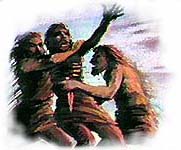
The implication for the Creation/Curse/Catastrophe model is clear. It postulates that the pre-Flood world was a time of exceptional Divine interventions upon the Earth. Even in post-Flood times, when God takes a strong hand to show His displeasure over sin, floods, earthquakes, volcanic eruptions, plagues, etc. are cited in Scripture. The fiery destruction of Sodom and Gomorrah, the ecological events of the Exodus, the turning back of the sundial and Joshua's long day are merely some examples of recorded post-Flood Divine actions.
It is also critical to notice that when God dealt with ancient Israel as a theocracy, He stressed that punishment on the Covenant people would be given with increasing intensity:
“But if you will not listen to me and carry out all these commands… I will punish you for your sins seven times over… ” (Leviticus 26:14, 18, 21, 24, 28 NIV).
The final result of this increasing intensity would be a land wasted "…so that your enemies who live there will be appalled" (Leviticus 26:32 NIV).
This increasing degree of punishment in order to bring them to repentance seems indicative of how the Lord has acted in history towards sin. The account of the pre-Flood world is brief in Scripture, but Divine activity appears to have been even more forceful in the pre-Flood world before God sanctioned human government to act on His behalf in dealing out punishments.
Strata from all geologic “Periods” have evidence of time indicators such as changing environments/ecosystems, footprints, nests, in situ growth, rain prints, trace fossils, fossil soils, etc. Young-Earth creationists often acknowledge—in varying degrees—such time indicators in the post-Flood world. The Creation/Curse/Catastrophe model allows ample reason to recognize them in the pre-Flood world as well.
Other Geologic Implications
The question of geologic succession and strata correlation becomes easier to understand when the Creation/Curse/Catastrophe model is applied. Not only is the Earth viewed as very biozoned at the time immediately after Creation, but the intensifying effects of the Curse over hundred of years of pre-Flood time provided ample reasons for systematic fossil and strata development. It is significant that evolutionary geologists recognize how geologic fossil succession closely resembles ecologic succession today:
At the present time, plant and animal succession occurs whenever newly vacated territory becomes available. Such opportunities arise after forest fires and the draining of swamps, and following the retreat of glaciers, and other similar natural events.
In the dim geologic past, however, no outside reservoir of life existed, and not all the space and energy resources could be utilized immediately because nothing had yet evolved to utilize them.
At one time, for example, the lands were barren of vegetation; many geologic ages ran their course before plants evolved that could live on dry land. The gradual and lengthy process whereby the energy sources of our planet were utilized successively by plants and animals is called geological succession. It differs in no fundamental way from the ecological succession that occurs today when a new environment appears, except that it requires much more time (Stokes, 1966, p. 370, emphasis mine).
The Creation/Curse/Catastrophe model removes the immense time assumptions and views fossil, geologic succession as evidence of sequential environmental/ecosystem changes since Creation. Many of these changes seemed to be related to the cursed, pre-Flood Earth. And, contrary to the evolutionary assumptions, life as readily available to move into adjacent disrupted ecosystems.

Even in evolutionary thinking, migration has long been credited for the sudden and enigmatic fossil appearance of the angiosperms in the “Cretaceous” (Stearn et al., 1979, p. 339).
Migration has also long been suggested as an explanation to the sudden appearance of the larger mammals in the strata directly above the last of the dinosaurs fossils (Le Conte, 1905, pp. 541-542). Only a few small mammals are known to have existed in the dinosaur ecosystems (interpreted as “Periods” according to ancient Earth geology). But this is exactly what the Creation/Curse/Catastrophe and other creation models would expect since the larger mammals and the large reptiles lived in two distinct ecosystems and were unable to exist together. After the demise of the dinosaurs in each area, the existing larger mammals from surrounding “Cenozoic” ecosystems could, and did, safely migrate into the vacated ecological niche left by the dinosaurs.
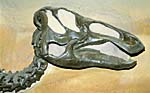
Furthermore, it is important to understand that the dinosaurs are believed to have existed in limited coastal environments/ecosystems around the world:
The duckbills [dinosaurs] appeared in the late Cretaceous… In whatever part of the globe they were, they lived on the coastal plains of one sea or another. (As did all the dinosaurs.) We don't know whether they, or any other dinosaurs, also lived in inland areas, because there are no geological formations that preserve inland habitats from the dinosaurs' time (Horner, 1990, p. 72, see also p. 196).
Here is the strongest of indications that the dinosaurs inhabited only a narrow ecological niche worldwide. And equally important is the faulty conclusion that "no geological formations… preserve inland habitats from the dinosaurs' time." This is made on the basis that geologic “Periods” are distinct in time. In the Creation/Curse/Catastrophe model, habitats other than coastal plain environments would also be forming geologic records simultaneously with the “Mesozoic” coastal plains. The evolutionist would miss their significance. These inland geological formations would be assumed by the evolutionist to be of another time.

For a better understanding of how dinosaurs may fit into a biblical Judeo-Christian worldview, see ChristianAnswers.Net's graphically-rich The Great Dinosaur Mystery Online Web site.

The dramatic change to angiosperm vegetation in the dinosaur environment (from “Triassic and Jurassic” to “Cretaceous”) may have greatly contributed to the doom of the famous reptiles while at the same time preparing the way for the migration of larger mammals (and man) into those areas. The diet of almost all of the dinosaurs is not thought to have included angiosperms (Stokes, 1966, p. 263).
The significance of this change in food supply in the “Cretaceous” becomes more evident when factoring out immense ages and having ecosystems change in the much shorter time-span in the turbulent, pre-Flood world. The Creation/Curse/Catastrophe model's interpretation of the fossil record indicates that many types of dinosaurs may have become extinct even before the commencement of the Genesis Flood Event due to a change in the food supply.
Correlation by Fossils
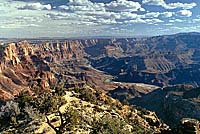
Most areas on the Earth have only certain geologic “Periods” represented. The total geologic record is pieced together in an evolutionary scheme from around the world using the known principles of superpositional stratigraphy, biostratigraphy, and radiometric dates. Years ago, Henbest (1952, p. 305) summarized the situation:
To reconstruct the history of epochs and periods requires the assembling of records from every known province of the world and connecting them in the proper time sequence. This process not only calls into play every known device of age determination and correlation and cross-checks, but involves the handling of enormous quantities of complicated data whose quality runs the entire gamut of conjecture, speculation, and well-reasoned induction.
Traditional Flood geology has tended to reject the idea of correlation by fossils. Conversely, conventional, evolutionary geology thrives on it. The Creation/Curse/Catastrophe model proposes there is a “seed” of truth buried deep within the conventional thinking. But the plant that grows out of it looks neither like the conventional model nor the traditional Flood model. The evolutionary-ancient Earth theory allows too much time. The Flood model by placing most of the fossiliferous strata into the one-year Genesis Flood Event does not allow enough time.
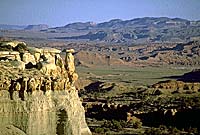
Evolutionary geologists today acknowledge that more and more catastrophic happenings have been recorded in the strata. Nevertheless, their demand of an ancient age for the Earth continues unabated (Ager, 1981; Huggett, 1989; Donovan, 1989; Berggren and Van Couvering, 1984; Harris, 1990). The conventional solution is to account for most of geologic time in the “nothingness” of bedding planes and erosion surfaces.
Conversely, the traditional Flood model has difficulty pinpointing the Flood's stratigraphic location. Some of this is due to the recognition that strata “time indicators” are difficult to fit into a one-year catastrophic Deluge. Also creationist geologist Snelling (1995, p. 162) graphically pointed out his belief that creationists have not adequately explained the reason for the general, orderly succession of fossils.
Homotaxis and Synchronism
None other than the “bulldog” of Darwin, Thomas Henry Huxley, an early champion of the theory of Evolution, raised the fur on every respectable geologist when he questioned how correlation by fossils was being handled. As related by Woodford (1963, p. 75):
The presence of successive and dissimilar fossil faunas in the stratified rocks of northwestern Europe was demonstrated by William Smith and his contemporaries as early as 1815. Some forty-five years later, Darwin convinced the scientific community that evolution of stratigraphically lower faunas into higher ones is more probable than alternating creations and extinctions.
Soon after the “Origin of Species” appeared, however, Thomas Henry Huxley (1862, 1870) challenged the assumptions, already well established in his time, that two widely separated sedimentary rock masses containing closely similar faunas or floras must have been deposited at the same time. He asked for a sharp distinction between homotaxis (identical or similar succession of faunas or floras) and the kind of correlation that implies synchronism (identical age for each correlated faunal or floral pair). Huxley (1862, p. xlvi) asserted that ‘a Devonian fauna and flora in the British Islands may have been contemporaneous with Silurian life in North America, and with a Carboniferous fauna and flora in Africa.’
This shocked the evolutionary world coming from the mouth of Huxley and is still considered the height of geologic heresy over 130 years later. Huxley's geologic “heresy” had hit too close to home. The reader is encouraged to read what Huxley (1898, pp. 272-304, 340-388) said in addresses before the august bodies of the Geological Society (1862) and the Meeting of the British Association for the Advancement of Science (1870).
This danger of confusing homotaxis and synchronism (Huxley's terms) is at the root of the correlation problem. Creationists need to keep their eyes open to a potential vast pre-Flood application, as well as post-Flood events.
Geologic literature is full of concern regarding the effect of migration on correlation. True, this concern is often dismissed by evolutionists because of the old-Earth belief. It is assumed that millions of years are available for flora and fauna to become widespread within each envisioned “Period,” thus largely negating migration correlation concerns. Allan, for example, rejected Huxley's “bomb-shell” because "…geological chronology [has shown] the rate of dispersal of marine organisms may safely be neglected…,"(1948, p. 2).
Nevertheless, Allan acknowledged the “fundamental assumption” of “geological contemporaneity is the same as chronological synchrony… is current today, it is still a 'constant source of gratuitous speculations, and it is still logically unsound” (1948, p. 2). Allan saw the need for paleoecological studies in geology. Paleoecologic studies have indeed become standard in geologic research since then.
The traditional Price Flood model overlooks the importance of paleoecological and geological changes over time or of migration because of its focus on the one-year Deluge. The Creation/Curse/Catastrophe model uses ecological changes and migration as positive factors in evaluating both pre-Flood and post-Flood times. It is through such studies that stratigraphic boundaries for the Genesis Flood Event can eventually be better determined for each region on the Earth.
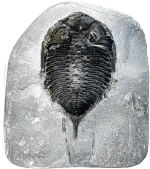
Microevolutionary changes (those limited changes which occur within the created Genesis “kinds”) are often the basis for strata correlation. In the Creation/Curse/Catastrophe model the geologic activities of particularly the pre-Flood times (and to a lesser degree, the post-Flood times) allow opportunity for development of local stratigraphic sequences as “kinds” reproduce new varieties, die out, migrate, and ecosystems change. Floras and faunas within their respective ecosystems would be expected to diversify. Later they could migrate to surrounding ecosystems when the food web expanded and could now support them.
Furthermore, since ecological succession follows certain set patterns, we would expect worldwide similar patterns being detected. Ecological succession in each locality allowed the evolutionist's rationale for fossil correlation over great distances.
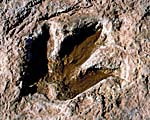
Tracks and Nests
Various strata worldwide clearly show evidences of time passing. For example, it is now known that strata from the dinosaur ecosystem (“Mesozoic”) are replete with billions upon billions of dinosaur footprints found in distinct paleoenvironments, in multiple track layers on top of each other in many areas of the world (Lockley, 1991, p. 125). Layers of tracks may extend over thousands of square miles, yet follow definite paths around paleo-lakes or epeiric seashore environments (Lockley, 1991, pp. 83-138).
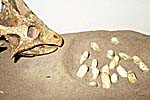
Dinosaur nests are also increasingly found. Ingenious explanations not withstanding, a satisfactory answer has not been found in traditional Price Flood geology on how such multiple layers of tracks and nests could have been preserved during the Genesis Flood Event or post-Flood events. Flood geologists have attempted to place such time indicators in the Genesis Flood Event (at all stages, you name it!) or in the post-Flood world (CRSQ, 1996, pages 231-239; See also the special issue of Creation Ex Nihilo Technical Journal, volume 10 [Part 1], 1996).
The Creation/Curse/Catastrophe model would place the North American “Mesozoic” strata with its dinosaur fossils, tracks, nests, etc. as pre-Flood.
It is rightfully noted that a “mighty erosive event” has left the strata containing the dinosaur nests and remains as only “erosional remnants” (Oard, 1996, p. 238). The Creation/Curse/Catastrophe model would interpret the large, regional erosion as the continental evidence of the Genesis Flood Event. (Deposition is probably off the continent.) When dinosaur tracks and nests are seen as preserved from pre-Flood events, the whole question is more simply understood. The overall nature of the tracks and nests display a time element fundamentally foreign to the one-year Flood event.
Furthermore, placing vast amounts of strata with dinosaur tracks, nests, etc. as post-Flood creates unrealistic geological implications for a world in which the Curse is specifically said by the Scriptures as lessened.
The Genesis Flood Event and Stratigraphy
At Adam's creation we should also expect to find strata present that had been formed during Creation Week. It should never be overlooked that much happened geologically during Creation Week before Adam's creation. Such Creation Week created strata later provided raw material for geologic events associated with the Curse on the Earth. Although the Flood violently affected the land, the Creation/Curse/Catastrophe model predicts that much pre-Flood strata survived the Genesis Flood Event.
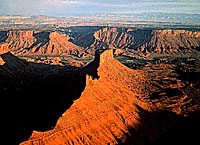
We should expect the Genesis Flood Event to record, as a minimum, great erosion (and probably often offshore deposition) brought about by 40 days and nights of rain that created huge runoffs on the land areas. In contrast to the rapid water rising at the beginning of the Flood, Scripture noted how gradually the Floodwaters recessed.
Other Genesis Flood Event geologic evidences would include volcanic activity, additional plate movements (the Creation/Curse/Catastrophe model assumes periodic rapid plate movement at various times throughout the pre-Flood world as well as the Genesis Flood Event itself), etc. Forty days and nights of rain may have doomed most humans and land creatures to death by drowning and decay in the Floodwaters without continental burial, and hence the apparent lack of Flood-related fossils.
Research will have to show how widespread the “Eden” ecosystem (“Cenozoic”) had become by the Genesis Flood Event. Was it already worldwide? The Cenozoic landscape is now nearly universal on the Earth with small exceptions.

Remnants of “earlier” ecosystems (i.e., Paleozoic and Mesozoic) still exist on the Earth today. The most recent finding of such a remnant is the Wollemi pine—previously thought by scientists to be extinct for 150 million years—in an isolated 1.2 acre grove in a rain forest preserve 125 miles from Sydney (Anderson, 1994, p. 5). Here is a tiny “Mesozoic” plant ecosystem (it has been labeled the “Jurassic Bark”) in modern-day Australia. It appears to have re-established itself in a limited way after the Flood.
Much of the world at the time shortly after man's creation appears to have been something other than “Cenozoic” (mammals/ angiosperms) since large areas of the world have “Paleozoic” or “Mesozoic” strata directly on top of basement Precambrian. It is hoped that further research will refine this Creation/Curse/Catastrophe model and in the process supply young-Earth creationists with a better interpretation of the world's geologic record.
Acknowledgments
The author wishes to thank many reviewers, both anonymous and known, for their helpful suggestions. And I would like to express my special gratitude for the encouragement from the late Dr. John Klotz, one of the original ten founding members of CRS, who read an earlier version of this paper in 1996 and for his friendship during my studies at Concordia Seminary in St. Louis in the early '90s. I wish to point out that Erich von Fange (1990, 1994) has written some excellent general books on the effects of the Curse. Special thanks as well to Marji, my wife, for her immense patience over the years, her welcome encouragement, her listening ear, and her coining the name for the Creation/Curse/Catastrophe model. And, thanks to Him who, in His own time and in His own way, provided a “window of opportunity” for the author to write and publish on a subject of interest since high school days. "Praise the LORD… He has caused His wonders to be remembered… He remembers His covenant forever" (Psalm 111:1, 4-5 NIV).
References
CRSQ—Creation Research Society Quarterly
-
D.V. Ager, The Nature of the Stratigraphical Record, Second edition (New York: John Wiley and Sons, 1981).
-
Robin Sutcliffe Allan, “Geological Correlation and paleoecology,” Bulletin of the Geological Society of America 59 (1948), pp. 1-10.
-
Ian Anderson, 1994, "Pine 'Dinosaur' Lurks in Gorge," New Scientist 144 (1957/1958):5.
-
Steven, A. Austin and Kurt P. Wise, "Preflood/flood Boundary: as defined in Grand Canyon and east Mojave." In Robert E. Walsh (editor), Proceedings of the Third International Conference on Creationism (Pittsburgh: Creation Science Fellowship, 1994), pp. 37-47.
-
W. A. Berggren and J. A. Van Couvering, Catastrophes and Earth History (Princeton: Princeton University Press, 1984).
-
"Speaking to the Earth: an interview with Steven Austin and Kurt Wise," vol. 33, no. 5 (Bible-Science News, 1995), pp. 17-21.
-
Harold W. Clark, Fossils, Flood, and Fire (Escondido, CA: Outdoor Pictures, 1968).
-
“Dinosaur letter exchange,” Creation Research Society Quarterly 32 (1996), pp. 231-239.
-
S.K. Donovan, editor. Mass Extinctions: Processes and Evidence (New York: Columbia University Press, 1989).
-
Carl O. Dunbar, Historical Geology (New York: John Wiley and Sons, Inc., 1960).
-
Eusebius, The ecclesiastical history. With an English translation by Kirsopp Lake, Volume I (London: William Heinemann Ltd., Harvard University Press, Cambridge, 1926).
-
Charles Coulston Gillispie, Genesis and Geology (Cambridge: Harvard University Press, 1951).
-
S.L. Harris, Agents of Chaos (Missoula, Montana: Mountain Press Publishing Co., 1990).
-
Lloyd G. Henbest, "Significance of Evolutionary Explosions for Diastrophic Division of Earth History—Introduction to the Symposium," Journal of Paleontology 26(3) (1952), pp. 299-318.
-
John R. Horner and James Gorman, Digging Dinosaurs (New York: Perennial Library, Harper and Row, 1990).
-
Richard Huggett, Cataclysms and Earth History: The Development of Diluvialism (Oxfore: Clarendon Press, 1989).
-
Thomas H. Huxley, Discourses: Biological and Geological Essays (New York: D. Appleton and Company, 1898).
-
John W. Klotz, Genes, Genesis, and Evolution (St. Louis: Concordia Publishing House, 1955, 1970).
_____Studies in Creation (St. Louis: Concordia Publishing House, 1985).
-
Joseph Le Conte, Elements of Geology (New York: D. Appleton and Company, 1905).
-
Martin Lockley, Tracking Dinosaurs: A New Look at an Ancient World (Cambridge: Cambridge University Press, 1991).
-
Josh McDowell and Don Stewart, Answers to Tough Questions (Nashville: Thomas Nelson Publishers, 1993).
-
Henry M. Morris, Scientific Creationism, Public School Edition (San Diego: Creation-Life Publishers, 1974).
-
John D. Morris, The Young Earth (Colorado Springs: Master Books, 1994).
-
Ronald L. Numbers, The Creationists (New York: Alfred A. Knopf, 1992).
-
Michael J. Oard, "Polar Dinosaurs: Response to Garner, Robinson, Garton, and Tyler," (Letters to the Editor), Creation Research Society Quarterly 32 (1996), pp. 237-239.
-
M. Parfit, “The Floods That Carved the West,” Smithsonian 26(1) (1995), pp. 48-58.
-
George McCready Price, Evolutionary Geology and the New Catastrophism (Mountain View, CA: Pacific Press Publishing Association, 1926).
-
Alfred M. Rehwinkel, The Flood in the Light of the Bible, Geology, and Archaeology (Saint Louis, MO: Concordia Publishing House, 1951).
-
ndrew A. Snelling (reviewed by), Studies in Flood Geology by John Woodmorappe, Creation Ex Nihilo Technical Journal, 9(2) (1995), pp. 161-163.
-
Colin W. Stearn and Robert L. Carroll and Thomas H. Clark, Geological Evolution of North America, Third Edition (New York/Chichester/Brisbane/Toronto/Singapore: John Wiley and Sons, 1979).
-
William Lee Stokes, Essentials of Earth History, Second Edition (Englewood Cliffs, NJ: Prentice-Hall, Inc., 1966).
-
Erich A. von Fange, Genesis and the Dinosaur (Syracuse, Indiana: Living Word Services, 1990).
_____Noah to Abram: The Turbulent Years (Syracuse, Indiana: Living Word Services, 1994).
-
Tasman Walker, “A Biblical Geologic Model,” in Robert E. Walsh (editor), Proceedings of the Third International Conference on Creationism (Pittsburgh: Creation Science Fellowship, 1994), pp. 581-592.
-
David C. Watts, “Fossils and the Fall,” Biblical Creation 7(18) (1984), pp. 20-21.
-
John C. Whitcomb and Henry M. Morris, The Genesis Flood (Philadelphia: The Presbyterian and Reformed Publishing Company, 1961).
-
Robert S. White and Colin J. Humphreys, “Famines and Cataclysmic Volcanism,” Geology Today (Sept.-Oct. 1994), pp. 181-185.
-
Kurt P. Wise, "Were There Really No Seasons?: Tree Rings and Climate," Creation Ex Nihilo Technical Journal, 6(2) (1992), pp. 168-172.
-
A.O. Woodford, “Correlation by Fossils,” in Claude C. Albritton, Jr. (editor), The Fabric of Geology (Stanford, California: Freeman, Cooper and Co., 1963).
