Krogman, The Croc
A New Species of Primeval Man?
No, just one of my graduate school professors!
Upon entering college, and later Dental School at the University of Pennsylvania, I faced a constant barrage of evolutionary philosophy. Raised in a Christian home and taught the Bible from a very early age, I had no reason to doubt the Biblical record of beginnings. Yet the overwhelming scientific evidence for Evolution seemed almost unassailable to me.
This resulted in a compartmentalization of ideas and concepts in my mind. One part of me wanted to hold on to the faith I had been taught. Another readily grasped the “scientific” explanations of origins. I was not happy with the turmoil it produced in me. Many times I really doubted my faith.
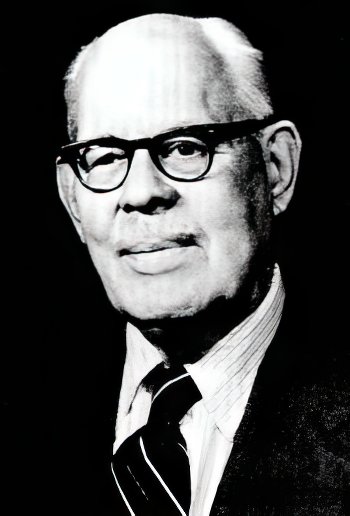
That all began to change one day in a graduate class at Penn. About 140 students were studying the “Evolutionary Development of Human Dentition” taught by Wilton M. Krogman, Ph.D., Professor of Physical Anthropology. A large man with a massive jaw, he lectured on, among other things, the teeth of crocodiles. As students often do, we nicknamed him “Krogman the croc.”
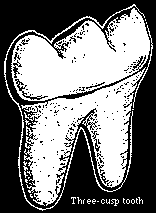
One afternoon, the subject of his lecture was the development of the four-cusp tooth from the three-cusp tooth. He was trying to show us how the more “primitive” three-cusp tooth with those three cusps in a line (a dog molar) changed into a four-cusp tooth with the four cusps in a square, each cusp at a corner. The four-cusp tooth, he said, could be found mostly in primates like monkeys, apes, and chimps.
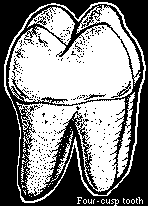
I found this a fascinating idea and wanted more information. Raising my hand, I asked what I thought was a reasonable question. I said, “Dr. Krogman, you have shown us examples of the three-cusp tooth and examples of the four-cusp tooth. Would you please explain which of those three cusps, the forward, middle or rear moved out of line and which way did it move, toward the cheek or toward the tongue? Also, where did the fourth cusp arise, on the cheek side or on the tongue side, and please give some examples of this occurrence?”
I asked this question honestly, as an interested student. It was a sincere effort to obtain more information. I had no doubt Dr. Krogman would supply an adequate explanation.
His reaction, however, astounded me. He suddenly became red in the face, slammed his notes shut and stalked out of the room! At the time I did not realize that I had asked the most difficult question possible, challenging the standard Darwinian theory of evolution. My question, in essence, asked, “where are the transitional forms?”
Over the years I have continued to ask that same question, in various ways. I have yet to receive a definitive answer. Since that day, I have also learned that Charles Darwin himself anticipated the question. In the first edition of his book, The Origin of Species (Everyman's Library Edition, London: J.M. Dent and Sons, 1967), he stated that the most serious objection to his argument was the absence of transitional forms, that is, the missing links (pp. 292-93). But, he explained, they were not really missing; they had simply not yet been discovered.
One might excuse Darwin for that, but in the 135 or so years since, not one missing link has been found. In addition, more “missing links” (gaps in the fossil record), are known today than Darwin ever anticipated. Paleontologists have almost given up hope of finding those elusive transitional forms. Consequently, the theory of evolution is undergoing serious modifications to account for their absence.
Today the fossil record is vastly richer than that which Darwin had before him. Yet, without true transitional forms, scholars like Eldridge and Gould have needed to propose explanations such as “punctuated equilibrium” and “saltations.” This, they suggest, accounts for the absence of a clearly defined progression in the development of plants and animals.
Dr. Krogman had no answer to my question. Neither did Darwin, himself; nor has anyone else. The facts are clear. There is simply not enough hard evolutionary evidence for anyone to sink their teeth into!
Dr. Robbins, DDS, retired from private practice in New Jersey, was previously on the faculties of Georgetown University School of Dentistry, Temple University Dental School and University of Pennsylvania School of Dental Medicine.
Author: Austin Robbins for Associates for Biblical Research
More information
- Who’s who and what’s what in the world of “missing” links?
- The Origin Of Mankind, Paul S. Taylor
- Is there fossil evidence of “missing links” between humans and apes? Did ancient humans live millions of years ago? Answer
- The Origin of Humans, Questions and Answers
- Do cavemen fit with the Bible?
Copyright © 1995, Associates for Biblical Research, All Rights Reserved—except as noted on attached “Usage and Copyright” page that grants ChristianAnswers.Net users generous rights for putting this page to work in their homes, personal witnessing, churches and schools.